








MoneyTime review UK: financial literacy for kids
MoneyTime: an online money skills course for children and teens
Can MoneyTime help children learn real-life money skills? Teaching children about money isn’t always straightforward, which is why we tried MoneyTime, an online financial literacy course for children and teens. We’ve now been using it for several months as part of our home education, covering everything from earning and saving to budgeting, tax and investing.
💚 Gifted review: MoneyTime gifted me access so I could take a proper look and share my honest thoughts. This review is independent and unpaid, and all opinions are my own. I only feature resources on The Home Ed Daily that I genuinely believe are relevant and useful to home educating families. If you buy through my link, I’ll receive a small commission at no extra cost to you. Thank you 💚
Using this exclusive link gives readers who sign up to an annual plan a very generous 25% off
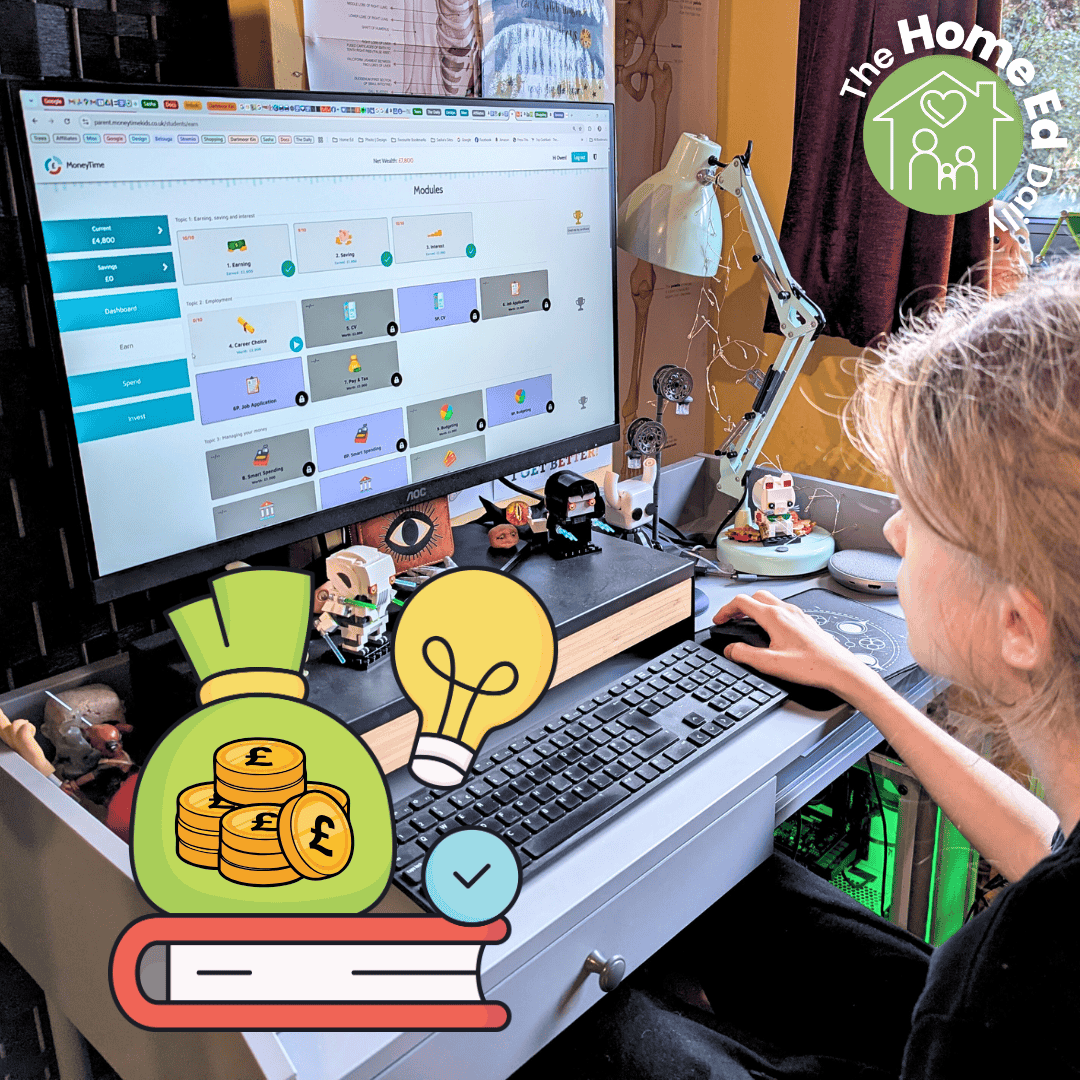
We’ve been using MoneyTime, an online programme that teaches financial literacy through interactive lessons and game style decision making. Children earn virtual money, choose how to save or spend it, and see the results straight away, without any real world risk. That learning by doing approach really works. I don’t say this often, but MoneyTime genuinely impressed me.
Why I think it works for home educating families
Money is one of those life skills we assume children will somehow pick up along the way. Many of us didn’t. I certainly didn’t. Using this programme made me notice gaps in my own understanding and that really brought home how important this learning is. MoneyTime makes money make sense (try saying that quickly!). Not in an abstract way, and not through dry worksheets, but through choices and consequences. Children earn. They save. They spend. They make mistakes. And they clearly see why those choices matter. It’s designed for ages 10 to 14, but as always with home education, age is flexible. I’d suggest it from around 10 up to 16, and older teens would benefit too. I learnt a few things myself along the way.
It fits beautifully into home ed as part of maths, PSHE, or life skills. It’s self paced, easy to navigate, and it naturally sparks conversations about money habits, work, and goals. It isn’t a replacement for real life experience like pocket money, jobs, or budgeting at home, but it’s an excellent complement. A safe space to experiment, get things wrong, and learn without real money on the line.
 Practical details
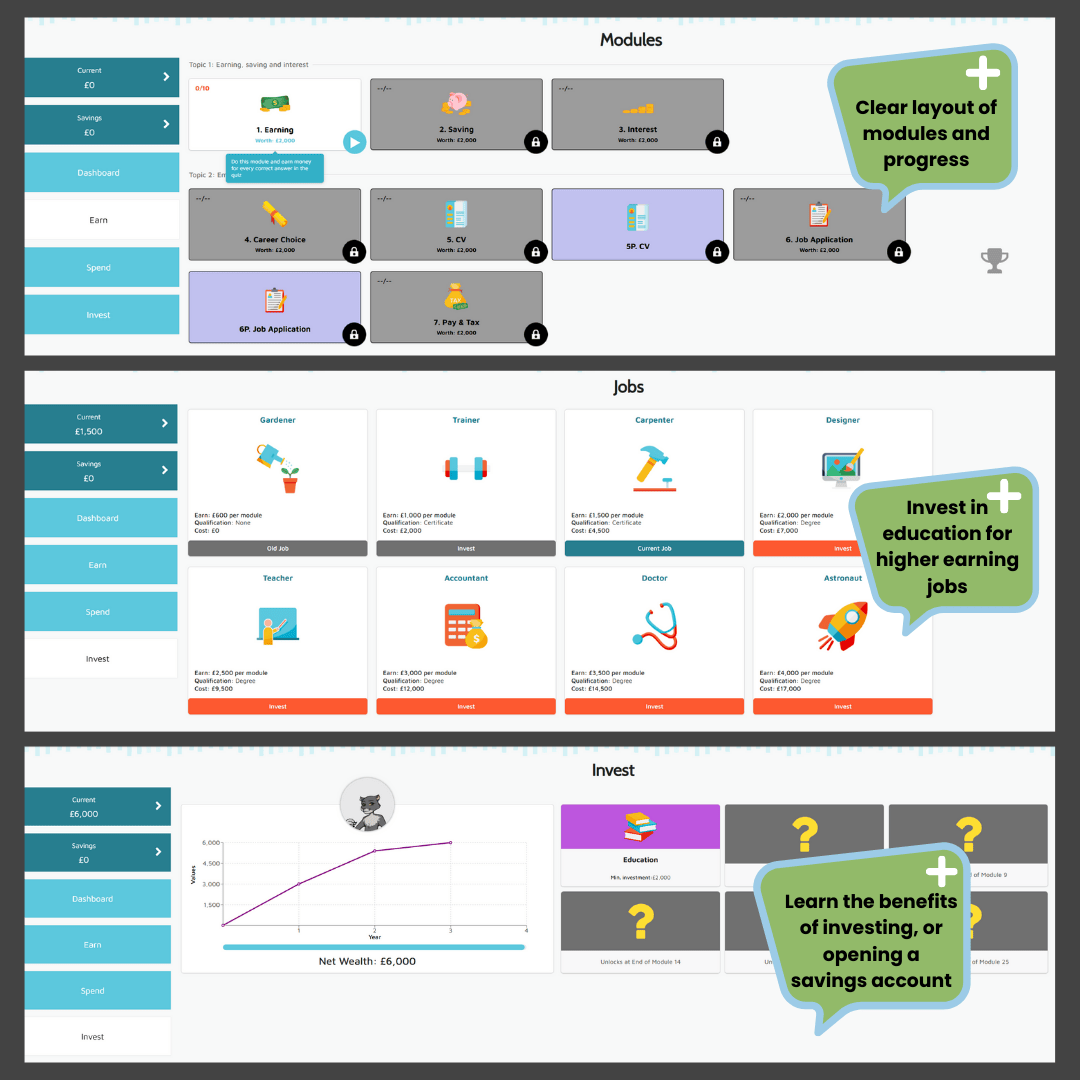
- 30 self directed lessons across 8 financial topics: Saving, budgeting, investing, borrowing, insurance, entrepreneurship, property, employment.
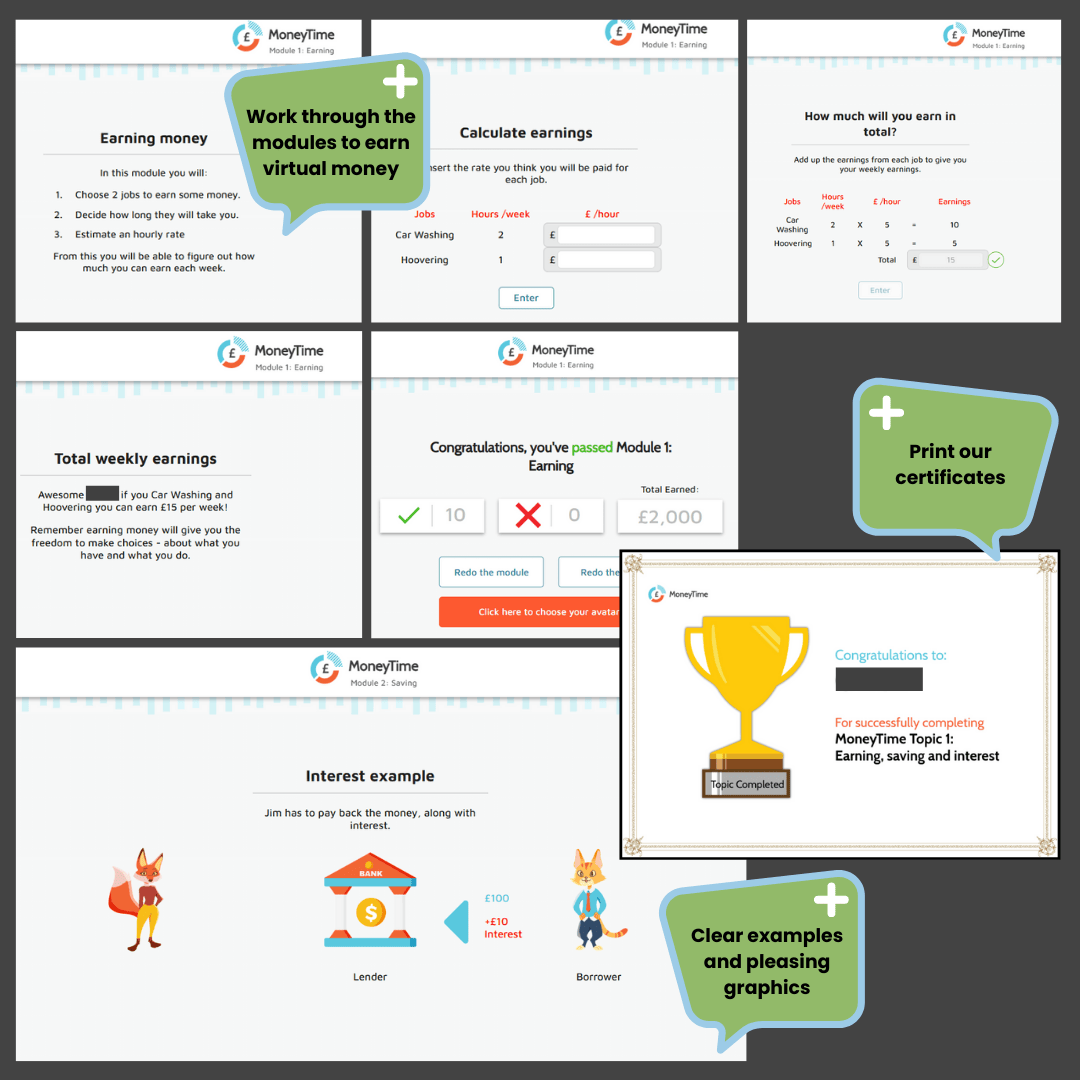
- Game style decision making: Children earn “virtual money” by completing each lesson and then answering quiz questions. They can then choose to spend; on their avatar, upgrade their job, invest, save, or donate.
- Parent/child modules: There are optional modules that can be done together, such as creating a budget, writing CVs, or interviewing an adult about real expenses.
- Short time commitment: The site claims each lesson should take around 20 minutes, we certainly found it quick and simple to use.
- Automatic quizzes & progress reports: Quizzes are auto marked and you can see how your child is doing (which helps you know where to support).
- Parent login: You can view your child’s progress and module results in the parent dashboard. You can only be logged in to MoneyTime as either the child or the parent - not both, so some logging in and out of accounts is required.
- Certificates: When a module is done, your child can request an emailed certificate showing their completed topics.
-
Teaches money by doing
The ‘game’ aspect means children aren’t just reading theory, they make choices and see outcomes. That experiential side helps embed the learning. -
Self-paced & low prep
For many home ed parents, this is gold: you don’t have to be a financial expert or plan lessons. The child can largely use the program themselves, and you step in when they want to discuss or extend a topic. -
Choice of involvement
Because there are parent/child modules, you can choose how much you engage. If your child is confident, you might just let them be. If they ask for help, the modules give structure for deeper conversation. -
Relevant & modern
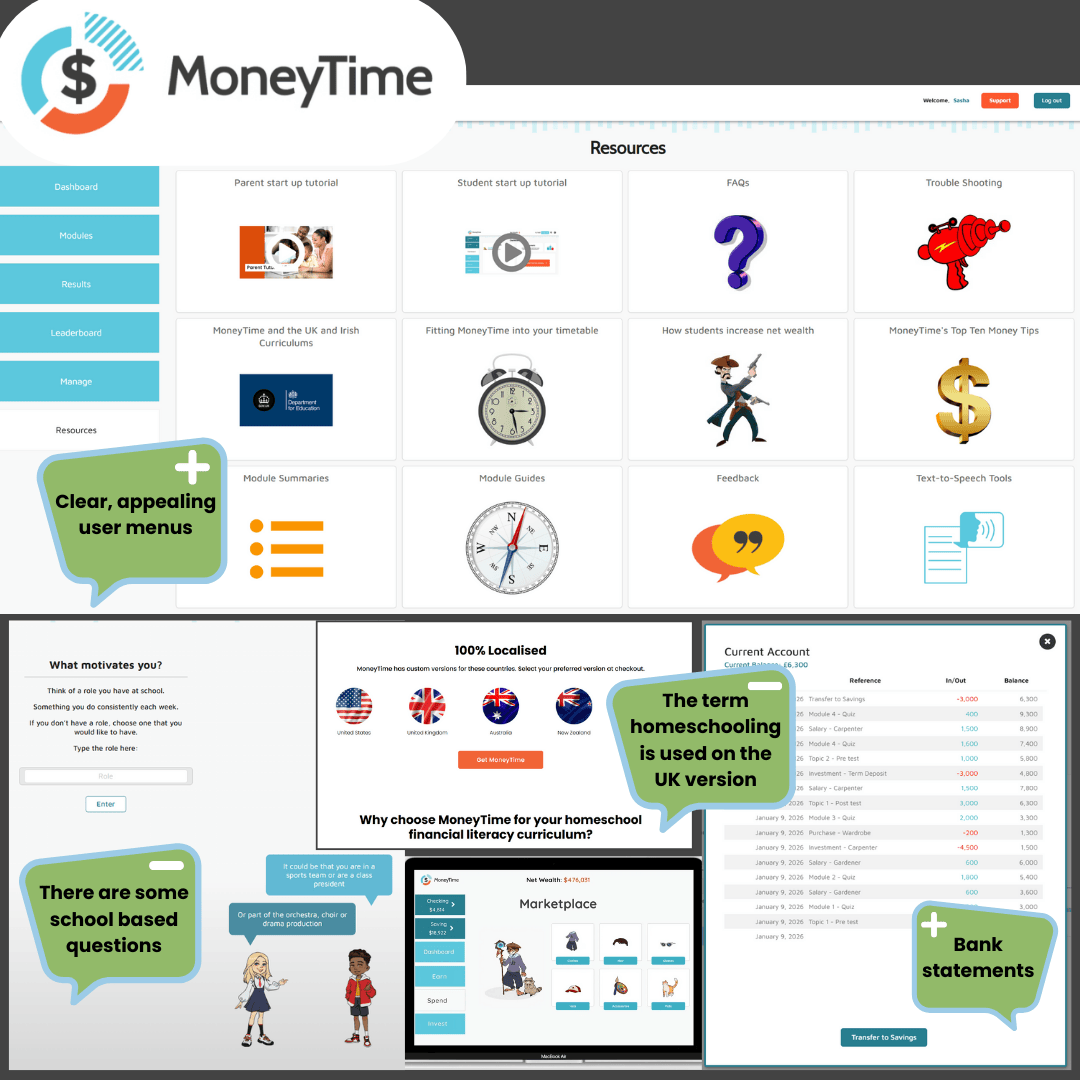
The localisation means references to savings, investing, and property are less US-centric in the UK version. It tries to keep terminology and scenarios practical. -
Good breadth of topics
It doesn’t just stop at “earn / spend / save.” You get into more advanced ideas: small business, property, insurance, borrowing. That gives room for learners to stretch. - Ages: I’d say ideal for roughly 10 to 16, though home ed adaptable for older or younger.
- Cost: A monthly subscription is £9.95. Saving 25% on each additional child (£7.45 per month each). No minimum contract. Cancel anytime using the customer portal. A one year license is £49. You save 25% on each additional child (so £36.75 each). No recurring billing. 60 day money back guarantee.
- Using our link will give you a generous 25% off that annual plan price, so £36.75, with any additional children £27.56 each.
On a personal note
The only criticisms I have are small, and common with resources aimed at a broad audience. Firstly, I do wish products aimed at the UK market would use the term home education rather than homeschooling. Language matters, and home education is the term most families here identify with and prefer. Secondly, some of the module questions are worded as though the user is in school. This did perplex my son, as he wasn’t always sure how to answer from a home ed perspective. It would be lovely to see terminology and examples that better reflect the experiences of those learning outside school. That said, these are minor gripes and very easy to work around. Nothing is ever perfectly tailored to home education, and they certainly don’t detract from the quality of the programme itself.
Overall, MoneyTime is excellent, and it’s filling a knowledge gap I hadn’t even realised was there.
My 14 year old son didn’t just tolerate it. He genuinely enjoyed it. He found it quick and easy to use, and wants to continue, which is praise indeed from him. That alone is worth paying attention to. In just a few modules, he learnt about earning, how banks work, simple and compound interest, different types of accounts, and how savings grow over time using an interest calculator. It even prompted him to ask for jobs so he could earn money himself. It also led to some conversations that made me realise how little in depth learning around money we’d done before.
There was nothing like this around when I was his age. No safe place to experiment with money. No chance to understand interest or long term impact without real consequences. MoneyTime offers exactly that. It helped him see earning and saving in action, and understand how it all fits together. That feels like a life skill worth investing time in.
If you have a child around secondary age and you want them to step into adulthood with confidence rather than confusion around money, this is one of the best tools I’ve seen. I don’t often say we’ll be continuing with a resource long term, but this is one we are genuinely sticking with.
Extension ideas to try:
Everyday earning and spending
Paid household jobs
- Move beyond “helping out” and introduce paid tasks.
- Set clear jobs with agreed pay. For example, £5 for cleaning the car, £1 for sorting recycling, £3 for a room tidy.
- Link this directly to what they see in MoneyTime about earning and effort.
Pocket money with purpose
- Instead of open ended pocket money, split it into two jars or accounts. Spend. Save.
- Let them decide the percentages. You could add 'interest' to the 'save' jar. Review it monthly together.
Saving and planning
Savings goal challenge
- Choose something realistic they want. A game, trip, or contribution to something bigger.
- Work out how long it will take to save. Track progress visually.
- Link this back to interest and compound growth in MoneyTime.
Delayed spending experiment
- When they want something, agree to wait 48 hours or a week.
- After the wait, revisit the decision.
- Talk about impulse, regret, and value.
Understanding work and income
Mini self-employment
- Encourage a small money making project.
- Dog walking, gardening, art commissions, baking, reselling old items.
- Help them track costs, time, and profit.
Invoice practice
- If they do paid work, show them how to write a simple invoice or record their income.
- This links directly to MoneyTime ideas around work, tax, and budgeting.
Spending and reflection
End of month money chat
- Once a month, sit down and talk about money choices.
- What went well. What they would change next month.
- Keep it calm and judgement free.
Real consequences, small scale
- If they run out of spending money, let that stand.
- Offer support and reflection, not rescue.
- This is often where the deepest learning happens.
Linking it back to MoneyTime
- After a MoneyTime module, ask one simple question:
- “How does this show up in real life?”
- Then choose one small action that week to match the learning.
MoneyTime review update August 2026:
Several months on, O is still using MoneyTime and we’re still genuinely impressed with it. The short, self-paced lessons are easy to fit around everything else, and the mix of earning, saving, budgeting and spending continues to spark useful conversations at home. It has held his interest far better than a dry financial literacy workbook ever would, and he is steadily building a much clearer understanding of how money works in real life. One of those rare resources that has stuck!