

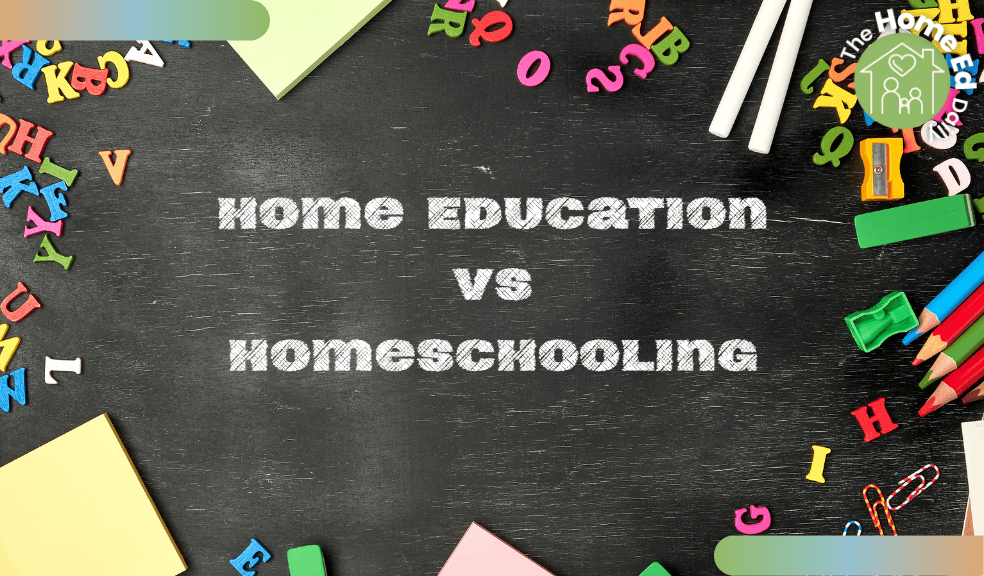
Home education vs homeschooling: why the words matter in the UK
In the UK, many families prefer the term home education rather than homeschooling. The difference may sound small, but the words we use shape how learning outside school is understood by parents, professionals, the media, and the public.
If you educate your child outside school, the words you use matter more than people might think. To some, home education and homeschooling sound like the same thing. They are often used interchangeably online, and many people would not pause to think there is any difference. But for lots of UK families, the distinction matters. The term we choose shapes how people understand what we do. It affects how friends and family see us, how journalists write about us, how local authorities respond to us, and how home-educating parents see themselves too.
That is why many of us prefer the term home education.
Why many UK families say home education
In the UK, home education is the term most families use when they have chosen to take full responsibility for their child’s education outside the school system. It reflects both the legal reality and the lived reality.
Parents or carers are not simply supervising school work at home. They are taking responsibility for a child’s education in a much broader sense. That might include structured lessons, but it might also include conversations, projects, outings, reading together, hobbies, life skills, real-world experiences, and learning that grows naturally from a child’s interests.
Home education describes that much better than homeschooling does.
Why homeschooling can feel like the wrong fit
For many UK families, the word homeschooling feels too narrow. It often brings to mind a picture of school recreated at home. A child at the kitchen table. Timetables. Workbooks. Online lessons. A parent standing in as teacher. That may suit some families, and there is nothing wrong with that approach if it works for them. But it is only one version of learning outside school.
For many of us, home education looks very different. It might mean visiting a museum on a quiet weekday. Listening to a child talk for an hour about Roman roads or marine biology. Baking and using it to explore ratios and measurement. Learning through play, discussion, documentaries, art, nature, community, travel, games, books, and daily life. It is often more flexible, more individual, and more responsive than school can be.
School at home is not the same as education at home.
A UK difference that often gets missed
Part of the confusion comes from the fact that homeschooling is much more common in the United States. Online, especially on large platforms, US language tends to dominate. Search results, news articles, social media posts, and video content often default to homeschooling, because that is the term most widely recognised worldwide.
In the UK, though, the picture is different. Some local authorities and services use homeschooling in a different way, sometimes referring to children who are still on a school roll but are being educated at home temporarily through arrangements linked to school, illness, exclusion, or alternative provision. That is not the same as elective home education.
So while the terms may blur online, they do not always mean the same thing in practice.
Language shapes perception
This is why terminology matters. Words shape how people see us. They influence public understanding, media coverage, and sometimes policy too. When we say home education, we are describing our reality more accurately. We are also gently pushing back against assumptions that what we do is just school moved into the home. That matters when speaking to local authorities, journalists, MPs, extended family, or anyone else trying to understand our choices.
Many home educating parents get used to correcting misunderstandings. We explain that our children are not necessarily following school hours, school terms, or school methods. We explain that learning can happen in ways that do not look much like school at all.
Using the right language helps with that. It gives people a clearer starting point.
It also shapes how parents see themselves
This part matters too. Language is not only about how others view us. It also affects how parents understand their own role. If you keep hearing homeschooling, it is easy to slip into thinking you should be recreating school. You may start worrying that your days do not look formal enough, structured enough, or teacher-led enough.
Home education opens that up. It reminds us that education is bigger than school. It helps shift the mindset from delivering lessons to supporting learning. That can be a powerful change, especially for families in the early days who are still unpicking years of school-based expectations.
The words we use do not just describe what we are doing. They shape how we think about it.
Why this matters in the media
Media language matters as well. When the word homeschooling appears in headlines, it is often linked to stories that feel sensational, simplistic, or negative. It can conjure up an image that does not reflect the rich variety of real home ed families in the UK. By contrast, home education tends to sit more comfortably in thoughtful discussion about autonomy, personalised learning, family life, and educational choice.
That does not mean every use of homeschooling is wrong or harmful. Sometimes it is simply the term a writer, editor, or member of the public is most familiar with. But where we have the choice, using home education helps tell a more accurate story.
A quick note on SEO and why you may still see both terms
There is one practical complication. Sometimes UK writers and websites still need to use the word homeschooling in article titles, headings, or search terms because more people type it into Google. That does not mean it is the preferred term. It often just reflects the way search engines and online platforms lean towards US language.
So if you sometimes see both terms used on UK websites, that is often why. It is not always about preference. Sometimes it is simply about helping the right families find the article in the first place.
A small distinction that makes a real difference
Choosing home education over homeschooling may seem like a tiny thing, but it carries weight. It helps describe our families more accurately. It challenges lazy assumptions. It makes space for the breadth and freedom of learning outside school. And it reminds both others and ourselves that education does not have to look like school to be real, rich, and meaningful.
Words matter. And for many of us in the UK, home education is the term that fits.