




15 easy French activities for children at home
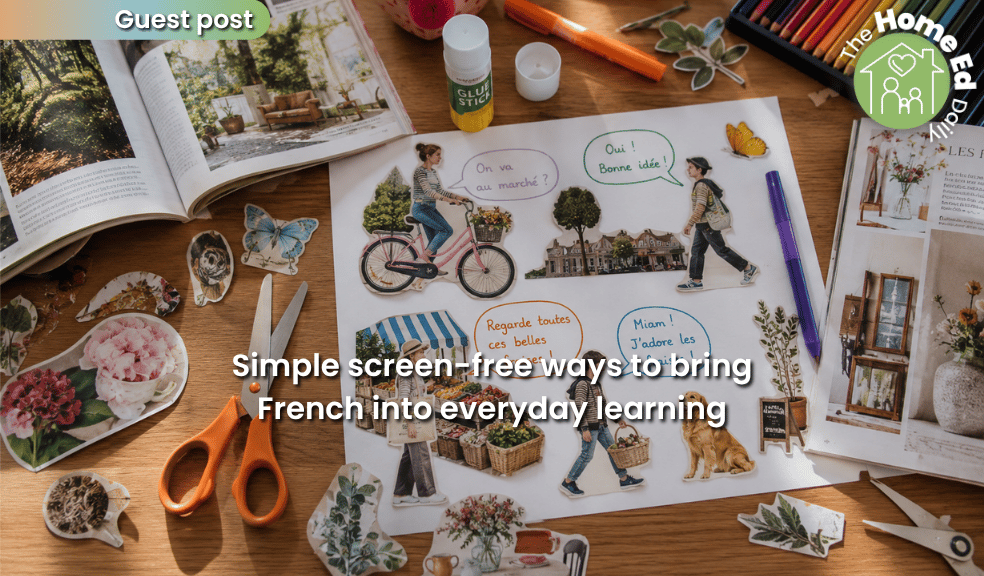
Simple screen-free ways to bring French into everyday learning
Learning French doesn’t always mean sitting down for a formal lesson.
For children already learning French, short, playful activities can help reinforce familiar vocabulary without reaching for another workbook. For complete beginners, they can be an easy first introduction to the language, with no pressure to remember everything straight away.
They also help children see French as something they can use while playing, moving, eating, creating and going about everyday life. And parents don’t need to speak French themselves to try them.
The ideas below are suitable for children roughly aged 4 to 12. Simply adapt the amount of French you use to suit your child. Most also work perfectly well with one child, with a parent taking the second role.
1. Wake up with French
Add a little French to some morning movement. You could create a simple obstacle course with cushions, chairs and soft toys, or just call out actions as you move around the room.
Try:
Je marche. (I’m walking.)
Je saute. (I’m jumping.)
Je cours. (I’m running.)
Je tourne. (I’m turning around.)
Je m’étire. (I’m stretching.)
Je respire. (I’m breathing.)
Je ris. (I’m laughing.)
Finish with a few seconds of deliberately ridiculous laughter and Je ris !
Connecting a word with an action can make it much easier to remember.
2. French numbers everywhere
Count things you’re already doing: stairs at home, jumps in the garden, Lego bricks, steps along a path or objects at the park.
Start with un, deux, trois... and gradually count further as the numbers become familiar.
There’s no need to turn it into an exercise. Simply using the numbers for a real reason gives them more chance to stick.
3. Have a colour hunt
Choose one colour and see how many things you can find around the house or garden.
Say:
On cherche des objets rouges !
(Let’s look for red objects!)
A beginner might simply point and say:
C’est rouge.
(It’s red.)
A child who knows more French could name the object:
Une pomme !
(An apple!)
Or make a simple sentence:
La pomme est rouge.
(The apple is red.)
Choose another colour next time.
4. Take a French song break
Choose three to five French songs and return to the same ones regularly.
Traditional songs to try include:
Frère Jacques
Savez-vous planter les choux ?
Ainsi font, font, font
Promenons-nous dans les bois
Dance, clap, sing along or simply listen. Children don’t need to understand every word. Hearing the same sounds and phrases repeatedly helps them become familiar with the rhythm of spoken French.
5. Become dinner detectives
Make some simple cards containing French words that can describe food.
You could try délicieux (delicious), sucré (sweet), salé (salty), amer (bitter), acide (sour), chaud (hot), froid (cold), croquant (crunchy), mou (soft), dur (hard), épicé (spicy), frais (fresh) or juteux (juicy).
At dinner, choose one or two words that fit the meal.
There’s no need to create a full sentence or correct every mistake. Simply noticing and choosing an appropriate French word is useful practice.
6. Make a mood board
Create some small cards or posters showing simple feelings, perhaps with an emoji or drawing alongside each one.
Try:
Je suis content(e). (I’m happy.)
Je suis triste. (I’m sad.)
Je suis fatigué(e). (I’m tired.)
Je suis en colère. (I’m angry.)
Je suis calme. (I’m calm.)
J’ai peur. (I’m scared.)
Ça va bien. (I’m doing well.)
Keep them somewhere accessible and let your child choose whichever one best describes how they feel that day.
Once the phrases become familiar, you can begin using them naturally in conversation.
7. Play the mystery object game
Place some familiar objects in a basket or bag. One person chooses an object without showing anyone else and gives simple clues in French.
For a lemon, for example:
C’est jaune. (It’s yellow.)
C’est acide. (It’s sour.)
C’est un fruit. (It’s a fruit.)
Then guess:
Un citron !
(A lemon!)
A beginner can give one clue. A more confident learner can try several.
8. Take French to the playground
You don’t need to invent new games. Add a little French to ones children already know.
1, 2, 3, soleil !
This is a French version of Red Light, Green Light. One person stands with their back turned while everyone else moves towards them. When they turn around and call 1, 2, 3, soleil !, everyone freezes.
You can also use:
On y va ! (Let’s go!)
Arrête ! (Stop!)
For hide and seek, or cache-cache, try:
Je compte. (I’m counting.)
Prêt ou pas, j’arrive ! (Ready or not, here I come!)
The game is already familiar, so children can concentrate on the new words rather than learning new rules as well.
9. Make a one-bubble-a-day comic
Draw characters or cut pictures from old magazines and gradually create a comic strip. Add just one French speech bubble each time.
For a football story, you might use:
On joue au foot ! (We’re playing football!)
Passe-moi le ballon ! (Pass me the ball!)
Vas-y ! (Go for it!)
But ! (Goal!)
Over time, children can add more characters, settings and familiar expressions.
10. Make fruit and veg animals
Use pieces of fruit and vegetables to create an animal, with adult help for cutting where needed.
As you make it, add simple French:
C’est un lapin ! (It’s a rabbit!)
C’est un chat ! (It’s a cat!)
Je coupe une carotte. (I’m cutting a carrot.)
Use whatever you already have: apples, cucumber, strawberries, carrots, grapes or blueberries.
Eating the evidence afterwards is entirely optional.
11. Let your child be the teacher
Ask your child to become the French teacher for five minutes and teach three words to somebody else.
They could teach a grandparent:
Bonjour. (Hello.)
Merci. (Thank you.)
Au revoir. (Goodbye.)
Or teach a sibling three animals, a parent three colours or a friend three numbers.
Having to explain something to somebody else is a surprisingly good way to discover what you remember.
12. Make a family recipe book
Create an illustrated recipe book and gradually add French names for ingredients and kitchen objects.
For example:
une pomme (an apple)
un œuf (an egg)
une cuillère (a spoon)
une assiette (a plate)
Children could draw ingredients, write labels, add photographs or decorate the pages.
There’s no need to finish it quickly. Let it grow whenever cooking gives you another useful word to add.
13. Keep a French adventure journal
After a walk, museum visit, beach day or family outing, add a page to a notebook. Stick in tickets, photographs or drawings and label a few things in French.
A beach page might include:
la mer (the sea)
le sable (the sand)
une coquille (a shell)
A woodland walk could include:
un arbre (a tree)
une feuille (a leaf)
un écureuil (a squirrel)
It can become a record of family adventures as well as a growing collection of useful French words.
14. Hold a teddy bears’ birthday party
Give two favourite toys a birthday party and let them have a very simple French conversation.
Teddy 1: Joyeux anniversaire !
(Happy birthday!)
Teddy 2: Merci !
(Thank you!)
Teddy 1: Tu veux un gâteau ?
(Would you like some cake?)
Teddy 2: Oui, s’il te plaît !
(Yes, please!)
Teddy 1: Voilà !
(Here you are!)
Teddy 2: Mmm, c’est délicieux !
(Mmm, it’s delicious!)
A shoebox can become a table, cardboard can become birthday cake, and the teddies are unlikely to complain about anybody’s pronunciation.
15. Choose a room of the week
Rather than covering the entire house in French labels at once, choose one room.
In the kitchen you might label:
la table (the table)
la chaise (the chair)
le verre (the glass)
l’assiette (the plate)
la cuillère (the spoon)
la fourchette (the fork)
le couteau (the knife)
le frigo (the fridge)
le four (the oven)
la porte (the door)
la fenêtre (the window)
Use sticky notes, masking tape or reusable labels. After a week, remove them and choose another room.
Bringing French into everyday life
None of these activities needs to become a formal lesson. They’re simply ways to hear, recognise and use French alongside things children are already doing.
A complete beginner might start with one colour, three numbers or a favourite song. Children who already know some French can expand the activities with longer sentences, written clues or their own conversations.
Sometimes five minutes really is enough. A few familiar words used regularly can make French feel much less like something that only exists in a textbook.
If you’d like more support with learning French, Katia Bukina is a French teacher and creator of Learn with Katia, where she shares language-learning ideas and offers online French classes for children.