







How to reduce home education prep and save time
Spend less time preparing: simple ways to reduce home education prep
There is a quiet, sneaky myth in home education: the idea that the success of a learning day depends on how much time you spent prepping for it the night before.
Whether you follow a structured curriculum, let your child’s interests lead the way, or take a piecemeal approach like the rest of us, it is ridiculously easy to fall into the trap of measuring your worth as a home educator against the latest home ed influencers on TikTok.
When my son was younger, for a while I got completely swallowed by the blogging comparisons. This was in the pre-social-media days. I spent far too many late nights cutting out tiny printed pieces, laminating things that frankly didn’t need to survive a nuclear winter, and plotting out grand unit studies.
But here’s the reality check I eventually had to give myself: carrying 100% of the prep burden didn’t make me a better educator, parent or blogger. It just made me an exhausted mum.
Home ed gives us the freedom to step off the school treadmill, yet we can so easily build a new one right in our own living rooms. Meaningful learning doesn’t require late-night prep sessions or elaborate setups.
By making a few small shifts in how we handle resources, daily rhythms and household responsibilities, we can cut down the prep load and give our children more opportunities to become involved in the process too.
Here are four down-to-earth ways to drop some of the prep stress and make more room for actual learning.
1. Hand over the scissors (and the glue)
When we assume every resource needs to be pristine and fully prepared before our children see it, we can miss out on a useful part of the activity itself.
Involving children in the physical prep of their own materials isn’t a cop-out. It can be hands-on learning involving plenty of real-life skills.
Fine motor skills: For some children, activities such as cutting, folding paper and handling small objects can help build the hand strength and coordination also used in writing, drawing and crafts.
Sorting and decision-making: Working out which picture matches which label, organising cards into categories or deciding how materials should be arranged can support skills such as sorting, planning and problem-solving.
A sense of ownership: Children may feel more invested in something they have helped to make or prepare themselves.
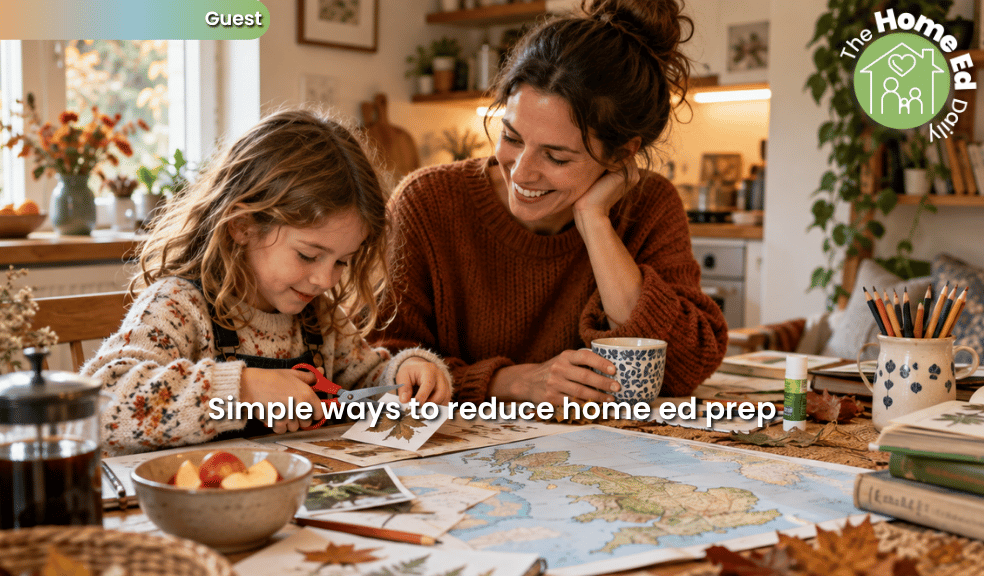
If a game or activity needs cards cutting out or pages collating, you don’t necessarily need to do it after everyone has gone to bed. Put the printouts on the kitchen table, hand over the safety scissors if appropriate, and let preparing the activity become part of the activity.
It lightens your workload and turns an administrative job into something children can take part in.
2. Anchor learning to things you’re already doing
You don’t need dedicated two-hour lesson blocks or elaborate themed weeks to explore big ideas such as history, science or world cultures.
Some of the most memorable learning happens right in the middle of everyday life.
This doesn’t mean throwing out all your books. It simply means noticing the learning opportunities already woven through the day.
Look for ways to drop small prompts into moments you already share.
Breakfast and snack breaks: An intriguing photograph, unusual map, postcard or odd fact left on the table next to a plate of toast can spark a conversation without needing a prepared lesson.
Mealtimes as cultural windows: Food is a wonderfully low-prep conversation starter. Cooking a recipe from another country or trying a new ingredient can give children a sensory connection to geography, culture and history that a textbook alone can’t provide.
If cooking a full meal feels like too much, start with snacks. Ask where they think the food comes from, what they expect it to taste like and whether it reminds them of something they already know.
Background audio: A playlist of traditional music, a period drama soundtrack or an audiobook playing while everyone is drawing, building or pottering around can bring another layer of culture or storytelling into the house with very little preparation.
When learning is woven naturally through the day, you don’t have to wear a “teacher hat” twenty-four seven. It simply becomes part of family life.
3. Choose tools that work more than once
A massive culprit of parent burnout can be the hunt for the “perfect worksheet” or topic-specific printable.
Spending two hours finding, printing and preparing something your child spends four minutes filling in is a quick route to frustration.
Moving towards open-ended, multi-use tools can save hours of hunting around online.
Build a bank of reusable real-world images: Photographs of wildlife, landscapes, historical artefacts or works of art can be used in all sorts of ways, from creative writing and science observations to history discussions.
Reusable setups: Blank outline maps, three-part cards, simple grid sheets and graphic organisers can work just as well for studying ancient Egypt as they do for investigating local pond life.
Primary sources and real objects: A magnifying glass, a tray of rocks, an old atlas or a collection of vintage coins can prompt all sorts of questions and self-directed research without requiring anything to be printed.
Ask friends and family if they have anything interesting they’d like to donate to your curio collection. You may be surprised by what turns up.
When you focus on gathering a small collection of versatile tools rather than endless single-use printables, there is less to prepare and less to store.
4. Make packing away part of the activity
We all know how hard the end of the day can be. It’s often the point when energy hits rock bottom and everyone has had enough, including the parents.
Looking at a kitchen table buried under open reference books, scrap paper and paints is enough to make any adult want to quietly disappear.
If it works for your family, involving children in resetting the space can take some of that load off you and make looking after shared materials part of the activity too.
Try a five-minute team reset: Putting books back on shelves, wiping the table and sorting pencils can become the natural final step.
This echoes a familiar Montessori principle: using something, completing the activity and then returning the materials ready for next time. The same idea can work whether you’ve been learning about frogs, cooking together or building with Lego.
Prepare tomorrow together: Before everyone disappears to do something else, spend five minutes gathering any books, notebooks or project pieces they might want to return to the next day.
Having children choose and set out their own materials can build independence, foresight and self-reliance. And, best of all, there is something deeply satisfying about walking into the kitchen the following morning and finding a clean table waiting for you.
Connection over curation
Home education is a long game. It doesn’t need to be Insta-perfect or scheduled like a school timetable.
Small nuggets of learning can appear throughout the day in quiet, ordinary ways. Getting children involved in preparing, organising and looking after the things they use can build useful life skills while also taking some of the pressure off the parent.
And perhaps, occasionally, you might even get to drink that cuppa while it’s still hot.
Jo Ebisujima is a Montessori educator, author, veteran home educating parent and founder of 193 Little Adventures.