






How to make art a regular part of home education when you don’t feel artistic
Simple ways to build drawing and creativity into your home education week
"I'm not arty!"
I've lost count of how many times I've heard those words from parents over the years. Usually followed by something like, "I can't even draw a stick figure!"
Before Artventure, I ran my first little business teaching children's art lessons. I loved watching children discover what they were capable of, but I was always struck by how many parents were convinced that drawing was something they simply couldn't do.
Later, working as an artist-in-residence in schools, I noticed something similar. Many teachers weren't confident teaching children how to draw either.
It got me thinking. If so many adults have grown up believing they can't draw, who's teaching the next generation?
I've always believed that drawing is a skill everyone should have the opportunity to learn, just like reading and writing. You don't need to become an artist any more than you need to become an author, but being able to express an idea through drawing is a wonderful thing.
I wanted to break that cycle of one generation telling the next, "I can't draw."
The lesson that gave me an idea
One day, during an artist-in-residence programme, I was asked to teach 91 students in a single session.
Normally, I'd gather the children around a desk to demonstrate what we were going to draw. But there was absolutely no way I could fit 91 children around that desk!
So I decided to film the lesson beforehand and play it on the big screen.
What happened next was a real lightbulb moment.
The teachers were standing back. I was standing back. And every child was watching, drawing, learning new skills and experiencing success!
Nobody needed to be an expert standing beside them. They just needed someone to show them the steps in a way they could understand.
That experience eventually led me to create Artventure, an online library of step-by-step art lessons for children.
You don't have to know how to draw to help your children learn
If you're home educating your children and don't feel particularly artistic, I'd love you to know that you don't have to be good at drawing to help them learn.
You don't need to know how to draw a horse, understand perspective or have a cupboard full of expensive art supplies.
You just need to give your children opportunities to learn, practise and enjoy creating.
Sometimes that means drawing alongside them. Sometimes it means finding someone else to demonstrate a technique. And sometimes it simply means giving them a pencil and paper and seeing what happens.
The important thing is that art doesn't become something you avoid because you're worried you won't be able to teach it properly.
Keep the materials simple
One of the easiest ways to make art happen more often is to make it easy to get started.
If you need to search for an idea, buy special materials and spend half an hour setting everything up, it's tempting to decide you'll do it another day.
You really don't need much.
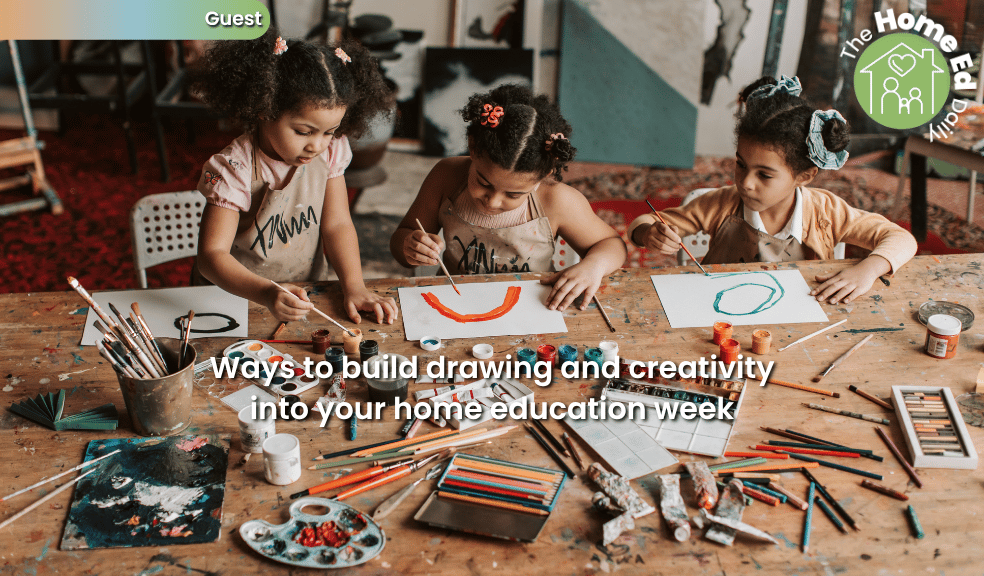
My favourite materials are simply paper, a black oil pastel, a big paintbrush, a pot of water and some watercolour paints. I use these almost every time because they're easy to work with and give such lovely results. The oil pastel makes a strong outline, while the watercolours quickly fill larger spaces with beautiful colour.
You could keep a small art box somewhere accessible so that when someone feels like drawing, everything is ready to go.
A simple drawing activity that actually happens is far more valuable than an ambitious project that never gets started.
Find a rhythm that works for your family
One of the lovely things about home education is that learning doesn't have to look the same in every household.
Some children might enjoy starting the morning with a drawing. Others might prefer an art activity after being outdoors, or drawing while listening to an audiobook.
You could choose one day each week to try something new, or simply keep the materials handy for when there's a natural opportunity.
If you're finding it difficult to get started, try setting aside just 15 or 20 minutes. That's enough time to learn a simple technique or begin a picture that can be finished later.
And if your child becomes completely absorbed and wants to keep going, that's wonderful too.
Art doesn't have to fit neatly into a timetable to be worthwhile.
Teach skills as well as encouraging imagination
I'm a big believer in giving children the freedom to experiment and use their imaginations. But I also believe there's enormous value in teaching them how to draw.
Sometimes people worry that showing children step-by-step techniques will limit their creativity. I see it quite differently.
Imagine a child who wants to draw a dog but has no idea where to begin.
Show them how to start with a few simple shapes, and suddenly they have something to work with. They can change the ears, add spots, give the dog a funny expression or draw a whole family of dogs.
Learning the technique hasn't taken away their creativity. It's given them more ways to use it.
It's a bit like learning to write. Once you know how to form letters and words, you can use them to tell whatever story you like.
Drawing works in much the same way.
What if your children are different ages?
You don't necessarily need a different art activity for every child.
A younger child might be happy drawing basic shapes and adding colour, while an older child might enjoy experimenting with shading, texture or a more detailed background.
They can work from the same starting point without producing the same result.
And don't worry if their finished pictures look nothing alike. That's part of the fun. In fact, that's the goal!
Sometimes children will follow every step carefully. Other times they'll take an idea and turn it into something completely different.
Both are valuable.
Have a go yourself, even if you're not confident
Remember those parents who told me they couldn't draw a stick figure?
Many adults have carried that belief around since childhood, and I've seen Artventure change that for parents as they learn alongside their children.
But children also hear the way we talk about our own abilities.
Instead of saying, "I'm hopeless at drawing," try, "I've never learnt how to draw that. Shall we have a go?"
You might be surprised by what you can do when someone shows you where to start.
And even if your drawing turns out a little wonky, that's fine! Be sure to use positive words about your own efforts, too. Something as simple as "I'm proud I gave that my best shot!" shows your children that trying is something to celebrate.
Children don't need you to produce beautiful artwork. It's good for them to see that learning takes practice, mistakes are normal and you can enjoy something without being brilliant at it.
Give it a place in your week
Art can be a lovely change of pace. It gives children a chance to explore their ideas and enjoy making something with their own hands.
It doesn't need to be complicated, expensive or perfectly planned.
If you're unsure how to teach drawing, guided lessons can be a helpful starting point. That's why I created Artventure, where children can watch a drawing demonstration and follow along at their own pace.
But whether you're using a guided lesson, drawing something you've spotted in the garden or simply putting pencils and paper on the table, my encouragement is the same.
Drawing isn't a talent you're either born with or without. It's a skill we can all learn.
And perhaps the most wonderful outcome isn't just the artwork your children create today. It's that they'll grow up believing drawing is something they can do, with happy memories of learning and creating alongside you.
One day, they might be the adults confidently showing their own children how.
About the author
Kirsty Shadiac is an Australian artist and founder of Artventure, an online library of step-by-step art lessons for children, and Art Eye Deer for older children and teenagers. Since 2012, Artventure has been used in 149 countries, helping children develop their drawing skills, creativity and confidence.
Looking for more ideas? Explore our Art & Design Resources