





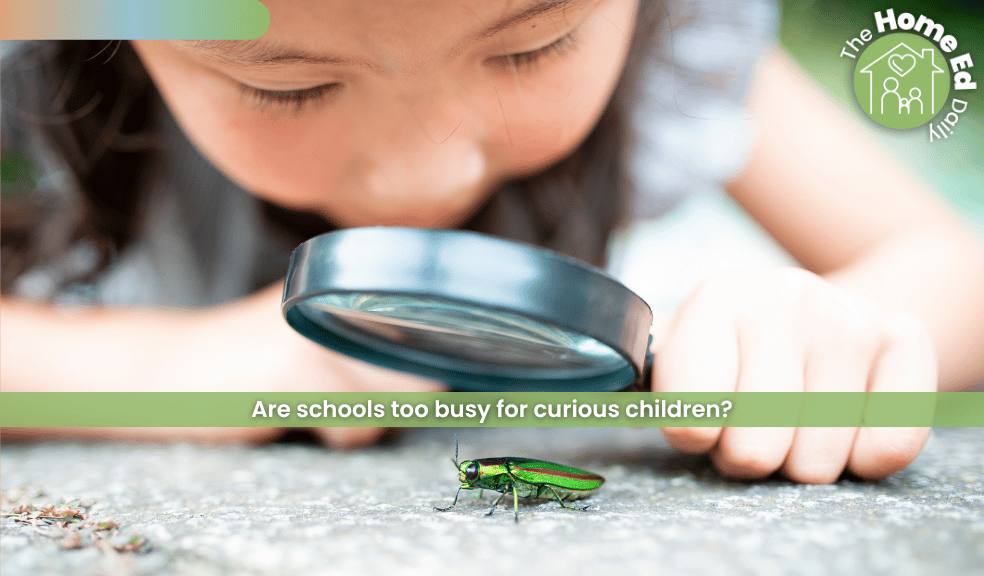
What happens when children stop asking questions?
How home education can help children start asking questions again
A recent article by Katy Purviance on Substack caught my attention because it puts words to something many families have felt for years: some children do not lose their curiosity because they grow out of it. Sometimes they learn that curiosity is inconvenient.
One line from the article stayed with me. Researcher Susan Engel observed a teacher respond to a curious child by saying, “I can’t answer questions right now. Now it’s time for learning.”
It is a small sentence, but it says a great deal. Because what is learning, if not asking questions?
This is not a teacher-bashing piece. Many teachers care deeply about children’s curiosity and do what they can within difficult limits. But the structure of school often leaves very little room for the slow, untidy, branching nature of real thought. There is a timetable to follow, a curriculum to cover, behaviour to manage, tests to prepare for, and thirty children moving through the day together.
In that setting, curiosity can easily become something to contain. A child asking “why?” may be seen as delaying the lesson. A child who spots a contradiction may be seen as challenging authority. A child who wants to follow an unexpected idea may be told to get back on task. A child who finishes quickly and starts asking more questions may become the child who “won’t settle”.
Yet these are often the very qualities adults say they want children to develop. Independent thought. Problem solving. Confidence. Creativity. A willingness to look beneath the surface. The difficulty is that those qualities are much easier to praise in theory than to manage in a room full of children who all need to move through the same activity at the same time.
Compliance is easier to measure than curiosity
Schools are often asked to do two things at once. They are expected to develop thoughtful, creative, independent learners, while also producing measurable outcomes. Those two aims do not always sit comfortably together. It is much easier to measure whether a child has completed a worksheet than whether they have followed a thought deeply. It is easier to record a test score than a rich conversation. It is easier to reward neatness, speed, quietness, and correct answers than to make space for uncertainty, challenge, and original ideas.
Research into motivation helps explain why this matters. Self-determination theory, developed by Edward Deci and Richard Ryan, identifies autonomy, competence, and relatedness as key psychological needs. When these are supported, motivation and engagement are more likely to flourish. When they are blocked, wellbeing and motivation can suffer.
This is one reason many home educating parents recognise a familiar pattern. A child leaves school exhausted, anxious, flat, angry, or convinced they are “bad at learning”. Then, slowly, often with more rest and less pressure, small signs of curiosity begin to return. Not always quickly. Not always neatly. Sometimes it starts with Minecraft, insects, baking, YouTube videos about shipwrecks, or a sudden obsession with sharks at 9.40pm. But it matters.
Curiosity is not an optional extra
Curiosity is sometimes treated as a nice addition to learning. A bonus. Something to add once the “proper work” is done. The research suggests otherwise. A 2014 study published in Neuron found that people remembered information better when they were in a state of curiosity. They also remembered unrelated information encountered during that curious state more effectively. The researchers linked this to activity in brain regions involved in reward and memory. In plain English, curiosity helps learning stick.
This will not surprise many home educating families. We see it all the time. A child who cannot remember a list of facts for a worksheet can suddenly absorb huge amounts of information about ancient Egypt, football statistics, animal behaviour, coding, Greek myths, fungi, rollercoasters, or World War Two aircraft because something has lit the fuse. The learning may not look tidy from the outside. It may not arrive in subject boxes. It may begin with a question that seems completely unrelated to anything “educational”. But the mind is working.
The child labelled difficult
One of the hardest things for parents is watching a bright, questioning child become labelled as difficult. Of course, children can be rude. They can be disruptive. They can avoid hard things. They can push boundaries. Home education should not romanticise every refusal as deep philosophical resistance. But it is also true that some children struggle in school not because they do not care, but because they care about meaning. They want to know why something matters. They notice unfairness. They dislike pointless repetition. They need time to think. They do not always accept “because I said so” as a satisfying answer.
In a busy classroom, that can look like defiance. At home, it can become information. Instead of asking, “How do I make this child comply?” we can ask, “What is this behaviour telling me about how this child learns?” That one shift can change the whole atmosphere.
Home education gives curiosity more room, but it does not guarantee it
Home ed can offer something rare and precious: time. Time to follow a question past the first answer. Time to pause when a child is tired. Time to let an interest run for weeks, or disappear after one afternoon. Time to learn through conversation, projects, walks, documentaries, books, play, practical skills, community, online classes, museums, workshops, and the ordinary business of family life.
It also allows children to have more say in the shape of their learning. That does not mean children never need structure. Some do. Some thrive with routines, plans, clear expectations, and direct teaching. But structure does not have to mean control. It can be a trellis rather than a cage. The trap is bringing school home without realising it. A home educated child can still be pressured into performing learning rather than living it. We can still turn every interest into a written task. We can still rush to correct. We can still panic when learning does not look productive. We can still measure the wrong things because we are frightened that, without proof, it will not count. Many of us do this at some point - I know I do. Not because we do not trust our children, but because we are carrying years of messages about what education is supposed to look like.
How to protect curiosity at home
Curiosity does not need an elaborate curriculum. It needs room, attention, and respect. When your child asks a question, try writing it down instead of answering it straight away. Keep a family “I wonder? list” on the fridge or in a notebook. Some questions can be answered quickly. Some can become research projects. Some can simply sit there, quietly doing their work in the background.
Try not to turn every spark into a lesson. If your child becomes interested in birds, you do not have to create a six-week ornithology unit by bedtime. You might put binoculars by the window, borrow a bird guide, look up a call, watch a nest camera, or go for a walk. Enough is allowed to be enough.
Let children see you not knowing things. “I’m not sure. Let’s find out,” is one of the most powerful phrases in home ed. Separate skill-building from curiosity when needed. A child may need help with reading, writing, maths, or exam preparation. That can sit alongside interest-led learning without taking over. Not everything has to be child-led, but not everything has to become a battle either. Most of all, notice when your child comes alive. Notice what they return to. Notice what they talk about when nobody is testing them. Notice the questions they ask in the car, in the bath, on a walk, or just as you are trying to get them to bed.
Those moments are not distractions from education. They may be the heart of it.
A different way to think about learning
Home ed is not about proving that all schools are bad or that children shouldn't all learn in the same way. Many children are happy in school. Many teachers create thoughtful, curious classrooms despite the pressures around them. But for children who have been flattened by school, who have stopped asking questions, who have learnt to hide their thoughts, or who have come to see learning as something done to them, home education can offer a different starting point.
Not “How do we get through the work?” But: “What are you wondering about?” “What do you want to understand?” “What would help you feel brave enough to try?” “What can we build from here?”
A child’s curiosity is not a nuisance to be managed. It is not a luxury for when the serious work is finished. It is one of the clearest signs that the mind is awake. And when a child begins asking questions again, we should pay attention. Because something important is coming back.
Source notes:
This piece was inspired by Katy Purviance’s Substack article, Schools Don’t Just Fail to Develop Critical Thinkers. They Punish Them, and draws on research around curiosity, motivation, and creative thinking. The article also references Susan Engel’s work on curiosity in schools, Gruber, Gelman and Ranganath’s 2014 study on curiosity and memory, Deci and Ryan’s self-determination theory, and Kyung Hee Kim’s research on creative thinking scores.