







Teaching children about money: what I wish I’d learned sooner
Financial education for children: why money lessons need to start early
I was in my late twenties before I understood what an overdraft actually cost me.
Not in a vague "it's bad to be overdrawn" way. But actually understood it: the daily charges, the interest, the way it quietly erodes your account while you're busy just trying to get through the month.
Nobody had ever explained it to me. Not my parents or my teachers, not anyone. I had just assumed that an overdraft was a normal part of adult life, similar to paying council tax or renewing the car insurance. Something you dealt with when you got there.
The problem was, by the time I was in my twenties, the habits were already long formed.
The gap nobody talks about
I am not unusual. Talk to almost any adult about their financial education and you'll hear a version of the same story. We learned to count change in primary school. We did a bit of percentages in maths. And then we were handed a world of mortgages, pension contributions, credit scores and tax returns and expected to figure it out as we went along.
Most of us did figure it out eventually. But not without cost: bad decisions, unnecessary debt, years of financial anxiety that could have been avoided with a little knowledge at the right time.
The research backs this up: Financial habits and attitudes are largely formed in childhood. By the time a young person reaches their twenties, the patterns are already deeply ingrained. The window for building genuine financial confidence is much earlier than most parents realise.
What changed for me
When my son was around seven years old, he watched me tap my card at the supermarket and asked: "Is that free?"
He genuinely thought it might be.
That moment stopped me in my tracks. Because I realised that despite everything I had learned the hard way, I had somehow managed to raise a child who had no idea that money was finite. That the card was connected to an account. That the account had a balance. That the balance went down every time we used it.
He wasn't silly. He was just uninformed. And that was entirely my responsibility.
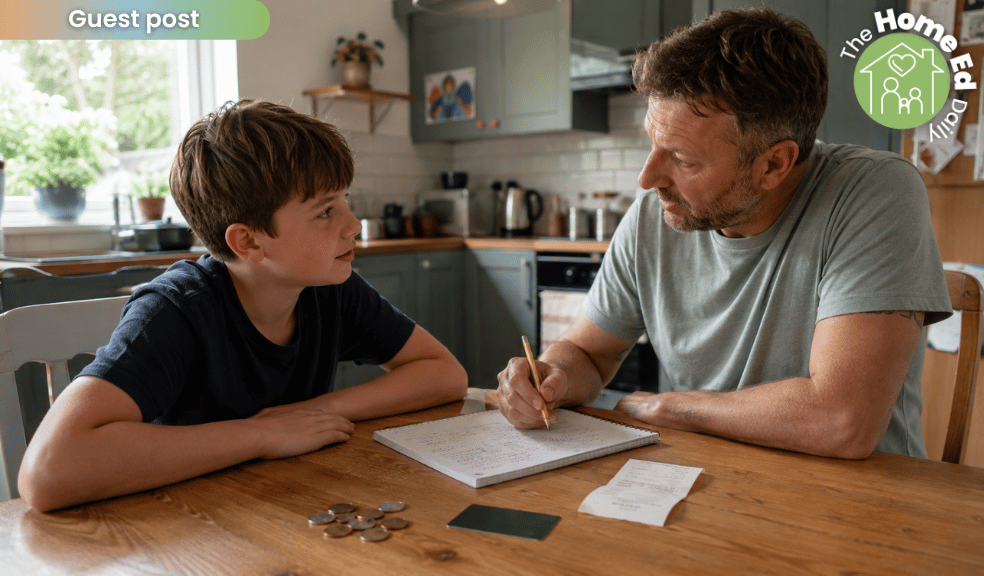
I started talking to him about money differently from that day. Not in a stressful way, not in a "we need to be careful" way that would have worried him, but in a curious, “matter of fact” way. What does a business actually do? Where does a salary come from? What is tax and why do we pay it? Why do some people rent and others buy?
The conversations that followed were some of the most interesting we have ever had.
What children are actually capable of
Here is what surprised me most: children are completely ready for these conversations. They are curious, they are sharp, and they are already observing the financial world around them every single day. They see prices in shops. They notice when things are expensive. They hear adults talk about money even when we think they are not listening.
What they are missing is not the capacity to understand. It is simply someone taking the time to explain.
A ten year old can absolutely understand what interest is. An seven year old can grasp the difference between a need and a want. An eleven year old can understand how a business makes a profit. These are not advanced concepts. They just need to be explained in the right way, without jargon, with real examples from everyday life.
Making sure my child doesn't have to learn the hard way
I felt strongly enough about this that I eventually created Smart Money for Kids: an online course for children aged 8 to 13 that covers the financial literacy our schools simply don't teach.
It covers everything from how money evolved through history to budgeting, saving, tax, banking, business and careers. It uses interactive videos and activities children can work through independently, and it is designed to make financial education genuinely engaging rather than something to endure.
The first month is completely free now (but this may change in the future), with no commitment required from your side.
What I really hope for, is a shift in how we think about this as parents. Financial education doesn't have to wait for school. It starts with a conversation at the supermarket checkout, a question at the dinner table, a moment of curiosity that you choose to take seriously rather than brush aside.
Your child is ready. The only question is whether we are.

Find out more at https://smartkidseducation.org/
Anna Markov is the founder of Smart Kids Education and creator of Smart Money for Kids, a fun and engaging online financial literacy course for children aged 8 to 13.