




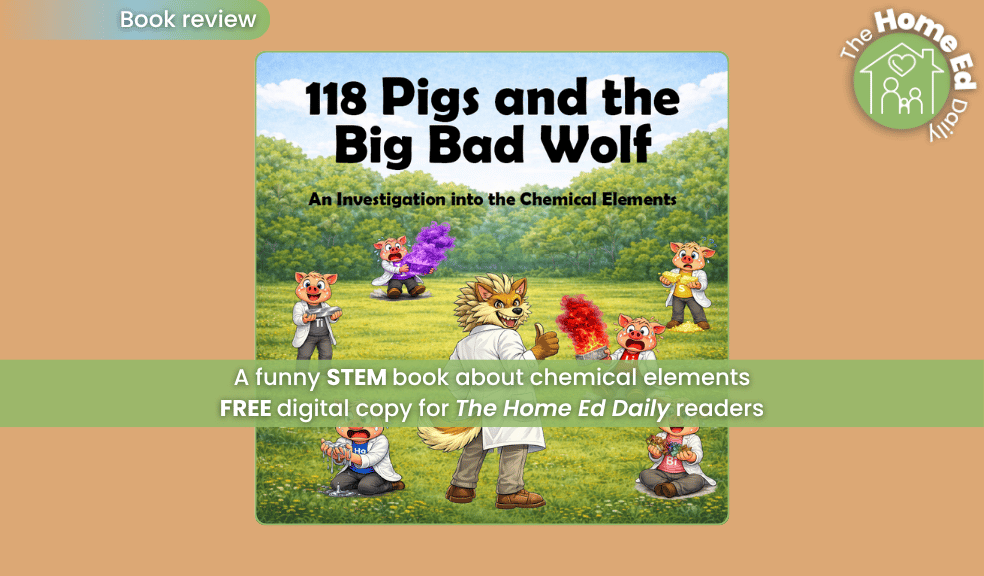
118 Pigs and the Big Bad Wolf book review: An investigation into the chemical elements by Dr Michael Tebboth
118 pigs, one hungry wolf, and a surprisingly useful, and funny, introduction to the chemical elements
💚 Disclosure: I was sent a PDF copy of this book for review so I could share my honest thoughts. This article is independent and unpaid, and I only feature resources that I genuinely believe may be useful for home educating families.
Some children meet the periodic table through a worksheet. Others meet it through 118 expendable student pigs being sent out to build wolf-proof houses from chemical elements. This is very much the second kind of book.
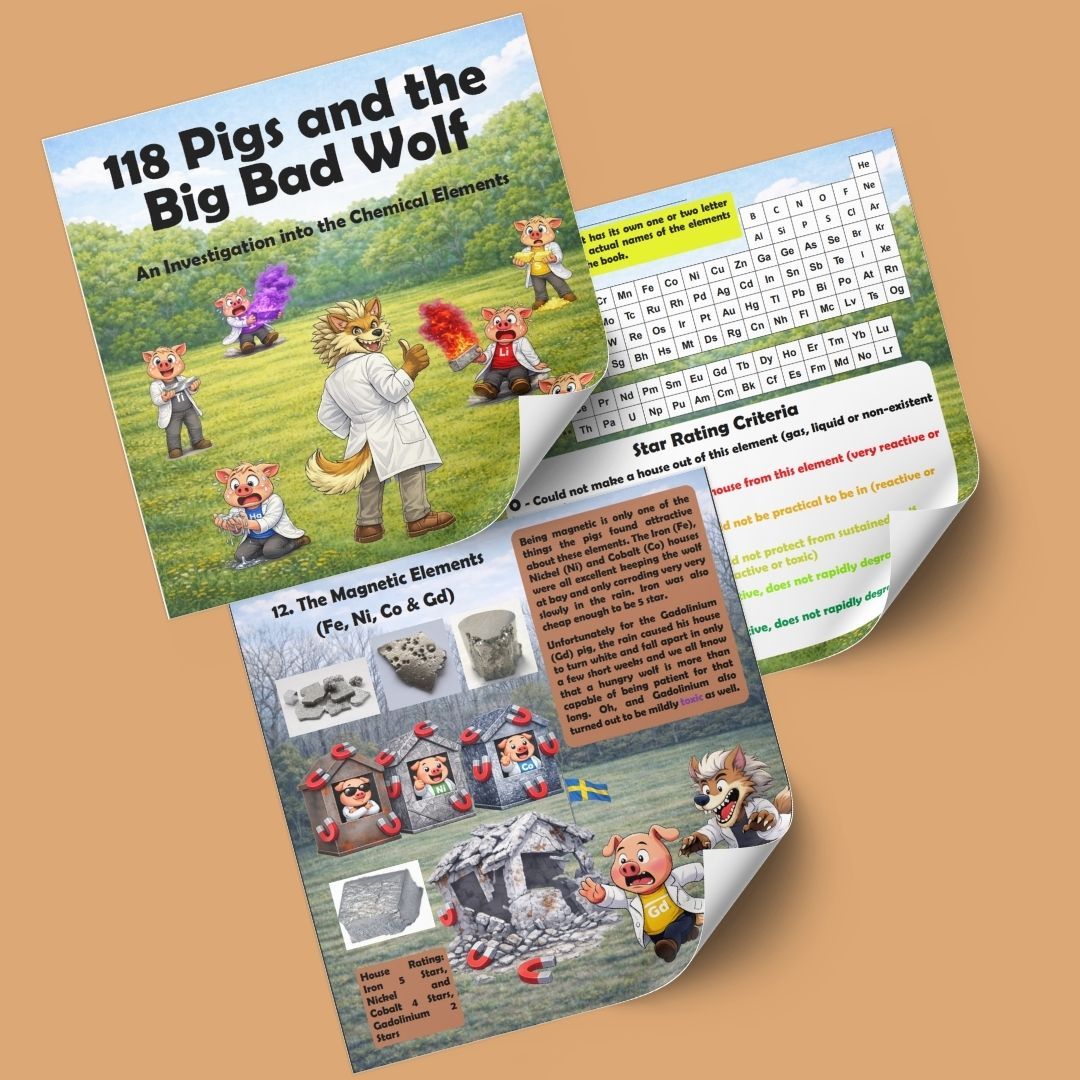
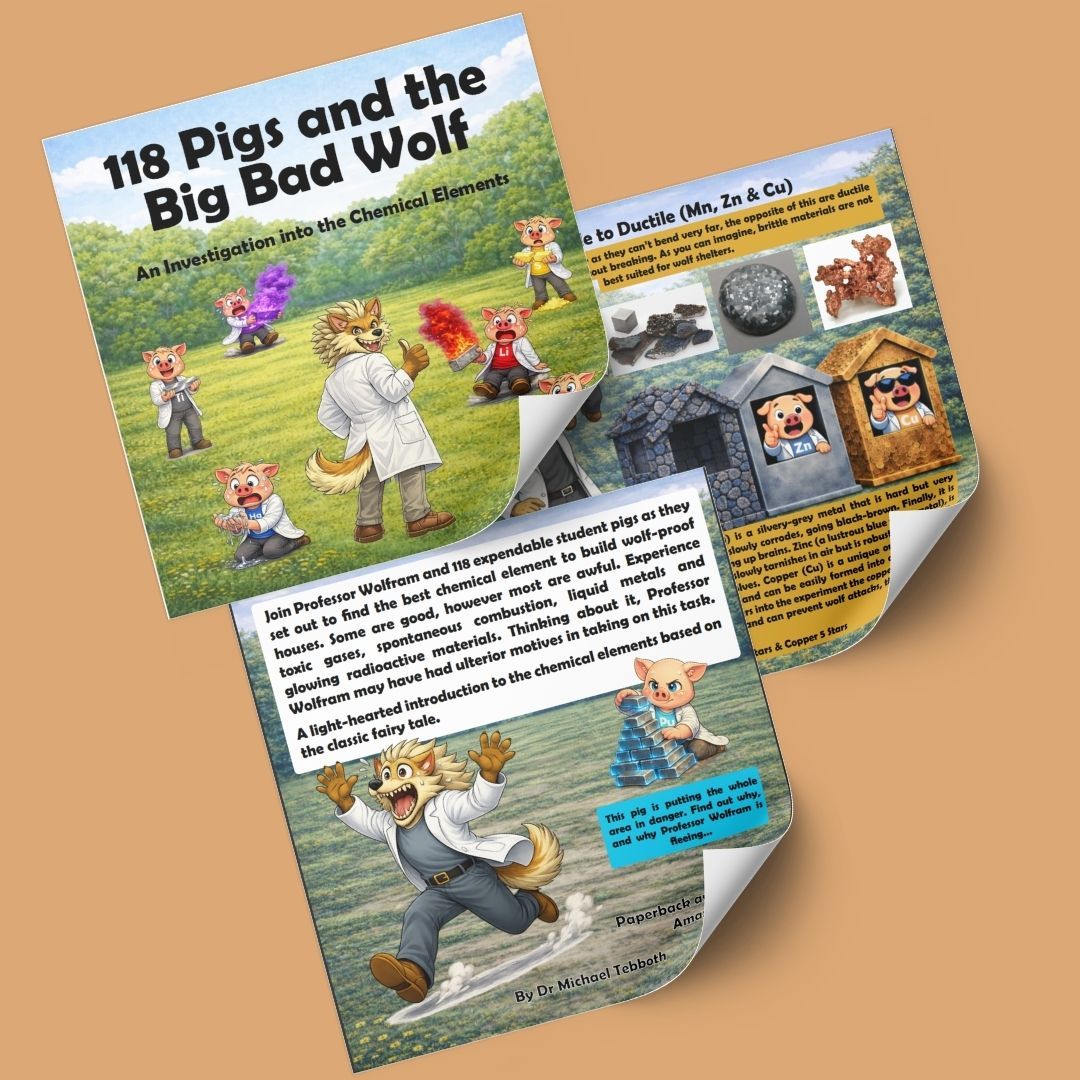
118 Pigs and the Big Bad Wolf: An Investigation into the Chemical Elements by Dr Michael Tebboth takes the familiar story of The Three Little Pigs and turns it into a comic STEM experiment. Instead of straw, sticks and bricks, the pigs test hydrogen, helium, aluminium, carbon, copper, radioactive elements, toxic gases, liquid metals, and quite a few materials that no sensible pig should ever go near.
It is silly. It is dark. It is packed with science. And for the right child, it could be a very memorable way into chemistry.
What is the book about?
The book is presented as an investigation by Professor Wolfram, head of the Anti-Wolf Predation Department at Swine University. His task is to find out which chemical elements would make the best wolf-proof houses. The set-up is simple. Each pig is given an element. They try to build a house from it. If the pig survives long enough, the house is tested by the wolf. The element then receives a star rating based on whether it is solid, safe, strong, stable, affordable, toxic, reactive, radioactive, or entirely unsuitable for pig-based architecture. The result is a tour through the periodic table, but not in the dry “memorise these symbols” sort of way. It is more “what would happen if a pig built a house from gallium and then the sun came out?” That is a far better question, frankly.
A strong hook for curious children
The clever thing about this book is that it gives children a reason to care about the elements. Hydrogen is not just “H”. It is a gas that is useless as a building material and rather fond of going bang. Noble gases are not just a group on the periodic table. They are invisible, non-reactive gases that will not keep a wolf out. Aluminium becomes interesting because it is reactive, but forms a protective layer through passivation. Carbon becomes more memorable because graphite and diamond behave so differently, despite both being forms of the same element. This is where the book works well for home ed. It does not ask children to start with abstract facts. It starts with a problem.
Could you build a house from this?
Would it survive the rain?
Would the wolf get in?
Would the pig be poisoned, burned, dissolved, exploded, irradiated, or merely eaten?
The science sits inside the story, so children can follow the joke first and the chemistry second. That can be very useful for children who switch off when a topic feels too formal.
What does it teach?
This is not a full chemistry curriculum, and it does not pretend to be. It is more of a lively doorway into the periodic table. Children are introduced to ideas such as:
chemical symbols
groups of elements
metals, metalloids and gases
reactivity
toxicity
radioactivity
corrosion
passivation
allotropes
density
magnetism
melting points
building materials
the difference between elements and compounds
The final section is especially useful because it steps back and explains that the book has taken some scientific liberties. It points out some of the simplifications, assumptions and exaggerations used for the story. This could open up a good conversation with older children about models, thought experiments, accuracy, humour, and why science writing sometimes simplifies complicated ideas. That section also makes it clear that lab safety matters. The pigs and Professor Wolfram are not exactly role models in this area!
Warning - the humour is quite dark
This is worth saying plainly. The book has a lot of cartoon peril. Pigs are eaten. Pigs explode. Pigs are poisoned. Pigs suffer from toxic gases, radioactive materials and disastrous building choices. The wolf is cheerful, hungry, and not remotely troubled by research ethics.
Many children will find this hilarious, especially those who enjoy Horrible Science, Roald Dahl-ish nastiness, comic danger, slapstick experiments, and dramatic scientific failure. More sensitive children may not enjoy it. It is not a gentle picture book about chemistry. It is a comic science book with a large body count and a gleefully ridiculous premise.
For home ed families, I would suggest previewing it first if your child is sensitive to animals being harmed, even in cartoon form. For children who enjoy dark humour, it may be exactly the sort of book that makes chemistry stick.
What age is it best for?
I would place it roughly around age 8+, depending on the child. Younger children could enjoy it as a read-aloud if they like the humour and have an adult nearby to explain some of the science. Confident readers in the upper primary years may enjoy dipping in and out of it. Older children at Key Stage 3 level could use it as a playful way to revise or extend their understanding of elements and their properties.
It may also work well for mixed-age home education. A younger child might enjoy the story and pictures. An older child could explore the chemistry behind each disaster. A parent could quietly decide not to build any houses out of phosphorus. Wise.
How families could use it
This book would suit families who like learning through stories, humour, questions and side trails. You could read a few pages at a time, choose one element to investigate further, or use it as the starting point for a mini chemistry project.
Here are a few simple ways to build on it:
Make element cards
Choose ten elements from the book and make a card for each one. Include the name, symbol, whether it is a solid, liquid or gas, one interesting property, and whether it would make a good wolf-proof house. Children could also add their own star rating.
Create a safe building materials test
Do not recreate the dangerous chemistry disasters from the book. Instead, test ordinary, safe materials such as cardboard, foil, fabric, paper, wood, plastic, clay or Lego. Which is strongest? Which keeps water out? Which bends? Which tears? Which would keep out a toy wolf? This keeps the spirit of the book while staying firmly in the land of sensible education.
Follow the periodic table trail
Print a periodic table and highlight each element as you meet it in the book. Children can colour-code the gases, metals, metalloids, radioactive elements, or five-star building materials. This turns the periodic table into a map of the story rather than a wall of mysterious letters.
Talk about elements and compounds
One of the most useful ideas near the end of the book is that some poor-scoring elements can combine to make very useful materials. Wood, for example, contains carbon, hydrogen, oxygen and nitrogen, even though some of those elements would be hopeless as building materials on their own. This is a lovely doorway into compounds, mixtures, molecules and real-world materials.
Research one element properly
Ask your child to choose one element from the book and find out more. Where is it found? What is it used for? Is it dangerous? Is it common or rare? Does it appear in everyday life? Possible choices could include aluminium, iron, copper, carbon, oxygen, gold, titanium or helium.
Final thoughts
118 Pigs and the Big Bad Wolf is a funny, odd, science-heavy romp through the chemical elements. It will not suit every child, but it has a clear place for curious children who enjoy dark humour, facts, explosions, unlikely experiments and learning that arrives through the side door rather than the front desk. What I like most is that it treats chemistry as something strange, physical and full of personality. The elements are not just names to memorise. They fizz, tarnish, melt, poison, glow, explode, protect, crumble, corrode and occasionally do a surprisingly good job of keeping a wolf out. For children who like their STEM with jokes and a bit of chaos, this could be a very enjoyable way to meet the periodic table.
Just maybe do not let Professor Wolfram run your risk assessment...
Book details:
118 Pigs and the Big Bad Wolf: An Investigation into the Chemical Elements. By Dr Michael Tebboth.
The author has kindly offered The Home Ed Daily readers a free digital PDF of the book. Download link here (141MB).
Also available to buy in paperbackAuthor bio:
Dr Michael Tebboth is a chemical engineer with 3 children who could not get an idea out of his head!