




Home Education in the UK | Practical Tips for New Home Educators
Home education guide | Homeschooling advice
Note: In the UK, the preferred term is home education. If you see the word homeschooling used anywhere on this site, it is only because Google search is heavily influenced by US terminology, and many families search for that phrase first. The language matters, though. In the UK, home education is the clearer and more accurate term. Read why the correct terminolgy matters.

Don’t buy or subscribe to anything until you have found your feet
It’s very easy to panic-buy resources at the start, especially when something is discounted or looks like a bargain. But try to pause before filling your shelves, folders, and inbox with things you may never use.
Borrow books. Look in charity shops. Use your library. Try free trials. Explore free online resources. Most of all, give yourself time to get to know your child’s interests, rhythms, and learning style.
Plenty of home educating families have a cupboard, hard drive, or basket full of resources they were sure they’d use, but never touched. You do not need to work everything out straight away. Go gently at first. Notice what works. Leave room to change your mind.
We’ve listed lots of online resources to help you get started, and many of them are free.
Don’t compare your children with others
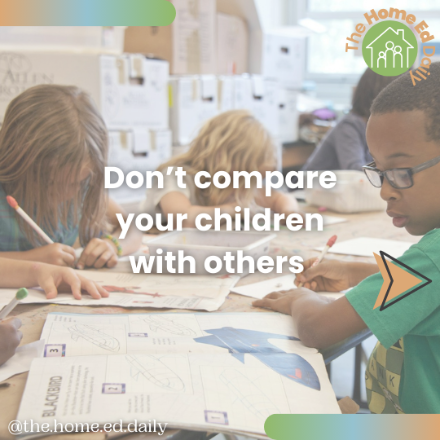
Every child learns differently. Some race ahead in one area and take their time in another. Some need quiet. Some need movement. Some need to talk things through. Some need to disappear into an interest for weeks before anything looks like “learning” from the outside.
Start by noticing your child’s strengths, interests, questions, and natural rhythms. Build from there. Try not to panic if they seem to be learning at a different pace from someone else’s child, or from where they “would be” in school. Home education does not need to follow the same shape as school. It is not a race through a fixed curriculum. It is a different way of learning.
There will be days when it feels overwhelming. That’s normal. But children are not falling behind just because they are not following the same path. Learning is lifelong. You have time to find what works.

Don’t feel you have to justify yourself to other people
People will ask questions. Some will be curious. Some will be worried. Many will ask about socialisation...
It can help to have a few calm responses ready, then move on. You do not need to explain every detail of your decision, your child’s learning, or your family life to people who are not genuinely listening. Before offering information, ask yourself whether this person’s opinion really matters to you. Are they asking with care, or are they asking to challenge, judge, or make themselves feel better?
There is more than one way to educate a child. Home education does not need to look like school, and it does not need to make sense to everyone else. You know your child. You know your reasons. That is enough.
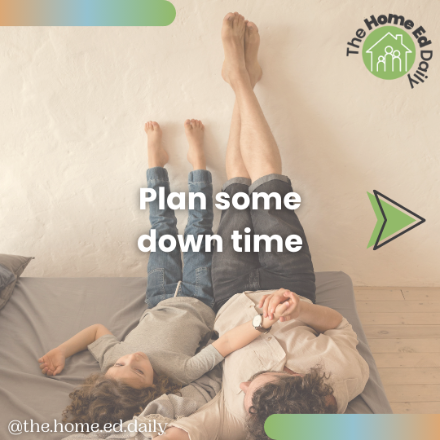
Plan some down time
It’s very tempting to fill every day with groups, trips, classes, activities, worksheets, projects, and plans. But home education is not something that only happens between 9am and 3pm. It is woven through ordinary life. You do not need to do all the things every day.
Children learn a huge amount through the time you spend together. Board games, documentaries, cooking, food shopping, walking the dog, gardening, chatting in the car, helping with household jobs. These things all count. They build skills, knowledge, confidence, independence, and connection. An “uneventful” day at home can still be full of learning. It might include maths, reading, problem solving, life skills, conversation, planning, patience, and creativity, without looking like a formal lesson at all.
Leave space in your week. Plan quiet days. Protect time to rest, potter, follow interests, or do very little. You and your children will need breathing room. Home ed works better when nobody is running on fumes.
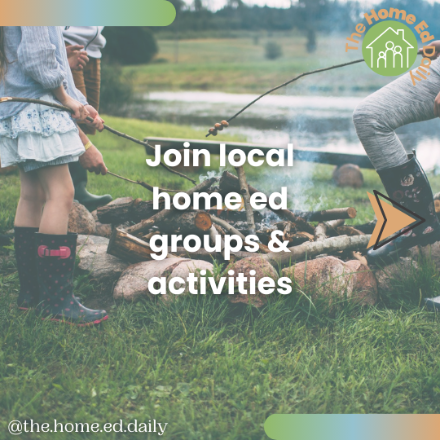
Join local home ed groups & activities.
Local and online home education communities can be a huge source of support, especially when you are just starting out. They can help you find meet-ups, activities, groups, tutors, resources, and other families who understand what this life actually looks like.
Facebook is often the easiest place to find local home education groups. Search for your county, town, or nearby area with “home education” and see what comes up. At the beginning, it can help to try a few different things. Go to a meet-up. Visit a group. Try a workshop or activity your child is curious about. You do not have to keep going to everything. The aim is simply to get a feel for what is available, what suits your child, and where you feel comfortable.
It can take time to find your people. Some groups will be a good fit. Some won’t. That’s normal. Talk to experienced home educators when you can. They are often full of practical wisdom, reassurance, and the kind of calm advice that only comes from having lived through the wobbly early days themselves. You do not have to do home education alone. A few connections can make the whole thing feel steadier.
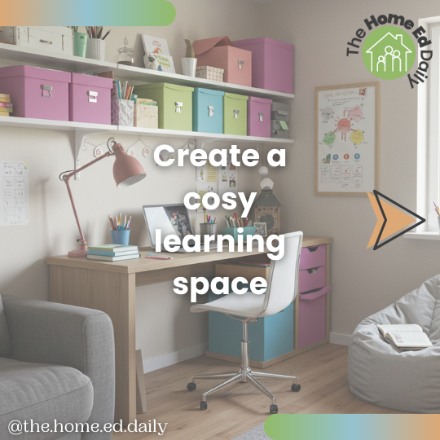
Create a cosy learning space
If you can, set up a small area for focused learning and creative work. It does not need to look like a perfect Instagram home ed post. Most real homes are working homes, not display shelves with matching baskets. A learning space can simply be a corner of the living room, a desk, a trolley of supplies, a shelf of useful books, or a clear place at the dining table. The point is to make everyday learning easier, not to recreate a classroom at home.
Having a familiar place for writing, projects, reading, online lessons, or art can help some children settle and focus. It can also make it easier to keep pens, paper, books, chargers, craft materials, and current projects within reach. But home education does not have to stay in one place. In many homes, it spreads everywhere. Reading on the sofa, science in the kitchen, maths at the table, documentaries in the living room, nature study outside, big conversations in the car.
Use the space you have. For us, that means a corner in the living room with the PC, and the dining table for most other things. It is not polished, but it works. A good learning space is not about how it looks. It is about whether it helps your family use the day well.
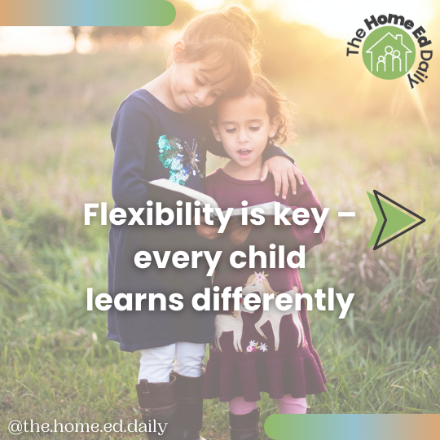
Flexibility is key, every child learns differently
There is no single right way to home educate. It looks different in every family, and it will often change over time as your child grows, your circumstances shift, and you learn what works. One of the biggest strengths of home ed is that you can adapt. If something is not working, you can pause, change direction, try a different approach, or leave it for a while. You are not tied to one method, timetable, curriculum, or way of measuring progress.
Children learn through daily life, play, conversation, projects, practical tasks, books, videos, visits, nature, hobbies, and deep dives into the things that capture their interest. Some families use structure. Some are more child-led. Many move between different approaches depending on the season they are in. If your child becomes fascinated by a topic, follow it. Go deeper. Let it branch into books, documentaries, experiments, trips, art, writing, maths, history, or whatever naturally grows from it.
Home ed does not need to be one-size-fits-all. It can be shaped around the child in front of you, and that is one of its greatest strengths.

Celebrate wins, big or small
Notice the progress. Not just the obvious milestones, but the quiet ones too. Finishing a book. Trying something tricky. Asking a thoughtful question. Sticking with a project. Managing a hard day better than last time. Making a connection between two ideas. Finally understanding something that used to feel impossible.
These moments matter. Celebrating them helps children feel seen, capable, and motivated to keep going. It does not have to be elaborate. In our house, ice cream, plushies, and Minecoins for Minecraft have all worked very well as little rewards. Sometimes a proper “I saw how hard you worked on that” means just as much.
Home education can make progress easier to notice because you are there for the tiny steps, not just the finished result. Mark them. Enjoy them. Let your child know their effort counts.

Make hay while the sun shines
One of the quiet joys of home education is being able to go places when everyone else is at school. Museums, beaches, woods, National Trust places, libraries, cafés, swimming pools, parks, castles, soft play, exhibitions. They are often quieter, easier to park near, cheaper off peak, and far less queue-heavy. Hurrah for the small victories.
And if the weather is glorious, whatever glorious means that day, change the plan. Sunshine, snow, crisp autumn air, a sudden break in the rain. The worksheet, project, or “learny” thing you had planned can usually wait. Go outside. Follow the day while it is offering you something good. Good outdoor clothing makes this much easier. Waterproofs are essential here on rainy Dartmoor! Being warm, dry, and vaguely prepared can turn a possible disaster into a perfectly decent adventure.
I also recommend keeping a family “go bag” in the car. Ours is less a glamorous spy kit, more a survival pile for unpredictable British weather, but it works. Wellies, flip flops, waterproof trousers, raincoats, a picnic blanket, camping stools, an umbrella, sun hats, sun cream, warm gloves, beanie hats, first aid bits, snacks, wipes, and anything else that stops a spontaneous trip becoming a logistical swamp. Some things double up, like our changing robes - a warm waterproof coat, and an impromtu swim robe/towel.
Home education gives you the freedom to use the good days when they come. Take the quiet museum. Take the empty beach. Take the sudden snow. The learning will still be there when you get back.
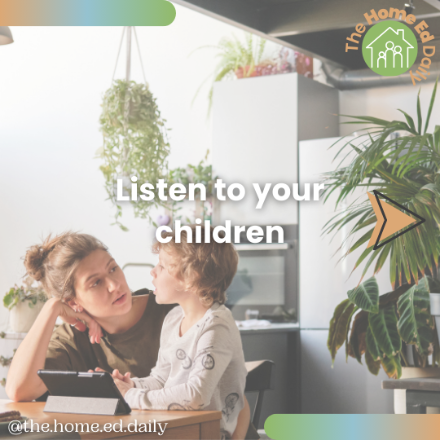
Listen to your children
At the beginning, home education can feel daunting. It is very normal to want structure, boundaries, plans, and some kind of proof that you are “doing it properly”. But try to leave room to listen.
Your child will show you a lot when you stop trying to force everything into a fixed shape. You begin to notice what lights them up, what frustrates them, how they think, what they return to, and where their natural strengths are. Home ed gives children space to follow their own paths. That does not mean they are left to work everything out alone. It means we guide, support, offer ideas, open doors, and help them build a life and education that actually fits who they are.
It is their education. Their childhood. Their future. One of the unexpected gifts of home education is how much you learn alongside them. I have explored subjects, places, skills, conversations, and whole ways of seeing the world that I might never have discovered if my children had been in school all day. Listen closely. Their interests are not a distraction from learning. Very often, they are the way in.
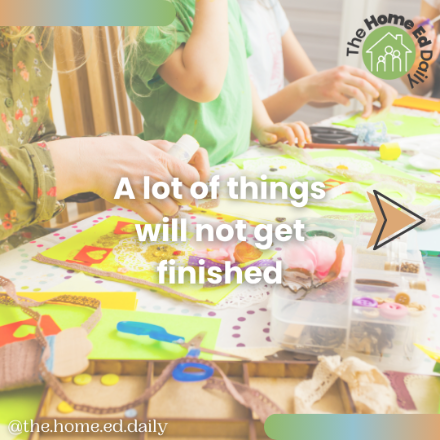
A lot of things will not get finished
Lower your expectations a little. Not in a gloomy way, but in a realistic, sanity-saving way.
Workbooks may be half completed. Projects may start with great enthusiasm and then quietly disappear under a pile of paper. A topic your child loved last week may suddenly lose its sparkle. That is normal. Of course, it would be lovely to finish every book, project, course, and activity neatly. But sometimes pushing through just for the sake of finishing wastes energy that could be better spent elsewhere.
If something has served its purpose, let it go. If your child has lost interest, pause. If a resource is causing more resistance than learning, move on. Completion is not always the goal. Sometimes the value was in the exploring, the conversation, the attempt, or the spark it created along the way.
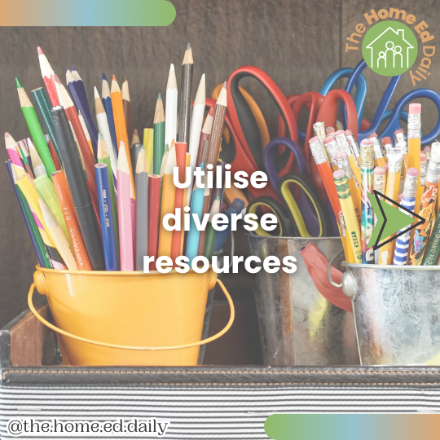
Utilise diverse resources
There are so many useful resources for home education, and they do not all need to be expensive or formal.
Online courses, documentaries, educational apps, museums, libraries, podcasts, audiobooks, nature reserves, local history sites, workshops, board games, maps, recipes, tools, conversations, and everyday life can all become part of your child’s learning.
Do get a library card. Libraries are brilliant for home educators. You can borrow books, order titles in, use reference sections, join activities, and often access free digital resources too.
It is also worth keeping basic supplies at home if you can. Pens, paper, notebooks, art materials, craft bits, glue, scissors, paints, card, and a few practical tools can make it much easier to follow an idea when it appears.
Charity shops are often treasure caves for home ed. You can find books, puzzles, games, science kits, craft supplies, DVDs, maps, and odd little things that suddenly become useful for a project.
Choose resources around your child’s interests, needs, and learning style. Think beyond workbooks and screens. The best resource is often the one your child actually wants to use.

Home education laws
Take time to understand your rights and responsibilities. In England, parents have a legal duty to ensure their child receives an efficient, full-time education suitable to their age, ability, aptitude, and any special educational needs they may have. This can be done by regular attendance at school or “otherwise”, which includes home education.
There is considerable freedom in how that education is provided. It does not have to look like school, follow the National Curriculum, keep school hours, or be delivered through formal lessons.
It is also worth learning how your own local authority approaches elective home education. Local home education Facebook groups can be useful for this, especially for hearing how families in your area usually communicate with the LA and what to expect.
Use reliable sources, not panic posts or rumours. Educational Freedom has helpful information, and it is also worth reading the Department for Education guidance and the Education Act itself so you know what the law actually says.
A little knowledge can make the early days feel much steadier. You do not need to become a legal expert, but you do need to know the basics.
The Children’s Wellbeing and Schools Act 2026 has introduced changes affecting home education in England and Wales, so it is worth reading a clear update on what has changed, what has not, and what families need to know next.
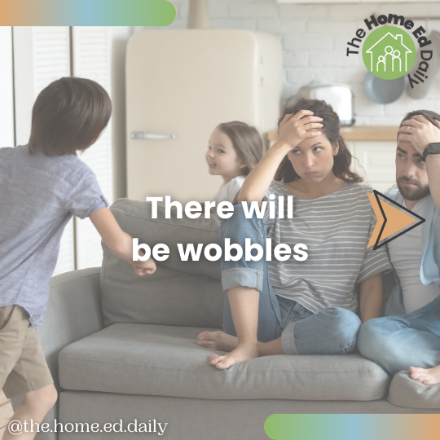
There will be wobbles
There will be days when you think, “I can’t do this.” There will be tired days, burnt-out days, messy days, and days when everyone seems to have forgotten how to cooperate with basic reality. That does not mean home education is going wrong. It means you are human.
Parents worry. We worry when our children are in school, and we worry when they are not. I had older children who went to school, and I still had all the same fears about whether I was doing enough, making the right choices, and giving them what they needed.
Home education can bring extra pressure because it sits alongside ordinary life. Work, family, money, housework, appointments, relationships, and everything else still has to be juggled. Some days will feel heavy. On those days, come back to trust. Trust yourself. Trust your child. Trust that learning is not only happening when everything looks neat, planned, and productive.
One of the best pieces of advice I was given was that it is almost impossible for a child not to be learning something. Learning happens everywhere. Through play, conversation, frustration, rest, helping out, asking questions, watching, trying again, and living alongside you. A wobble is not a sign that you have failed. It is just a moment to pause, breathe, lower the bar, and begin again.
Read our 'Getting Started' and 'Pros and Cons' articles too.