

I’m Home Educated by M. Hickman: book review
I’m Home Educated by M. Hickman: a picture book celebrating everyday learning
💚 Gifted review: This book was gifted to The Home Ed Daily for consideration. No payment was received for this review and, as always, all opinions are my own.
There are countless children’s books about starting school. Going back to school. School friends. School trips. School worries. School uniforms. There are rather fewer books in which a child can simply say, “I’m home educated”, and have that treated as a perfectly ordinary part of their life.
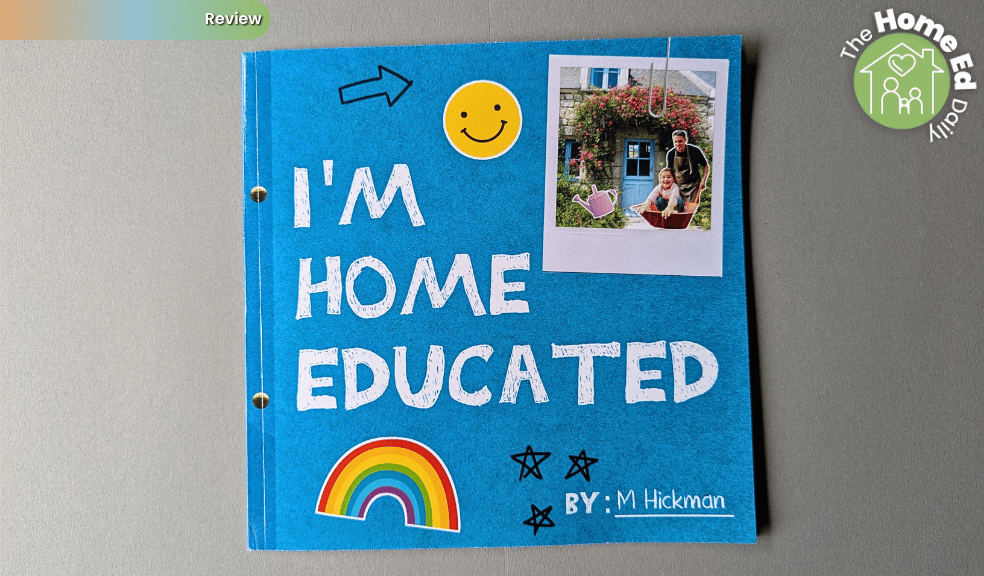
So I was genuinely pleased to receive a copy of I’m Home Educated by M. Hickman. It’s a small, square picture book about what home education can look like, told from the child’s point of view. And although my own children are well beyond the age it is aimed at now, I found myself thinking how lovely it would have been to have more books like this around when they were younger.
“No school today?”
The book begins with a question most long-term home educating families will probably recognise: “No school today?”
From there, it gently explains that not going to school doesn’t mean not learning. Instead, learning appears throughout ordinary family life. There are libraries and shops, cooking and games, old buildings and family stories, maps and road signs, art, music, technology, weather, nature, magnets, bicycles and the changing shape of the moon.
Reading isn’t confined to a reading lesson. It happens through books, audiobooks, toy instructions, menus, labels and posters.
Maths turns up when telling the time, counting money, measuring ingredients and playing games.
Writing has a purpose too, through birthday cards, emails, shopping lists and party invitations.
Science begins with questions about bicycles, microwaves and why our hearts beat faster when we run.
That really resonated with me. One of the things home education taught me over the years is just how much learning becomes visible once you stop looking for it only in things labelled as “education”.
A very different picture of learning
This isn’t a book about recreating school at home. There are no miniature desks or carefully arranged timetables here. Instead, it talks about curiosity, family life, exploring outside, resting when needed, spending time with friends, talking to people in the community and having the freedom for days to look different from one another. It reflects something I’ve written about before: the freedom of home education. Learning can be woven through ordinary family life, interests, play, conversations and the things we do every day.
One page says: “Our daily rhythm can be slow and simple, or we are free to run, jump, dance, swim, and scoot.” Another talks about deciding whether you need time alone or would like to see friends. I particularly liked that part of the book because home ed is so often described solely in terms of what children are “doing academically”. Yet having some control over the rhythm of your day can be just as significant.
Obviously, not every home educating family has complete freedom over sleep, meals or daily routines. Parents work. Appointments happen. Siblings need to be in different places. Some children actively prefer quite a lot of structure. The book presents an intentionally warm and positive version of home education rather than trying to document every possible family experience. I don’t think that is a problem, as long as it is understood as a celebration rather than a template for what home education is supposed to look like.
There really isn’t one version of home education.
I loved the way it talks about socialisation
Another section I particularly enjoyed looks at the people children meet in everyday life: “We speak to librarians, shopkeepers, doctors, dentists, postal workers, mechanics, hairdressers, waiters, and taxi drivers.” I also liked the broader picture of how home educated children socialise, through friends and groups but also through ordinary interactions with people of different ages in the wider community.
It goes on to talk about meeting people of different ages, backgrounds and cultures, as well as making friends through groups and activities.
That feels much truer to my experience of home ed than the perennial assumption that socialisation means putting thirty same-aged children together in a room. Home educated children can have friends, of course, but they also spend an unusual amount of time out in the wider world. They talk to adults. They meet younger and older children. They become familiar faces in libraries, museums, shops, groups and communities. I liked seeing that broader social world included rather than simply trying to reassure readers that, yes, home educated children have friends.
Why representation matters
For me, though, the most important thing about this book is perhaps even simpler. It gives home educated children the chance to recognise their own lives in a book. Children’s books about home education are still surprisingly rare. I felt much the same when I reviewed The Wonderful World of Ben by Lorraine Blanche, another lovely children’s book showing learning beyond school.
Children’s books help quietly establish what we think of as “normal”. Yet education in children’s fiction and non-fiction is overwhelmingly represented through school. Characters have teachers and classrooms, school friends and assemblies, packed lunches and playgrounds.
For most children, that reflects their life perfectly well. But tens of thousands of children in England are growing up with a different experience of education. Their days might involve a forest group, an online class, a museum, a maths workbook, Minecraft, baking, a home education meet-up, an audiobook in the car, an afternoon spent drawing or an enormous rabbit hole about Roman plumbing that nobody anticipated at breakfast. And their childhood deserves to appear in books too.
Representation doesn’t have to make a grand statement. Sometimes it is simply a child opening a book and seeing a family a little bit like theirs. That is one of the reasons I’m Home Educated feels worthwhile.
This could be particularly reassuring for children who have recently left school and are still adjusting to a different rhythm through deschooling. Home ed can initially feel unusual simply because nearly everything around children assumes school attendance. Having a book that calmly says, essentially, “Some children learn this way too” can help make that new identity feel less strange.
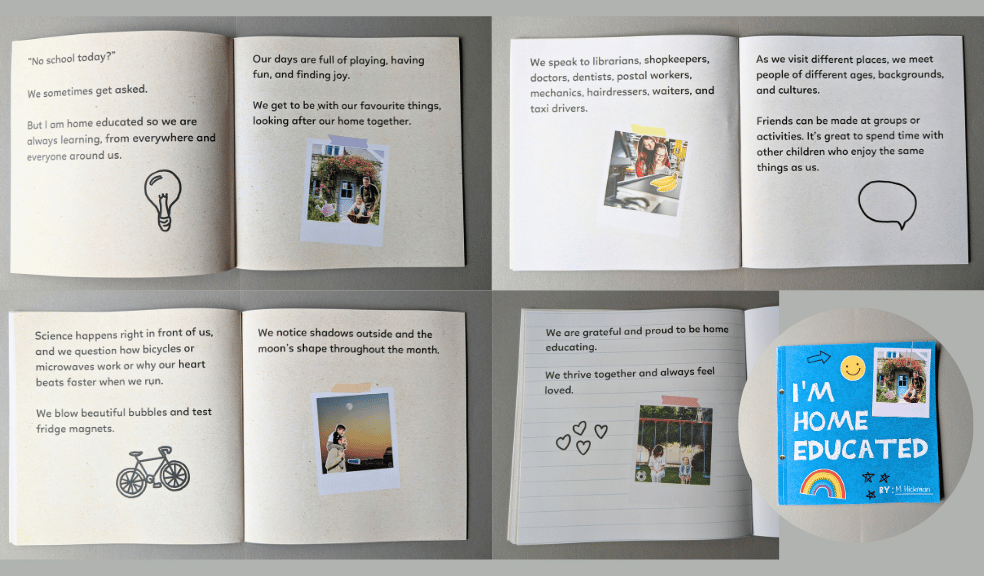
What does the book look like?
The design is very sweet. It uses a scrapbook-style mixture of textured paper, ruled and squared notebook backgrounds, little hand-drawn doodles and photographs that look as though they have been taped into the pages.
There are children cooking, exploring, visiting the library, making music, playing games and spending time with their families. The photographs show different families and children rather than following one single fictional character, which works well with the message that home education can look different for everyone. There is plenty of space around the text and the type is large and clear. Some spreads contain more writing than a typical preschool picture book, so I think younger children would probably enjoy it most as a book shared with an adult rather than something to tackle independently.
Visually, though, it feels relaxed and accessible. Nothing about it resembles a textbook. Thank goodness.
What age is I’m Home Educated suitable for?
I’d see this primarily as a book for younger home educated children, roughly ages 3 to 10, although that isn’t a hard boundary. A three or four-year-old could enjoy looking through it and talking about the pictures with a parent, while an older child might engage more with the ideas about how everyday activities connect with reading, maths, science, history and other areas of learning. Some older primary-aged children may also appreciate simply having their experience recognised, particularly if they have recently moved from school into home education.
My thoughts
There are individual statements that won’t describe every home educating household. Not all children can sleep for as long as they need. Not every day is full of joy. Sometimes home education involves arguments, boring admin, a child refusing to engage with anything except YouTube and a parent wondering whether eating toast counts as a life skill.
Real life gets a bit grubby around the edges. But I don’t think this book needs to contain all of that.
Its job is much simpler. It says that education can happen beyond school, learning can be part of ordinary life, families can find rhythms that work for them, and children who are home educated have a childhood worth celebrating.
My favourite idea in the whole book is probably contained in one early sentence: “Together we grow as we explore outdoors and live our lives.”
Because after years of home education, that feels much closer to the reality than any neat definition I could give. We learnt things. We went places. We met people. We followed strange interests. We changed direction repeatedly. Some things worked and some absolutely did not. And somewhere in amongst all of it, we lived our lives.
I’m Home Educated is a warm little reminder that learning was there all along.