
TurtleTime review: Creating a personalised children's book
TurtleTime review: We turned our own characters into a real storybook
My son has spent years inventing characters, drawing them and developing elaborate imaginary worlds. So when we had the opportunity to turn some of his creations into a proper illustrated storybook, he had some very definite ideas about how it should look. We decided to try TurtleTime, an online platform that uses AI to turn your own stories, characters, photographs and artwork into personalised books. What started as an experiment in creating a fantasy adventure called The Last Shadow became a surprisingly enjoyable creative project, and eventually a beautifully printed hardcover that arrived on our doorstep.
Here's how we got on, what impressed us, and a few things I'd like to see improved.
💚 Gifted review: TurtleTime kindly provided us with a complimentary hardcover book for review. All opinions are our own. If you decide to buy using my link, I may receive a small commission - at no extra cost to you. Thank you!
15% off TurtleTime hardcover books for our readers
TurtleTime has offered The Home Ed Daily readers 15% off printed hardcover books. Simply use the code HOMEEDDAILY15 when ordering. Postage is charged separately at the rate shown during checkout. Visit TurtleTime through our partner page
What is TurtleTime?
TurtleTime is a personalised storybook creator developed by parents Niall and Paula. It's primarily aimed at children aged 0–12, although our experience showed that older children with an interest in storytelling and character design can enjoy it too. You can create a story featuring your child, their family, pets or completely imaginary characters, using photographs, original artwork or written descriptions to guide the illustrations.
There are plenty of starting points, from bedtime stories, fairy tales and animal adventures to superheroes, dinosaurs, space exploration and fantasy. You can also choose from a wide range of illustration styles, including watercolour, classic storybook, cartoons, anime, comic book art and crayon drawings. Once your story has been generated, you can read it on screen, edit the text and illustrations, and decide whether to purchase a digital copy or order a printed book.
What interested me most was the opportunity to create something genuinely personal, rather than simply adding a child's name and photograph to an existing story.
Creating our story: The Last Shadow
I'll admit that my first impression of the TurtleTime website was a little mixed. It's full of very obviously AI-generated imagery, which I initially found rather off-putting, particularly as someone who works in art and design. But once I started creating our own book, I found the experience much more appealing. Being able to upload original artwork, develop our own characters and edit almost every aspect of the story and illustrations made a real difference. Rather than choosing a ready-made personalised book, we were able to create something that genuinely reflected my son's own ideas and imagination. For me, that's where TurtleTime really comes into its own.
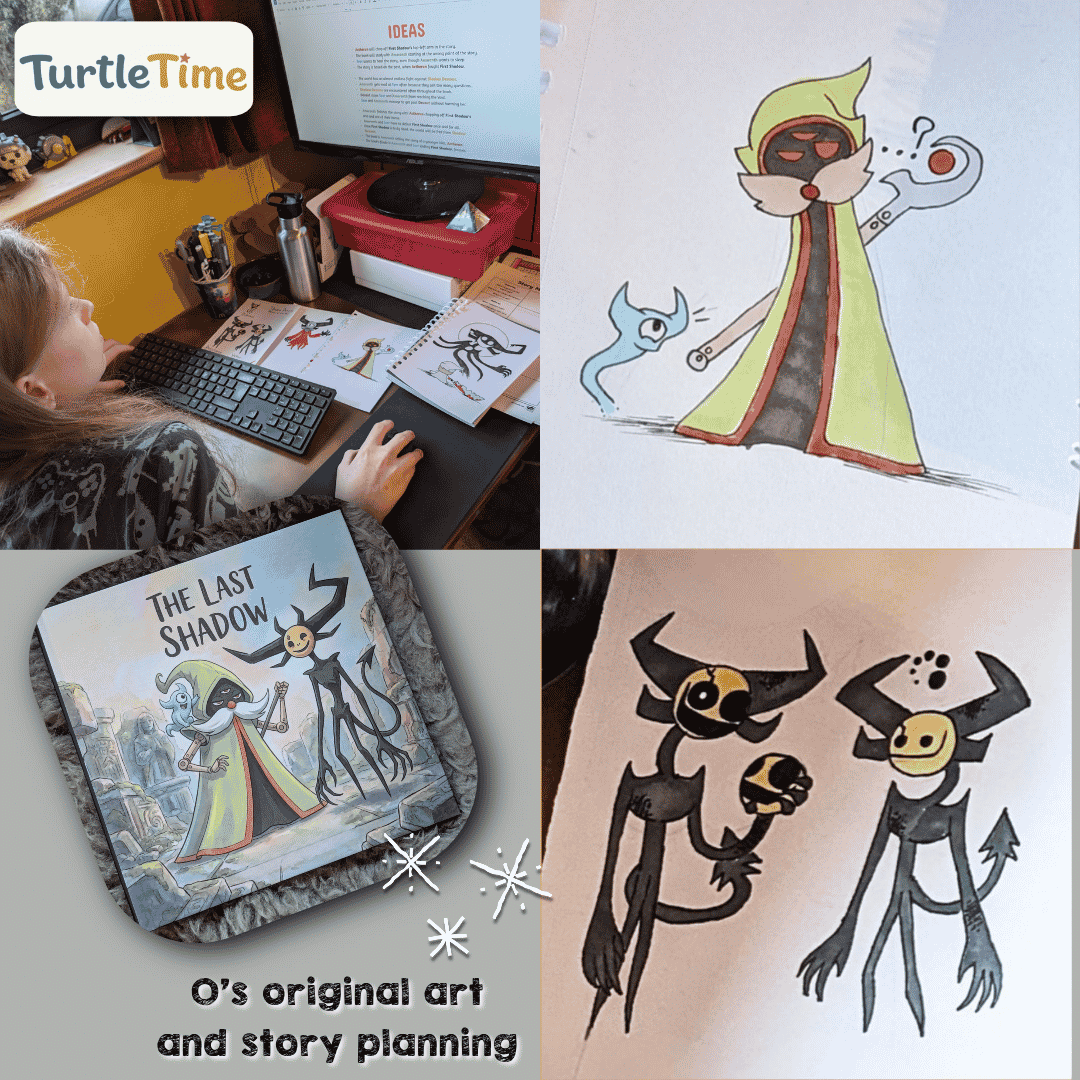
I tested TurtleTime with my son, who enjoys digital art, character creation and inventing fictional worlds. He's probably a little older than the typical TurtleTime customer, but his rather complicated ideas made him an excellent person to put the platform through its paces. We decided to create The Last Shadow, a fantasy adventure featuring characters he'd already designed and developed.
Getting started was straightforward. TurtleTime offers different story and character options, and uploading artwork or a photograph is easy. I particularly liked being able to use my son's original artwork rather than having to upload a photo of a real person. He had some very specific ideas about his characters' appearances, so we spent quite a bit of time refining the written descriptions. Some of his characters are rather unusual fantasy creatures, and getting their features exactly right involved some increasingly detailed prompts.
I would have liked the option to upload multiple reference images for each character, particularly when trying to explain unusual features or show different angles. Instead, we had to rely on written descriptions to communicate the details. To be fair, I suspect most families would be perfectly happy with the initial illustrations. We're probably more particular than average about these things! But my son knew exactly how his characters should look, and we wanted to see how closely TurtleTime could reproduce them. It did remarkably well.
Editing the illustrations and story
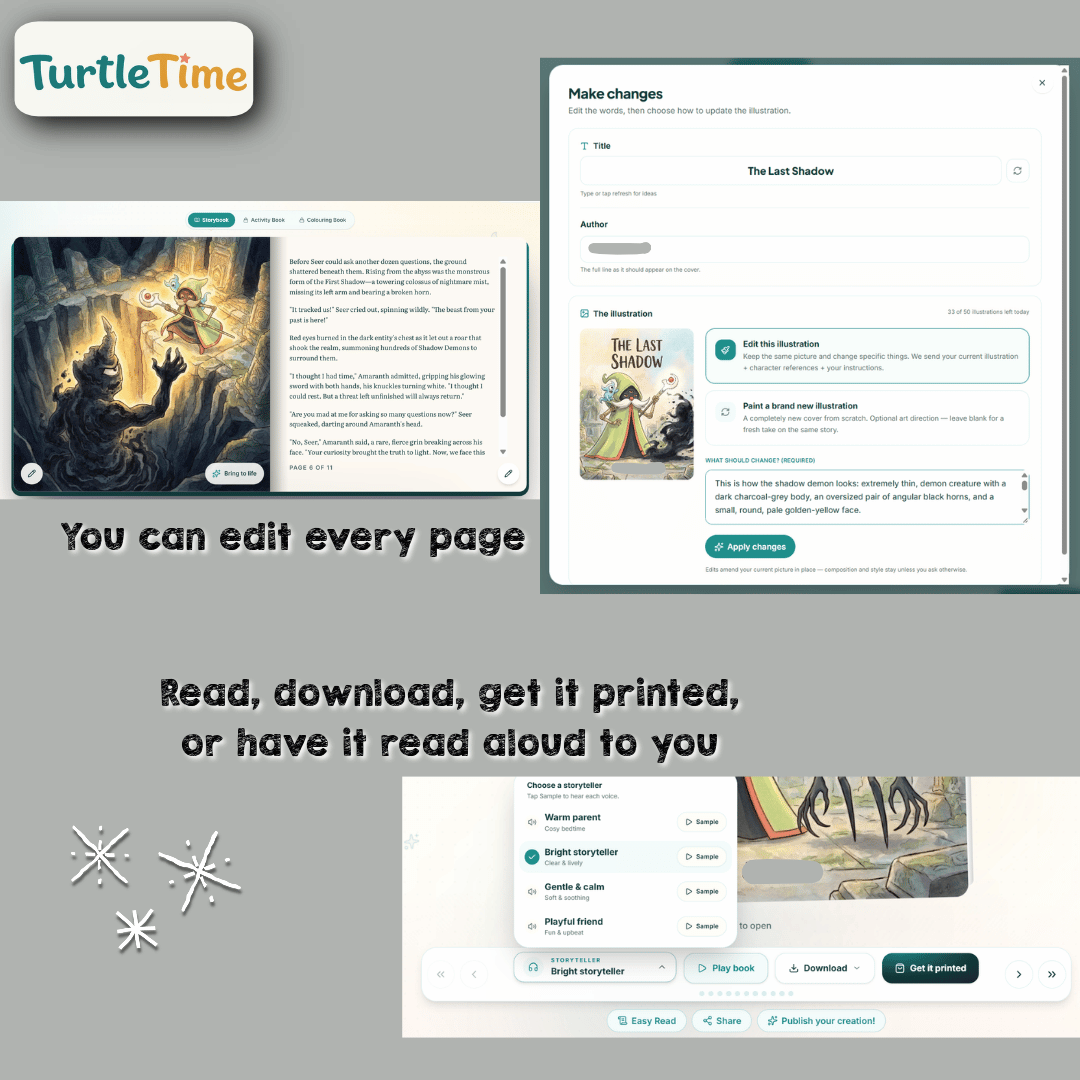
One of TurtleTime's strongest features is the amount of creative control you have once the initial book has been generated.
You can edit the cover, change the text on individual pages and adjust the illustrations throughout the book. When editing an image, you can ask TurtleTime to modify the existing illustration or generate something completely different. This flexibility made a real difference to our experience.
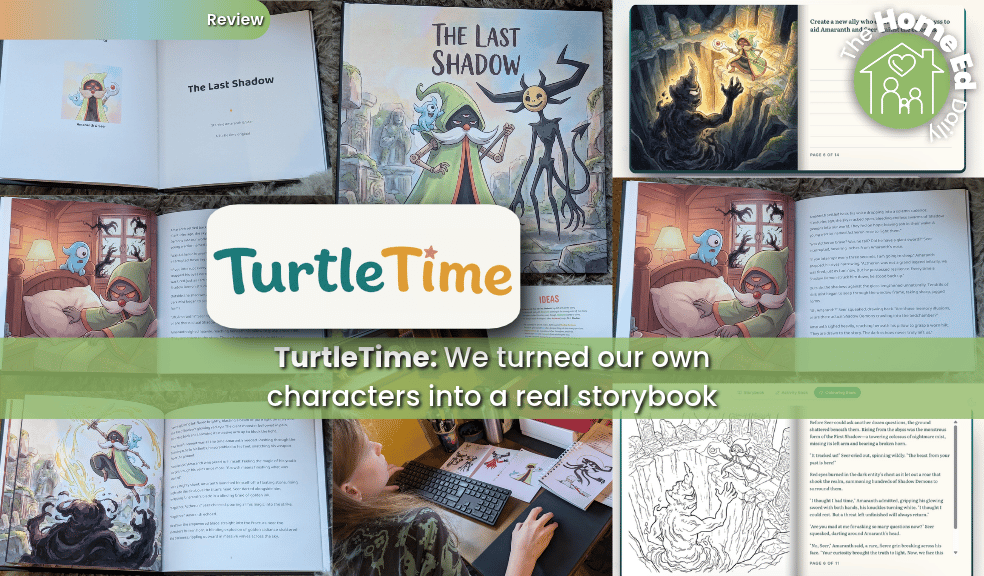
For example, one of my son's characters was an unusual shadow demon with an extremely thin body, enormous angular horns and a small, round face. The first cover illustration showed a rather shapeless black creature, which wasn't quite what he'd imagined. We returned to the editor and described the character much more precisely. The finished cover was completely different and much closer to his original design.
The story itself was also impressive. We'd provided an outline of the plot and characters, and TurtleTime used those ideas to create a well-written fantasy adventure with dialogue, action and character development. It wasn't simply a generic story with our characters dropped into it.
There were a few minor inconsistencies in the illustrations. One character somehow acquired a different number of eyes on a couple of pages! Given that we were creating a fantasy story populated by rather unusual creatures, it wasn't a particularly serious problem. AI-generated illustrations aren't always perfectly consistent, even with detailed instructions, but the ability to edit individual pages helps enormously. One improvement I'd welcome is the option to upload replacement artwork directly into individual pages. That would be particularly useful for children who enjoy drawing their own characters and want to combine their illustrations with the generated images.
My advice would be to read through the entire finished story carefully before ordering a printed copy. AI-generated writing can occasionally contain inconsistencies or awkward phrasing, and illustrations may include unexpected details. TurtleTime gives you the tools to correct these things, but it's worth checking every page before committing to print.
The finished hardcover: Was it worth it?
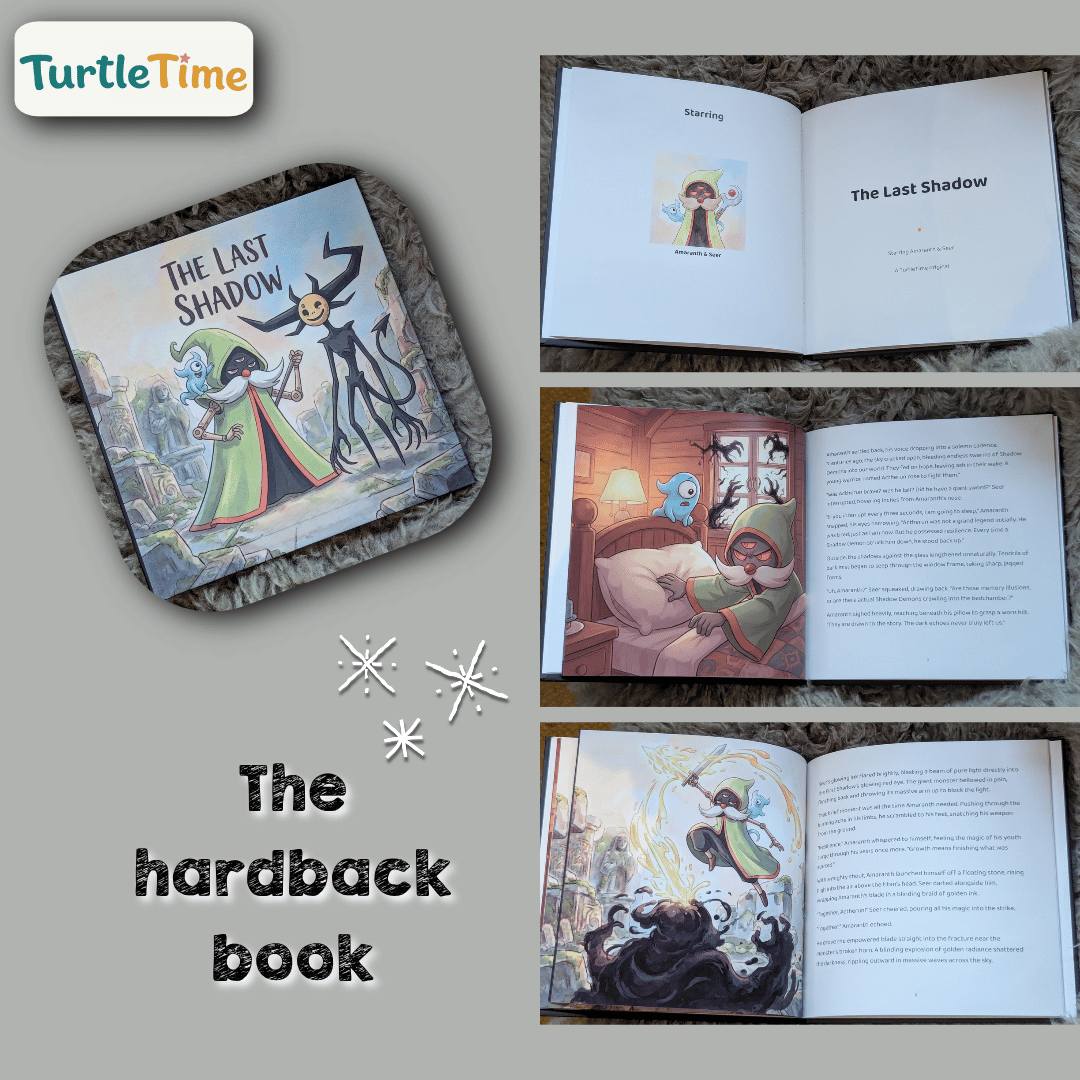
After completing our story, TurtleTime kindly arranged for a complimentary hardcover to be printed and delivered to us in the UK. Delivery was surprisingly quick, and I was genuinely pleased with the finished book.
The hardcover feels sturdy and well made, with a beautifully printed illustrated cover with your child's name as the author (I removed this in our photo for privacy). Inside, the layout is clean and uncluttered, with full-page colour illustrations opposite the story text. The artwork has reproduced very nicely. The colours are slightly softer than on screen, but the illustrations remain clear and detailed, and the overall finish is lovely. Our book includes a title page and character introduction, followed by the story itself. There's plenty of dialogue and quite substantial passages of text, reflecting the more involved adventure we wanted to create. Most importantly, my son was pleased with the result, particularly how closely the characters matched what he'd imagined.
Admittedly, now that he's fifteen, he's also slightly embarrassed at the thought of anyone else seeing his storybook! But I know that if something like TurtleTime had existed when he was younger, he would have absolutely loved it. Being able to take characters he'd drawn and stories he'd invented, and see them transformed into a proper illustrated book, would have been enormously exciting for him. As for the physical book, I think the hardcover represents good value for the quality of the finished product. It's the sort of thing I can easily imagine being given as a birthday or Christmas present, particularly for a child who loves making up stories.
More than just a storybook
One thing I discovered after creating our book was that TurtleTime offers quite a few additional features. As well as the main story, you can generate a companion activity book and colouring book based on the characters and illustrations.
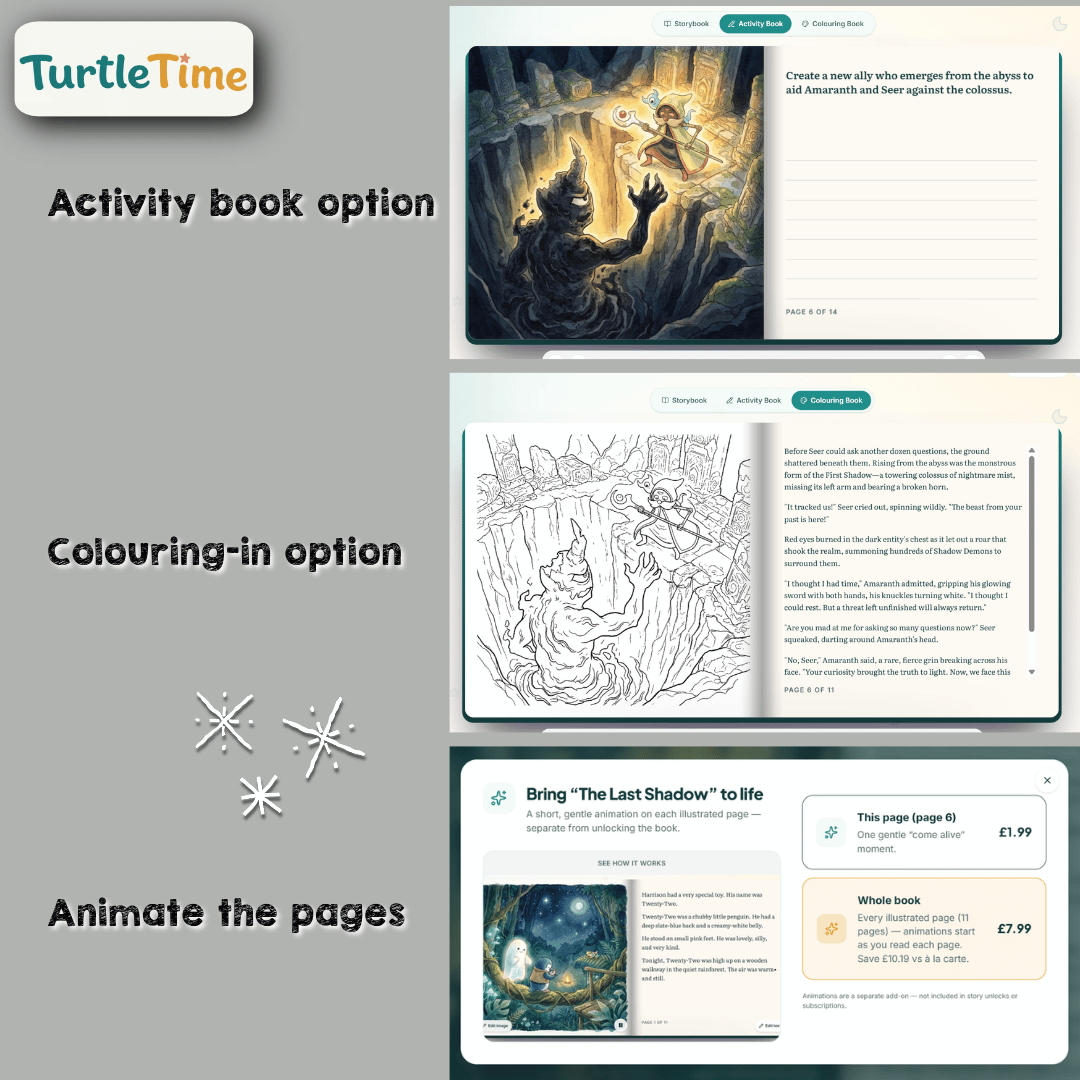
Our activity book included creative prompts inspired by The Last Shadow, such as inventing a new character to join the adventure or imagining what might happen in a sequel. I particularly liked that the activities were connected to our actual story rather than being generic worksheets. The colouring book transforms the illustrations into black-and-white line drawings, giving children another way to enjoy their characters and the scenes they've created.
The digital storybook also has a read-aloud feature, with a choice of different storyteller voices. There's an Easy Read option too, which may be helpful for some readers. Although I explored these features, I haven't tested the narration extensively enough to comment on its quality throughout a complete book.
Another interesting option is the ability to animate individual illustrations, adding movement to the scenes and bringing the story to life. This is a paid extra, with options to animate individual pages or the whole book. I haven't tried the animation myself, but it's certainly an interesting addition. It's worth checking which digital features and companion books are included with your chosen purchase, as some options may involve additional costs.
Could TurtleTime be useful for home ed?
Although TurtleTime is primarily designed for personalised storytelling and keepsake books, there are several reasons it might appeal to home educating families.
The platform offers story themes linked to phonics, reading confidence, maths, science, nature, history, emotions, friendship and problem-solving, alongside the more traditional adventures and fairy tales. I can see the appeal of creating a story around something a child is already interested in. A young dinosaur enthusiast could become the explorer in their own prehistoric adventure, for example, while a child fascinated by space might enjoy imagining themselves travelling to another planet.
The activity and colouring books offer opportunities to extend the experience through drawing, writing and imaginative play. I wouldn't treat the learning themes as a substitute for carefully chosen educational resources, particularly for subjects where factual accuracy matters. But as creative starting points, they offer plenty of possibilities.
What I particularly liked about our experience was the process of developing ideas together. My son had to explain what he wanted, consider the results, identify what wasn't quite right and refine his descriptions. He was very much involved in directing the story and illustrations, rather than simply accepting whatever the website generated.
Of course, children don't need AI to create stories, and I wouldn't suggest that generating a book offers the same experience as writing and illustrating one independently. But for children who have wonderful ideas and enjoy inventing characters and fictional worlds, TurtleTime offers another way to explore their creativity.
A word about AI and creativity
I know that AI-generated content is a divisive subject, particularly among parents, educators, writers and artists. There are legitimate concerns about how generative AI models are trained, the use of existing creative work without permission, their environmental impact, and the effect increasingly automated creativity might have on children.
As someone who works in writing, photography and design, I take those concerns seriously. I think children should have plenty of opportunities to write, draw, imagine and create things for themselves, without technology doing all the work. But I also think there's value in exploring these tools critically rather than dismissing every product that uses them.
What interested me about TurtleTime wasn't the idea of pressing a button and having AI create a generic story. It was the opportunity for my son to take characters he'd drawn, stories he'd imagined and ideas he'd developed himself, and turn them into a physical book. We spent a lot of time directing the creative process, refining illustrations and editing the results. The AI did the generating, but the original characters, ideas and creative direction were his.
That doesn't resolve the wider ethical questions surrounding generative AI, and I wouldn't dismiss anyone who prefers not to use it. Nor do I think AI-generated artwork should replace the work of human writers and illustrators. For us, though, TurtleTime offered an interesting and enjoyable way to bring an imagined story to life. It's possible to appreciate that experience while remaining thoughtful and critical about the technology behind it.
What about privacy and children's photographs?
Whenever a platform involves uploading photographs of children, privacy is an important consideration, particularly when AI is involved. TurtleTime states that uploaded photographs remain private, are never sold or used to train AI models, and can be deleted. The company also says that stories and illustrations are moderated for age-appropriate content, that parents control and approve their creations, and that user data isn't sold to advertisers. These are encouraging commitments, and TurtleTime's founders, Niall and Paula, were happy to answer my questions about how children's photographs are handled.
For parents who would rather not upload photographs of their children, it's possible to create characters using original artwork or written descriptions like we did. I particularly appreciated having that option.
Pricing, subscriptions and UK delivery
One thing worth knowing is that you don't need a subscription to create a TurtleTime book. Parents can create and read their story on screen for free before deciding whether to purchase a digital copy or order a printed hardcover. There are also monthly subscription plans for families who want to create stories regularly, with different story allowances and additional benefits depending on the plan.
TurtleTime ships worldwide, including to the UK. Postage is calculated and displayed at checkout before payment. Our hardcover arrived very quickly, and considering the degree of personalisation and quality of the finished book, I felt it represented good value. I also like that you can see and edit your story before paying. Personalised books aren't always inexpensive, so being able to check the finished result before ordering is reassuring.
Our verdict: Is TurtleTime worth trying?
I went into this review curious about whether a personalised storybook creator could produce something that genuinely reflected a child's own imagination, rather than simply another novelty product with their name added to it. I came away pleasantly surprised.
What impressed me most was how closely the finished book reflected the characters and story my son had imagined. We certainly put some effort into getting the details right, but TurtleTime gave us the flexibility to do that, and the finished hardcover was lovely. It wasn't entirely flawless. Some illustrations contained minor inconsistencies, and I'd welcome more options for uploading multiple reference images and original artwork. But these were relatively small frustrations in an otherwise enjoyable experience.
For younger children who love inventing stories, drawing characters or imagining their own adventures, I think TurtleTime could make a wonderful gift. The additional activity books, colouring pages and digital features also give families plenty to explore beyond the printed story. The use of generative AI won't appeal to everyone, and that's a perfectly reasonable choice. But for families who are comfortable exploring AI-assisted storytelling, TurtleTime offers an accessible and surprisingly flexible creative experience.
And having seen the finished result, I know that a younger version of my son would have been absolutely thrilled to receive a book featuring the characters he'd spent so much time imagining.
15% off TurtleTime hardcover books for our readers
TurtleTime has kindly offered The Home Ed Daily readers 15% off printed hardcover books. Simply use the code HOMEEDDAILY15 when ordering. Postage is charged separately at the rate shown during checkout. Visit TurtleTime through our partner page