





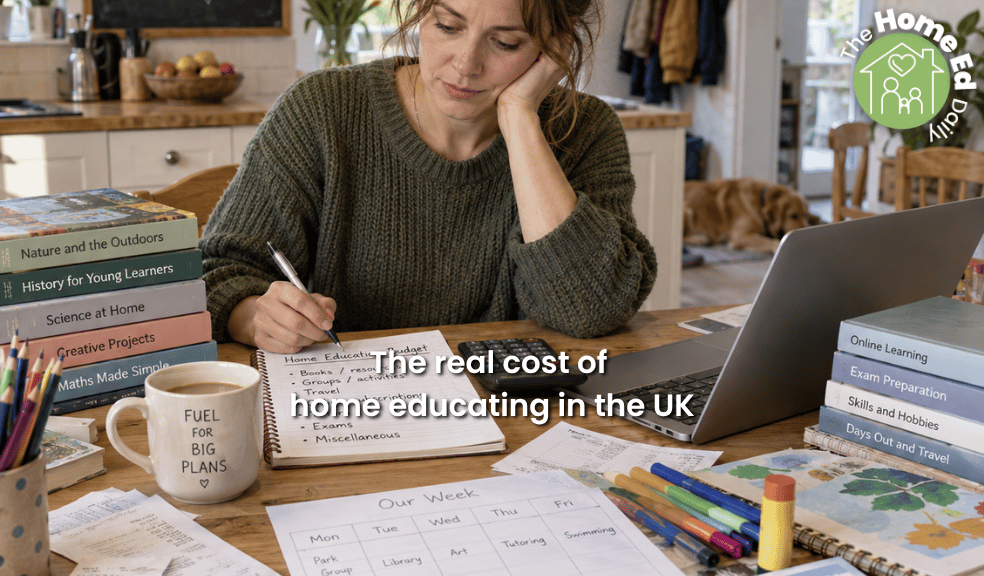
How much does home education cost in the UK? 2026 Guide
The real cost of homeschooling in the UK, from books, groups and days out to tutors, GCSE exams, travel and the income families may give up.
One of the first practical questions families ask about home education is also one of the hardest to answer properly: how much does it actually cost? You will find wildly different answers online. “Almost nothing.” “About £800 a year.” “Thousands.” All of them can be true.
You may have found this article by searching for the cost of homeschooling in the UK, although home education is the usual UK term. Either way, there is no fixed price. What families spend varies enormously depending on age, activities, resources, travel, tuition and qualifications.
A child learning mainly through libraries, free online resources, ordinary family life and a cheap local meet-up might cost surprisingly little to home educate. Another family might be paying for three weekly classes, an online curriculum, private tuition and five GCSE exam entries.
And then there is the cost that rarely appears in the cheerful home education budget spreadsheets at all: someone has to have the time to do it. That may mean reducing work, changing jobs, working evenings, juggling shifts or living on one income.
So rather than pretending there is a neat national average, here is a more useful look at what home education can actually cost in England in 2026.
This article focuses primarily on England. Costs, funding arrangements and support can vary elsewhere in the UK.
The quick answer: how much should you budget for home education?
There is no reliable official figure for the average amount a UK family spends on home education. Current 2026 guides illustrate just how wide the range can be. Some put a low-cost approach at around £0 to £500 a year, others at £300 to £800 or around £20 to £80 a month. Mid-range estimates run anywhere from about £500 to £4,000 annually depending on what is included. Full online schools can cost several thousand pounds a year.
That variation is not necessarily because somebody has got their sums wrong. It is because home education is not one product. There is no standard package you have to buy.
One family may use free resources for almost everything. Another may effectively create a private education package at home using tutors and online teachers. Most families sit somewhere between those two. And your costs are likely to change considerably as your child gets older.
Is home education free in the UK?
No. There are no school fees for elective home education, but parents generally take financial responsibility for providing it. Department for Education guidance says that parents who choose home ed take responsibility for its costs, including external help such as tutors, parent groups and part-time alternative provision. Examination costs are usually the parents' responsibility too, although some colleges, schools or local authorities may provide assistance in particular circumstances.
That means it is worth checking locally rather than assuming help definitely is, or is not, available. The good news is that a suitable education does not require an expensive curriculum. You can spend very little on the actual learning if that suits your child and your approach. The expensive bits tend to creep in around the edges.
Books, workbooks and learning resources
This is often where new home educators expect to spend most of their money. It does not have to be.
Libraries give families access to books, audiobooks and often digital resources. Oak National Academy has free lesson materials covering subjects from Key Stage 1 through to GCSE level, including videos, quizzes and worksheets. There are countless other free educational websites, documentaries, podcasts and publicly available resources too. You can also buy textbooks second-hand and pass resources between families.
Where people can spend a surprising amount is in the enthusiastic first few months. You leave school. You suddenly feel entirely responsible for your child's education. You panic. Three curriculum packages, seventeen workbooks and an educational subscription box arrive before anyone has established whether your child actually likes worksheets.
I would resist that urge. Start small. You can always buy more once you know how your child learns.
For a younger child using plenty of free material, £50 to £200 a year for books, stationery, printing and occasional resources could be perfectly workable. At the other end, a family buying complete curricula, specialist equipment and lots of books could spend hundreds more. Neither approach is inherently more educational.
Home education groups and meet-ups
This is one of those small expenses that does not look like much until you multiply it by forty weeks. Informal home ed groups can be very cheap. Current examples around England include groups charging around £5 per child, while older community meet-ups have charged about £4 per family. More structured home education activities can cost considerably more.
Suppose you attend one £5 meet-up every week for forty weeks. That is £200 a year. Add a sibling and the cost may or may not increase depending on how the group charges. For many families, that is money extremely well spent. Groups provide friendships, community and somewhere to go that does not involve you personally inventing an activity involving vinegar and bicarbonate of soda.
But it belongs in the budget.
Classes, clubs and workshops
This is where costs can begin climbing quite quickly. A weekly sport, science group, forest school, art class or home education workshop might cost anything from a few pounds to £20 or more per session.
For example, a Devon Gymnastics Club currently lists its home education class at £9.99 per session. A 2026 home ed activity day at the Weald & Downland Living Museum cost £15 per child plus £5 for an accompanying adult. Other community activities can sit nearer £5 a session. None of those prices is excessive in isolation. But take just two £10 weekly activities over a 36-week year and you are already at: £720.
Add swimming, music lessons, riding, theatre, climbing, Dungeons & Dragons, martial arts or whatever else your particular child acquires a passionate interest in, and the extracurricular budget can quietly become the main education budget.
The upside is that home education lets you choose. You do not need to provide every possible opportunity at once.
Days out
Museums, galleries, heritage sites, wildlife centres and attractions can be wonderful resources. They can also cost £50 before everyone has got through the entrance gate and requested a snack. Plenty of excellent places are free, particularly national museums and galleries, and local home education groups sometimes arrange discounted group visits. But paid days out add up.
A useful approach is to decide whether your family is more likely to benefit from individual visits or an annual membership. In 2026, English Heritage family membership costs £84 a year for one adult with children or £149 for two adults with children. National Trust family membership is £109.20 for one adult with children or £176.40 for two adults with children. If you visit frequently, that can be considerably cheaper than repeatedly paying admission. If you buy the membership in a burst of January optimism and only visit twice, rather less so.
Travel is one of the sneaky costs
This one deserves far more attention than it usually gets. Home ed groups and activities are not necessarily down the road. The science class may be 25 km away. The teenager's friends may live in three different towns. The exam centre may be over an hour's drive away.
You can easily spend more getting to an activity than you spend on the activity itself. There is fuel, parking, public transport and wear on the car. Rural families can be particularly affected because activities tend to be geographically scattered.
I would therefore keep a separate home education travel budget rather than pretending those journeys somehow disappear into ordinary household motoring. For one family that might be £10 a week. For another it might be £50. Over a year, the difference is enormous.
Memberships and subscriptions
Subscriptions are another modern home ed money leak.
A tenner here.
£7.99 there.
A maths platform.
A language app.
An educational streaming service.
Cloud storage.
A monthly science box.
Something you signed up to six months ago and have just realised nobody has opened since February.
Current home education services range from free platforms through subscriptions costing a few pounds a month to more substantial programmes. Some 2026 estimates put paid online resources at anywhere from under £10 to £60 or more per month depending on the level of teaching and support included.
Two £15 subscriptions cost £360 a year. That might be excellent value if they are used every week. It is less excellent if the login details are now archaeological artefacts. A subscription audit every few months is surprisingly satisfying.
Tutors
You do not have to use tutors to home educate. Plenty of families never do. Others use them selectively, particularly for older children, difficult subjects or exam preparation.
Current UK online GCSE tutors can start at around £26 an hour, with experienced tutors commonly charging considerably more. Current listings include tutors at £36, £50, £69 and above depending on subject and experience. That means one £35 lesson each week for thirty weeks costs roughly: £1,050 a year. Two subjects would double that.
This is why many families use tutors strategically rather than outsourcing every subject. You might teach or facilitate most things yourself but pay someone else for GCSE maths. Or chemistry. Or whatever subject causes both parent and teenager to lose the will to live fastest.
GCSE and IGCSE courses
The teenage years can change the home education budget dramatically. A child who spent years learning through books, projects, documentaries and ordinary life may suddenly need formal exam preparation. Online GCSE and IGCSE courses vary enormously. Some self-paced courses are available for a few hundred pounds per subject. The NEC, for example, currently lists many IGCSE courses at around £470. More intensive taught programmes can run into four figures per subject.
And the course price often does not include sitting the exam. That is the bit families need to check before signing up. Ask:
Does this include tutor support?
Marking?
Mocks?
Coursework support if relevant?
Exam entry?
Access arrangements?
Textbooks?
How long do I have access?
A £200 course and a £600 course may not actually be offering the same thing.
GCSE and IGCSE exam fees
This is one of the biggest unavoidable costs for home educated teenagers who want formal qualifications. Private candidates need to find an exam centre that accepts them, and centres charge both the awarding body's fee and their own administration and invigilation costs. In 2026, £200 to £300 per GCSE or IGCSE subject is a realistic planning figure for many straightforward subjects, but some cost considerably more.
Exam Centre London currently lists November 2026 GCSE Maths and English Language at £250 each. Tutors & Exams' 2025/26 standard fees include many GCSE subjects at £261.60, while some language and specialist subjects are around £490.50. Many International GCSE subjects are listed at £272.50.
Five subjects at £250 each means: £1,250 just to sit the exams. Eight would be £2,000. And that is before courses, textbooks or tuition.
Late booking can increase the bill substantially too. Tutors & Exams, for example, lists a standard £261.60 fee rising to £376.60 at its late-entry rate. So if your teenager is heading towards GCSEs, finding the exam centre early is not merely an administrative nicety. It can save actual money.
The biggest cost may be your income
This is the part I think we need to be much more candid about. Home ed can be done very cheaply if we only count resources. But somebody needs enough time to make family life work. That does not always mean one parent giving up work completely. Families work from home, freelance, share childcare, work shifts, use grandparents, work around teenagers who are increasingly independent, or juggle a frankly ridiculous combination of all of the above. But reducing paid work by even one day a week can dwarf the cost of every workbook you buy.
The National Living Wage for adults aged 21 and over is £12.71 an hour from April 2026. At that rate, cutting one 7.5-hour working day a week for 46 weeks represents roughly £4,385 in gross pay before considering tax, National Insurance, benefits, pension contributions or childcare changes. Two days would be roughly £8,770.
That is only an illustration. Actual household finances are much more complicated. But it shows why a statement such as “home education only costs £500 a year” can be technically possible and still completely miss the point. For some families, time is by far the largest financial cost.
Three realistic home education budgets
These are hypothetical families, not recommended annual spending levels or national averages. They simply show how differently the numbers can work.
Family one: very low-cost home education
One younger child. Parent-led, interest-led approach. Free online resources, library, outdoor learning and one local community meet-up.
Weekly meet-up: £200
Books, stationery and printing: £120
Occasional cheap outings: £100
Local travel and parking: £120
Free online resources and library: £0
Approximate annual spend: £540
They could spend less. They could also easily spend more if transport costs are higher. There is nothing inadequate about this education because it happens to be inexpensive.
Family two: a typical mixed approach
One child attending a weekly home education meet-up and two paid activities, using two online subscriptions, visiting attractions and buying some resources.
Weekly home education meet-up: £200
Two weekly activities: about £648
Two subscriptions: £360
One annual family attraction membership: about £150
Books and resources: £250
Trips and workshops: £300
Travel and parking: £600
Approximate annual spend: £2,500
There is nothing especially lavish here. It is simply what happens when several modest regular costs are added together.
Family three: teenager in an exam year
A home educated teenager taking five qualifications, using a mixture of self-paced courses, one live course and some tutoring.
Two GCSE/IGCSE courses: about £790
One live taught course: about £400
Weekly tutor for 30 weeks: about £1,050
Five private candidate exam entries: about £1,250
Textbooks and revision materials: £150
Exam travel and parking: £250
Social activities and groups: £300
Approximate annual spend: £4,200
And this teenager is not attending a full online school or having tutors for every subject. A family choosing a complete online school could spend considerably more. Current 2026 comparisons put some full-time online schools in the region of £4,000 to £11,000 a year.
None of these figures includes lost earnings. That is why the headline number never tells the whole story.
Does home education get more expensive as children get older?
It often does, although it does not have to. Younger children can learn an enormous amount through ordinary life, books, play, nature, conversation and inexpensive activities. Teenagers may bring:
exam courses
private candidate fees
textbooks
specialist tuition
more expensive activities
travel to exam centres
college preparation
On the other hand, older teenagers may also become far more independent, reducing the amount of direct parental time required. Home education costs do not rise neatly with age. They simply change shape.
Can you genuinely home educate on a small budget?
Yes. But I would rather say that honestly than turn it into another inspirational claim that everything is free if you are sufficiently creative.
Libraries help.
Free resources help.
Second-hand books help.
Free museums, parks, beaches, woods and community events help enormously.
Sharing resources with other families helps.
You can absolutely provide a rich education without spending thousands of pounds. But poverty does not become irrelevant simply because home education is flexible. If you have no car, very little disposable income, several children and limited free activities nearby, your choices may genuinely be narrower. Home education communities can help enormously through resource swaps, informal groups and shared trips, but access varies across the country. It is perfectly reasonable to consider finances when deciding whether home education is workable.
Where I think families waste money
If I could offer one bit of financial advice to somebody beginning home ed, it would be: Do not buy the imaginary version of the child you think you are about to educate. Wait until you meet the home educated version of the actual one.
They may hate the beautiful curriculum.
They may refuse the subscription.
They may learn more from YouTube than the £300 course.
They may love textbooks.
They may suddenly want formal lessons.
You do not know yet. Buy slowly. Borrow when possible. Use free trials. Choose one subscription rather than six. Do not book every weekday because you are frightened they will not socialise. And when something has clearly stopped working, cancel it. The cheapest unused resource is still a waste of money.
So, how much does home education really cost?
For some families, a few hundred pounds a year. For many, perhaps a couple of thousand once regular groups, classes, travel, resources and outings are included. During GCSE years, several thousand pounds can disappear surprisingly quickly. A highly structured online education with extensive tuition can cost considerably more. And for some households, none of those figures comes close to the value of the salary they have reduced or given up.
That is the honest answer. Home education can be inexpensive. It can also be financially difficult. Both things can be true.
What matters is not spending enough to make your home education look impressive. It is understanding what your family actually needs, what you can genuinely afford and where spending money makes life or learning meaningfully better.
Sometimes that will be a tutor.
Sometimes it will be an annual membership.
Sometimes it will be £5 for a home ed group and a flask of coffee.
And sometimes the best educational resource available is still completely free.
Also read: Can you home educate on a budget?
You may also have found this article by searching for the cost of homeschooling in the UK. Although “homeschooling” is commonly used in internet searches, home education is the usual and correct term in the UK, so that’s the wording I prefer to use throughout The Home Ed Daily. Read why: Home education vs homeschooling