








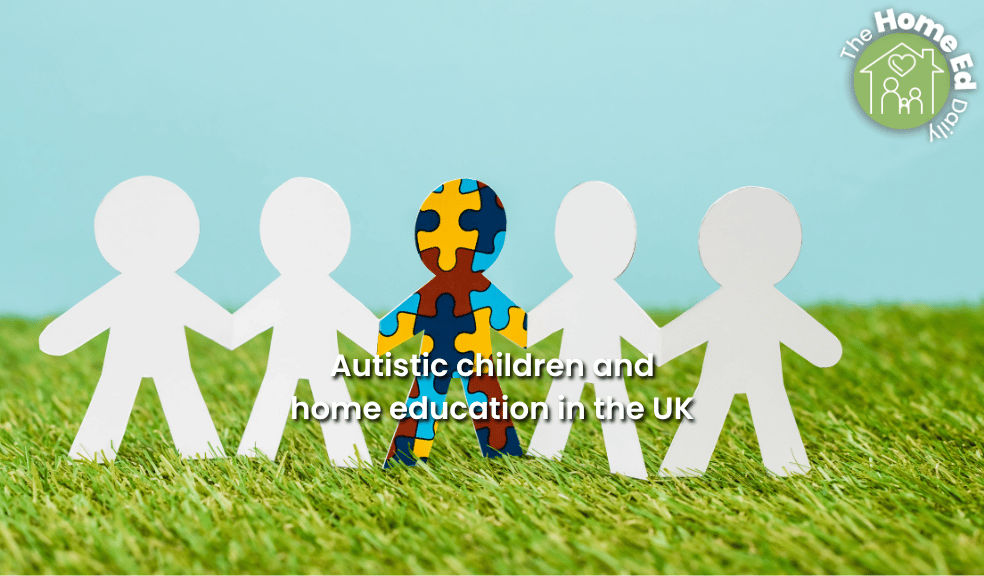
Autistic children and home education: when school stops working
Autistic pupils remain disproportionately absent from school. For some families, home education becomes a positive choice. For others, it can feel like the only workable option left.
For many families with autistic children, home education was never part of the original plan.
They expected their child to go to school. They bought the uniform, packed the lunch, found the book bag and did all the things families are expected to do. Then something began to go wrong.
Perhaps their child became increasingly anxious. Mornings became difficult. Attendance started slipping. They held everything together at school and fell apart when they got home.
Perhaps the sensory environment was overwhelming.
Perhaps reasonable adjustments were promised but never quite materialised.
Perhaps the school genuinely tried, but simply did not have the staffing, resources or flexibility their child needed.
Eventually, some families reach the point where continuing with school is causing more harm than leaving it. And for some of those children, home education changes everything. That does not mean home education is the answer for every autistic child. Nor should families have to take responsibility for education simply because an appropriate school placement or support has not been provided. But the difficulties autistic pupils continue to experience within the school system are hard to ignore.
Autistic pupils are still missing a huge amount of school
When I first wrote this article in 2024, figures published by Ambitious about Autism showed a sharp rise in persistent absence among autistic pupils. The latest figures are even more concerning. Analysis by Ambitious about Autism of Department for Education data for 2024/25 found that 67,298 autistic pupils were persistently absent from school, meaning they missed at least 10% of sessions.
That is around 29% of autistic pupils in schools in England, compared with 18% in 2018/19.
More than 13,000 autistic pupils were severely absent, missing at least half of the school year. The overall absence rate among autistic pupils was 11.1%, compared with 6.78% across pupils generally.
Those numbers matter because persistent absence is sometimes discussed as though the central problem is simply getting children through the school gate. For many autistic children, the more useful question is: Why are they finding it so difficult to be there?
Absence is often a symptom rather than the problem
Ambitious about Autism's 2026 research found that more than a third of autistic pupils surveyed had missed a month or more of school since September. Mental health difficulties were the most commonly reported reason for non-attendance, cited in 62% of cases. One in five were out of school because their school placement was considered unsuitable. That fits a much wider picture.
A busy classroom can involve constant noise, movement, transitions, social demands, uncertainty and sensory input. A child may be academically capable while finding the environment itself exhausting. Some manage to appear fine throughout the school day before becoming distressed or completely depleted at home. Others increasingly struggle to attend. And sometimes what looks from the outside like a child refusing school is a child who has reached the point where they simply cannot keep doing what is being asked of them.
That distinction matters. The answer to a child struggling because their needs are not being met cannot simply be greater pressure to attend the same environment unchanged.
SEND pressures are not a small issue
The number of pupils identified with SEND in England continues to rise. In 2025/26, more than 1.8 million pupils had either SEN support or an Education, Health and Care plan. Around 538,500 pupils had an EHCP, representing 6% of pupils, while 14.8% received SEN support without a plan. Autism remains the most common primary need among pupils with an EHCP. Around one in three pupils with an EHC plan in schools are recorded with autistic spectrum disorder as their primary need.
Those numbers do not mean every autistic child needs a specialist school or that mainstream education cannot work well. Plenty of autistic children are happy and well supported in school. But they do show why conversations about inclusion, school absence and home education cannot treat SEND as a marginal issue affecting a tiny group of families.
What do we actually know about autistic children and home education?
We do not currently have reliable national statistics showing how many home educated children in England are autistic. The Department for Education's elective home education collection records whether a child is known to have SEN support or an EHCP, but it does not publish a national breakdown of home educated children by individual diagnosis or primary SEND need. So claims that there has been a particular percentage increase in autistic children being home educated should be treated cautiously unless they are based on clearly defined local data or research. What the national figures do tell us is still significant.
In autumn 2025, local authorities knew of 126,000 children being electively home educated in England, up from 111,700 the previous autumn. Across the whole 2024/25 academic year, 175,900 children were recorded as being home educated at some point. Among children recorded as home educated on the autumn 2025 census date, 16% were known to have SEN support and 7% had an EHCP. That compares with 14% and 5% respectively in the overall school population used for comparison. Mental health was also the single most commonly recorded reason for home education, accounting for 16% of cases. School dissatisfaction connected with SEND accounted for around 4%.
There are important limitations. Around four in ten recorded reasons fell into unknown, no reason provided or other, and one label cannot capture the messy combination of anxiety, SEND, bullying, sensory difficulties and school breakdown that may sit behind a family's decision.
But the figures do support something home educating communities have been saying for years: For a substantial number of families, leaving school is connected to wellbeing and unmet need, not simply an ideological preference for education at home.
Choosing home education and being pushed towards it are not the same thing
This distinction is really important. Some parents actively choose home education because they believe it will suit their autistic child better. They may want greater flexibility, a quieter environment, more individual attention or an education built around their child's interests and ways of learning. That can be an entirely positive decision. Other families describe something very different.
They spend months or years trying to secure appropriate support. Their child becomes increasingly distressed. Attendance collapses. Parents reduce work or leave employment altogether. Eventually, home education becomes the only practical way they can see to protect their child's wellbeing.
Ambitious about Autism's 2025 research found the impact of lost education was not confined to children. Nearly 90% of parents surveyed said it had affected their personal or professional life, more than half had taken significant time off work, and one in ten reported losing a job because of the difficulties their child was experiencing around school.
Calling every one of those situations simply a parental “choice” can hide what happened before it.
Schools should not encourage families to home educate because support is difficult
Home education is a legitimate educational choice. It should not be used as a solution to a school's inability to meet a child's needs. Parents should not be put under pressure to deregister an autistic or SEND child because attendance has become difficult, because the school cannot provide support or because exclusion appears likely.
Current local authority guidance also makes this distinction clear. Parents can elect to home educate a child with SEND, including a child with an EHCP, but they should not be pressured by a school into doing so. This is sometimes described as off-rolling when a school's actions improperly encourage removal from the school roll in its own interests rather than the child's. If home education is being suggested by the school rather than initiated by the family, I would always get independent SEND or home education advice before agreeing to deregister.
Once a child becomes electively home educated, responsibility for providing their education generally shifts to the parents. That is a very significant decision and families deserve to make it with accurate information rather than while under pressure.
Why can home education work well for some autistic children?
The greatest advantage is probably flexibility. Home education can remove many things that have nothing to do with a child's ability to learn but may have made learning at school extremely difficult.
There does not have to be a noisy classroom.
A child can move when they need to.
They can eat when they are hungry.
They can work in comfortable clothes.
Lessons can be short.
A difficult day can become a quiet day without everything being treated as an attendance problem.
A child who needs longer to process a question can have longer.
Someone deeply interested in one subject can spend hours following it rather than stopping because the timetable says the class must move on. Learning can happen through books, documentaries, gaming, practical activities, conversation, online courses, museums, art, walks, projects or formal study. And crucially, the child does not have to expend huge amounts of energy simply coping with an environment before they can begin learning within it.
For a child who has spent months or years overwhelmed, that can be transformative.
Home education does not magically remove every difficulty
It is important not to romanticise this either. An autistic child remains autistic when they come home. Their needs do not disappear because school does. They may still struggle with anxiety, executive functioning, transitions, demand avoidance, sleep, sensory needs or social situations.
Some children require a great deal of parental support.
Finding suitable friendships can take work.
Specialist activities and tutors cost money.
Parents may reduce their employment.
And if a child has become deeply distressed before leaving school, recovery may take considerable time. Home education can remove an unsuitable environment. That is not the same thing as instantly undoing everything that happened within it.
The first priority may be recovery
Families sometimes leave school after a long period of anxiety and immediately panic about lost learning.
What curriculum should we buy?
How many hours should we do?
Are they behind?
Should we start maths on Monday?
For a child who has been overwhelmed for months, those may not be the most urgent questions.
They may need sleep.
Predictability.
Time at home.
Fewer demands.
Activities that feel safe.
The chance to rediscover interests that disappeared while all their energy was being spent coping with school. Home educators often call this period deschooling. That does not mean abandoning education indefinitely. It means recognising that a child who is exhausted or frightened may need some breathing room before you can discover what learning looks like outside school.
Autistic learning does not have one particular shape
There is a danger in moving from one rigid assumption to another. Not every autistic child wants completely autonomous education. Some love routine. Some want worksheets. Some thrive with online lessons. Some need a very clear timetable. Others recoil from anything that resembles school.
A child may need predictability but not rigidity. They may be capable of extraordinary concentration on one subject and struggle to begin another. They might communicate far more confidently through writing than speech. They may need an adult nearby even when they understand the work perfectly. The useful question is not: What is the best way to home educate an autistic child?
It is: What helps this particular child learn without constantly overwhelming them?
That answer can change with age too.
Home education should not have to compensate for a broken system
I remain concerned that conversations about rising home education numbers sometimes begin in the wrong place. The question becomes: Why are these families leaving school? as though the family itself is the unusual thing requiring explanation. We should also be asking: What happened before they left?
Why are almost three in ten autistic pupils persistently absent?
Why are more than 13,000 missing at least half of their education?
Why do families describe waiting for appropriate support while their children's wellbeing deteriorates?
And why do some parents reach home education feeling less that they freely chose it and more that every other option disappeared?
The answer cannot be to make home education harder in order to discourage families from leaving. Nor should it be to present home education as a cure for an education system struggling to meet SEND needs. Autistic children deserve suitable education whichever setting they are in. For some, that will be a mainstream school with appropriate support. For others, specialist provision. Some may need Education Otherwise Than at School arranged by their local authority. And for some families, elective home education will genuinely provide the flexibility, safety and individual approach their child needs.
Those are different routes, with different legal and practical implications.
The child matters more than the setting
Home education can give an autistic child something school sometimes struggles to provide: an environment built around them rather than one they must constantly adapt themselves to survive. For some children, that means curiosity returns.
They begin sleeping again.
They talk more.
They rediscover interests.
Learning becomes possible because so much energy is no longer being spent simply getting through the day. For other autistic children, school is where they want to be and the right support can allow them to thrive there. There should be room for both truths.
The problem is not that autistic children are somehow incompatible with school. Nor is home education automatically better because it happens outside it. The problem comes when the needs of the individual child disappear behind attendance statistics, systems and assumptions about what education is supposed to look like.
Whatever setting a child learns in, they deserve something more basic than that. They deserve an education they can actually access.