







What can home educated teenagers do after 16? UK guide
College, apprenticeships, qualifications and other routes. A practical guide to post-16 options for home educated teenagers in England, including college, A levels, vocational courses, apprenticeships, Functional Skills, work and continuing home education.
One of the worries that creeps in as home educated children become teenagers is what happens at 16.
When they are eight or nine, it is relatively easy to say that children do not all need to follow the same educational path. By fourteen or fifteen, the rest of the world suddenly seems to be talking about GCSEs, sixth form applications, college courses and careers. And if your teenager does not have the tidy collection of GCSEs that schools generally expect pupils to leave Year 11 with, it can feel as though doors are already closing. They aren’t.
Qualifications matter for some routes. Entry requirements matter. It is worth planning ahead, particularly if your teenager has a fairly clear idea of what they might want to do. But reaching 16 without five GCSEs at grade 4 or above does not mean reaching the end of the road.
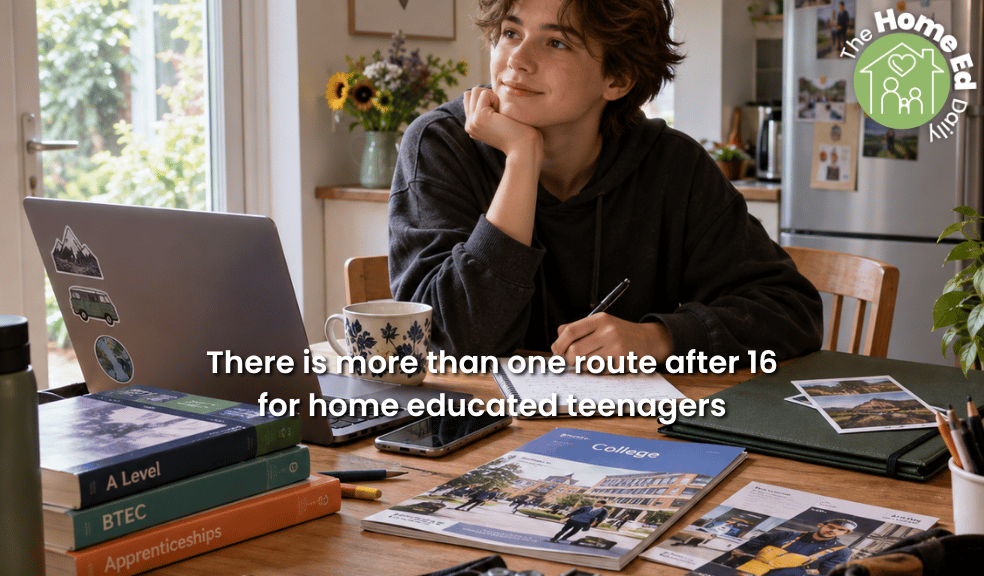
Home educated teenagers can go to college, take A levels or vocational qualifications, continue home education, work towards GCSEs or Functional Skills later, start an apprenticeship, work alongside training, volunteer, build a portfolio or take a slower route towards the qualification or career they eventually want.
The important thing is to understand the options rather than assuming there is only one acceptable route through them.
This article focuses on England. Post-16 education, funding and participation rules differ elsewhere in the UK.
What changes at 16?
First, there are two different ages that are easily muddled together.
Compulsory school age ends in the academic year in which a young person turns 16. In England, however, young people are expected to continue participating in education or training until they are 18.
That does not mean staying at school. The recognised routes include full-time education at school, college or through home education, an apprenticeship, or working, self-employment or volunteering for at least 20 hours a week alongside part-time education or training.
So a home educated sixteen-year-old does not suddenly have to enrol at college because they have reached the end of compulsory school age. Continuing home education is still an option.
College is not only for teenagers with eight GCSEs
One of the most persistent worries I hear is that a young person will not be able to go to college unless they have followed something close to the conventional school GCSE route. In reality, colleges offer courses at different levels and set their own admissions criteria. That last bit is important.
There is no universal rule saying, for example, that every sixteen-year-old needs five GCSEs to enter further education. A college might require five GCSEs at grade 4 or above for one Level 3 course, three GCSEs at grade 3 for another, an interview or portfolio for a creative course, or no particular GCSE grades for an introductory programme. And the same course can have different entry requirements at two different colleges.
For A levels and some Level 3 courses, the requirements can be quite high. Five GCSEs at grade 4 or above, including English and maths, is common, with higher grades required in subjects being continued at A level. Some sixth forms ask for considerably more. But vocational courses at Levels 1 and 2, foundation programmes and preparation courses can provide another way in.
This is why it is worth looking at actual local colleges well before your teenager reaches 16. Do not work from what somebody in a Facebook group says their college required three years ago. Look at the current course page, go to an open day and ask the admissions team.
If your child has been home educated, say so. Ask specifically whether they accept alternative evidence of ability where appropriate. Sometimes they will. Sometimes they won’t. It is better to know that at fourteen or fifteen than discover it in the spring of the year they hoped to start.
What if they don’t have five GCSEs?
This is where I think home educating families need more reassurance, but also realistic information. A teenager without five GCSEs is not necessarily shut out of further education. They may simply start somewhere different. Colleges commonly offer Level 1 and Level 2 vocational courses, foundation learning programmes, employability courses and other preparation routes. A student might complete a Level 2 course and then progress to Level 3 the following year. Some practical subjects begin at Level 1 regardless of GCSE results because the student needs to learn the underlying skills first. Courses vary enormously between colleges and regions, but the important thing is that progression does not always look like:
GCSEs → Level 3 → university.
It might look more like:
Level 1 → Level 2 → apprenticeship.
Or:
a preparation year → Level 2 → Level 3.
Or:
another year of home education → two or three GCSEs → college.
Or something else entirely. The lowest-friction route is often the conventional one because admissions systems are designed around it, but there are other routes when a teenager has not collected the expected set of qualifications at 16. That distinction matters. Saying “you don’t need GCSEs” can be misleading, because particular courses and careers absolutely can require them. But saying “without five GCSEs you have no options” is equally misleading.
A levels
Home educated teenagers can take A levels. They can enrol at a sixth form or further education college, or continue home educating and enter as private candidates. A levels are Level 3 qualifications, normally studied over two years. Students usually take three subjects. If the plan is college or sixth form, check entry requirements early. These are set by individual institutions, and some are strict about both the number of GCSEs required and the grades in particular subjects.
Taking A levels independently is possible too, but it needs more planning than simply choosing an online course. Private candidates must arrange their examinations through a school, college or other exam centre willing to accept them. Subjects involving non-exam assessment, coursework or practical elements may require additional arrangements, so this is something to investigate before committing to a specification. Ofqual specifically advises private candidates to check assessment requirements and secure an appropriate centre as early as possible.
For families considering GCSEs, IGCSEs or A levels outside school, Home Ed Exams is a very useful starting point. It brings together information on specifications, exam centres, access arrangements and other private candidate issues.
Other Level 3 qualifications and routes into university
A levels are not the only Level 3 qualifications that can lead to higher education.
Some vocational and specialist Level 3 qualifications carry UCAS Tariff points, including certain BTECs and other regulated qualifications. Depending on the subject and provider, some may also be available through online or distance learning, which can suit home educated young people who want to continue studying from home.
Computing and IT are particularly well represented, with Level 3 qualifications that can attract UCAS points and support progression into higher education. Those points may be enough for some foundation degrees or degree courses with a foundation year, depending on the university and course.
A foundation degree is usually a two-year higher education qualification and can often be topped up to a full honours degree with a further year of study.
A foundation year is different. It is an additional preparatory year at the start of an undergraduate degree, designed for students who do not meet the standard entry requirements for Year 1. If passed, the student usually progresses into the main degree course.
It is important to check the exact qualification before enrolling. Having UCAS points does not guarantee that a university will accept it for a particular course, and some universities specify particular subjects or qualifications in their entry requirements.
The Home Ed Exams Wiki also has a useful section on alternative qualifications for home educated students
Vocational courses
For teenagers who know they would rather do something practical or career-focused than study three academic subjects, further education colleges can open up a much wider range of possibilities. Depending on the college, this might include subjects such as animal care, construction, engineering, childcare, health and social care, hospitality, hair and beauty, public services, agriculture, computing, creative media or motor vehicle studies.
Vocational qualifications are offered at different levels. Very roughly, Level 1 sits below GCSE level, Level 2 is at GCSE level and Level 3 is at a similar qualification level to A levels. That does not mean the qualifications are interchangeable. It is a way of understanding their level within the qualification system.
A teenager who does not currently meet the entry requirements for a Level 3 course may therefore be able to begin at Level 1 or Level 2 and work upwards. And for some teenagers, that can be a far better fit than spending another year trying to collect qualifications they have little interest in simply because that is what everyone else appears to be doing.
T Levels
T Levels are another Level 3 option in England. They are two-year technical qualifications built around a particular occupational area and include a substantial industry placement. They are generally delivered through colleges or other education providers rather than being something a family can reproduce independently at home. Because they are Level 3 qualifications, entry requirements can be similar to those for other advanced courses. Again, the college decides. There are also T Level Foundation Years for students who are interested in progressing to a T Level but are not yet ready to begin the full programme.
It is worth knowing that the vocational qualification landscape is currently changing. The government is introducing new V Levels alongside A levels and T Levels, with the first tranche planned for teaching from September 2027. New Level 2 pathways are coming too. So if your teenager is still a few years away from college, some of the course names and structures you see now may have changed by the time they apply. This is one area where checking current information really matters.
What about English and maths?
English and maths tend to follow teenagers around post-16 in a way other GCSE subjects do not. For 16 to 19 study programmes in England, colleges have funding requirements around students who have not yet achieved Level 2 in English and maths. Under the 2026 to 2027 rules, a full-time student with GCSE grade 3 in English or maths generally has to continue studying towards the GCSE. A student with grade 2 or below, or no GCSE at all, can study an approved qualification which can include Functional Skills Level 2.
So a teenager can absolutely start college without passing GCSE maths or English. They may simply have those subjects built into their programme alongside whatever else they are studying. This is particularly relevant to home educated teenagers who have prioritised only a handful of qualifications before 16.
Where do Functional Skills fit?
Functional Skills qualifications in English and maths can be useful for teenagers who do not want, need or currently feel ready for GCSEs. Functional Skills Level 2 sits at the same qualification level as GCSE grade 4. But there is an important caveat.
Same level does not automatically mean accepted in exactly the same way.
A particular university, college course, employer or professional route may specifically ask for GCSE English or maths rather than simply a Level 2 qualification. So if your teenager has a particular destination in mind, work backwards. Look at the entry requirements for that course, apprenticeship or profession before deciding which qualification to take.
If they have no idea what they want to do yet, GCSE English Language and maths generally keep the widest range of future options open, where they are achievable. But Functional Skills can be a perfectly legitimate route in its own right and can be much more accessible for some young people.
Apprenticeships
An apprenticeship combines paid employment with training. In England, apprentices must be at least 16 and cannot be in full-time education when the apprenticeship begins. Apprentices spend most of their time working and part of their time completing training connected with their role.
The appeal is obvious for some home educated teenagers. They can earn money, gain experience and train towards a recognised occupation at the same time. But an apprenticeship is a job, not simply a college place. That means there has to be an employer willing to recruit them. Vacancies depend on the local job market, and employers can set their own entry requirements. Some apprenticeships ask for GCSE English and maths. Others are more flexible.
There are now Foundation Apprenticeships in England for young people aged 16 to 21. These are Level 2 apprenticeships intended as an entry route into an industry, and the government states that applicants do not need specific grades or qualifications to apply. For other apprenticeships, requirements vary considerably.
Young people aged 16 to 18 who begin an apprenticeship without suitable existing English and maths qualifications are funded to work towards the required qualifications as part of their apprenticeship. The government’s Find an apprenticeship service is worth browsing long before your teenager is ready to apply, simply to see what exists locally and what employers are asking for.
Work and volunteering
A sixteen or seventeen-year-old in England can also work, be self-employed or volunteer while meeting the post-16 participation requirement through part-time education or training. If this is their chosen route, the work, self-employment or volunteering needs to amount to at least 20 hours a week alongside appropriate part-time education or training.
Volunteering can also be useful even when it is not the main post-16 route. A teenager interested in animals might volunteer with an animal charity. Someone interested in conservation could build experience with a local environmental organisation. A young person interested in theatre might help backstage. An aspiring photographer might start creating a portfolio. A teenager considering childcare might volunteer with an appropriate organisation once they meet its age and safeguarding requirements.
Experience does not replace qualifications where qualifications are required. But it can help a young person discover whether they actually like the field they are imagining a future in, build confidence, gain references and develop skills that are difficult to learn from a course alone.
Educational Freedom makes a useful point here: home educated teenagers often have more scope to shape their learning around real interests and practical experience rather than treating everything before 16 as preparation for an exam.
Supported internships for young people with an EHCP
For some young people with SEND, another possible route is a supported internship. These are structured work-based study programmes for young people aged 16 to 24 who have an Education, Health and Care Plan and want to move towards paid employment. The programme is centred on a substantial workplace placement, with support from a job coach and education provider. Supported interns remain in full-time education while completing the programme. Provision varies locally, so this is one to discuss with the relevant local authority, college or SEND team.
Continuing home education after 16
College is an option. It is not a deadline. Some teenagers simply are not ready for college at 16. Others have qualifications they still want to take, have an established way of learning that suits them or want another year before making decisions. They can continue home education.
That year might involve GCSEs or IGCSEs as a private candidate. It might involve preparing for Functional Skills. It could involve online courses, independent projects, volunteering, work experience, creative portfolios or developing practical skills. A teenager might use another year at home to gain the particular qualifications required for the college course they actually want rather than applying for whatever happens to accept them immediately.
There is nothing inherently superior about reaching Level 3 at sixteen rather than seventeen. What matters more is knowing where they hope to go next and, where possible, keeping the doors to that route open.
One practical point for families receiving Child Benefit is that the rules after 16 are separate from home education law. Child Benefit can continue for qualifying full-time non-advanced education, which can include home education if it began before the young person turned 16. HMRC currently defines full-time education for this purpose as more than an average of 12 hours a week of supervised study or course-related work experience. Check the current rules for your own circumstances rather than assuming that simply describing a teenager as home educated automatically preserves entitlement.
What if they have no GCSEs at all?
This is probably the scenario that worries families most. A sixteen-year-old with no GCSEs does have fewer immediate options than a teenager with strong grades across several subjects. It is worth saying that plainly. They are unlikely to walk straight into a highly competitive sixth form and begin three A levels without evidence that they can manage Level 3 academic work.
Some apprenticeships will also be harder to access. And certain career routes eventually require specific qualifications. But fewer immediate options is not the same as no future.
They might:
- enter a college foundation or preparation programme
- begin at Level 1 and progress to Level 2
- study English and maths alongside a vocational course
- take GCSEs or IGCSEs later as a private candidate
- work towards Functional Skills
- continue home education for another year
- build a portfolio or practical experience
- volunteer while developing skills
- apply for a Foundation Apprenticeship
- take a longer route towards Level 3
The precise options depend on the young person and what is available locally. This is why the question changes from “How many GCSEs should a home educated child take?” to something much more useful: “What does this particular young person want to be able to do next?”
Work backwards from the destination when you can
If your fifteen-year-old knows they desperately want to study medicine, engineering or veterinary science, you can research that route now. Look at university requirements. Then Level 3 requirements. Then college entry requirements. Then work backwards to the GCSEs or other qualifications they will need.
That helps avoid discovering at seventeen that a particular GCSE was essential several steps earlier. If your teenager has absolutely no clue what they want to do, that is also thoroughly normal. In that case, the aim may simply be to keep a reasonable spread of options open.
English Language and maths are particularly useful because they repeatedly appear in college, apprenticeship, university and employment requirements. Beyond that, qualifications should have a purpose. Home educators do not need to recreate the school habit of collecting GCSEs simply because everybody else is collecting them.
There isn’t one correct route through sixteen
I think one of the hardest parts of home educating teenagers is watching their school-educated peers begin moving through very visible milestones.
GCSE results day.
College induction.
A levels.
University applications.
It can make a young person whose route is less tidy appear to be standing still. They may not be. A teenager taking an extra year to get their maths qualification, starting a Level 1 course, working two days a week, volunteering, building an art portfolio or simply working out what they actually want is still moving forward. Sometimes the route is:
GCSEs at 16, A levels at 18, university at 19.
Sometimes it isn’t. The important thing is not to pretend qualifications never matter. They do. It is equally important not to treat one conventional sequence of qualifications as though it is adulthood’s only entrance ticket. For home educated teenagers, sixteen can be less of a finishing line and more of a junction. Some roads are easier to enter with particular GCSEs already in hand. Others allow a teenager to build qualifications as they go. Some lead through college, others through training, work or another period of home education.
And if your young person reaches that junction without five neat GCSEs in their pocket, they have not missed their chance. You may just need to look a little more carefully at the map.
Further reading:
Exams for home educated students