








Home education and GCSEs: preparing for exams without losing the plot
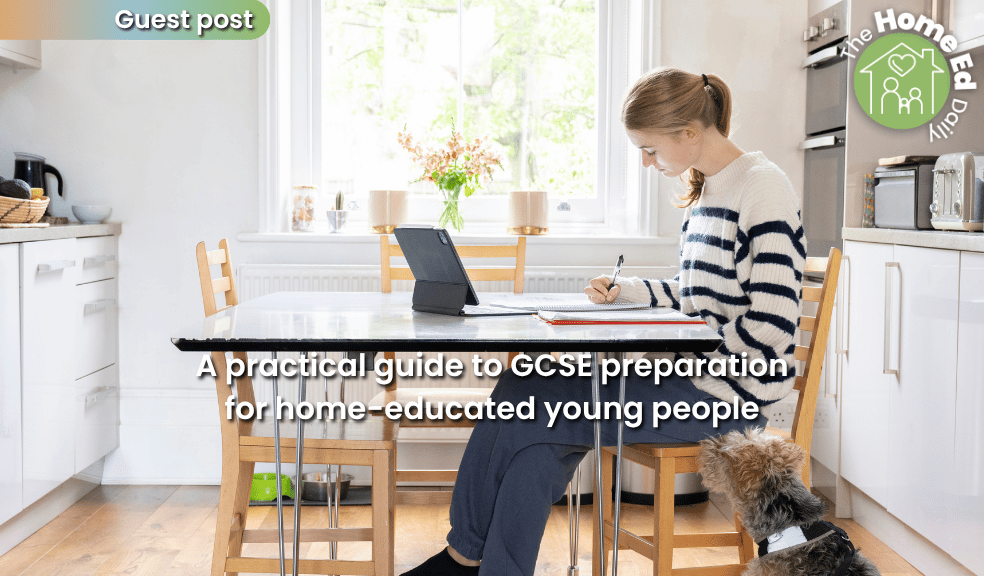
A practical guide to GCSE preparation for home-educated young people
GCSEs have a peculiar effect on otherwise sensible parents. One minute learning is centred around the young person and their interests. Then suddenly, somebody has bought forty highlighters, opened a spreadsheet and announced that Tuesday at 10.15 am is now “simultaneous equations”. I have taught maths for over 15 years, so I am probably legally required to enjoy a spreadsheet. But they can still get out of hand quickly!
Exam preparation needs some structure, but it doesn't need to turn your home into a secondary school. GCSEs should build on what's already working for your young person, adding only the exam structure they genuinely need.
Start with the next step and work backwards
Before buying a course or a pile of revision guides, look at what the young person may want or need next. Consider likely sixth forms, colleges, apprenticeships or training routes. Do they ask for a particular grade in English or maths? Will they accept an International GCSE? Is a particular science qualification required? Would Functional Skills be accepted instead?
Ask the provider directly. “Someone in a Facebook group said it was fine” is, unfortunately, not an admissions policy. This doesn't mean a 14-year-old needs their whole future mapped out. It simply means choosing qualifications that keep sensible doors open.
Having some idea of why they are working towards a qualification can help with motivation too. “You need to revise because GCSEs are important” is fairly abstract. “You need this grade because the college course you really want asks for it” gives the work a purpose.
GCSE or International GCSE?
A GCSE and an IGCSE (International GCSE) are separate qualifications. GCSEs in England follow national subject content and are regulated by Ofqual, with different awarding organisations offering their own specifications. GCSEs in England are graded from 9 to 1, with 9 being the highest grade.
IGCSEs were originally designed for international students, although some home-educating families in the UK also take them. Cambridge International and Pearson Edexcel are two common providers, but content, papers, assessment arrangements, exam series and grading can differ.
The practical question is often less “Which one sounds better?” and more “Which one can we actually study and sit successfully as a private candidate?”
Some IGCSE specifications appeal because their assessment arrangements can involve less coursework. However, this varies significantly between subjects and exam boards, so never assume that choosing an IGCSE automatically removes coursework.
The best choice is not automatically GCSE or International GCSE. It is the qualification that suits the learner, meets likely next-step requirements and can realistically be completed through an available exam centre.
Find an exam centre before choosing the course
Exam-centre admin is not the glamorous part of home education. I have yet to meet anybody who chose this route because they felt a deep calling to compare specification codes. It is, however, one of the most important jobs.
For GCSEs, the JCQ private-candidate search is a good starting point. For Cambridge IGCSEs, use Cambridge International's private-candidate information and approved-centre guidance. Appearing in a search does not guarantee that a centre will have a place, so you will always need to contact the centre directly.
Start early. When contacting a centre, give them the qualification, exam board, syllabus or specification code, tier where relevant, and the year you would like to sit the exam.
Things to ask about include:
• the total fee
• entry deadlines and late-entry fees
• cancellation terms
• access arrangements and how to apply for them
• any practical, spoken or non-exam components
• results
• certificate collection or postage
It is far better to discover in September that a centre cannot accommodate you than in March, when the learner has spent six months studying a qualification it cannot offer.
Sort out access arrangements early too
If the learner needs access arrangements, raise this with the exam centre when making the entry, not a few weeks before the exam. These can include extra time, a reader or computer reader, supervised rest breaks, use of a word processor or other reasonable adjustments, depending on the learner's needs and the relevant regulations.
The exam centre coordinates access arrangements. Ask early what evidence or information they will need. For home-educated learners, information from tutors or other professionals may sometimes help establish the learner's normal way of working, but the centre is responsible for deciding what evidence is required and coordinating any application.
Centres may also set their own earlier internal deadlines. The important thing is not to assume that because a learner uses a particular support at home, it will automatically be available in the exam room.
Build a plan with flexibility
One of the massive perks of home education is flexibility. Beautiful sunny day? Learn outside. Someone has become fascinated by Tudor medicine and spends three hours going down that rabbit hole? Brilliant.
When GCSE study begins, download the current specification from the exam board website and use it as the master list of what needs to be learnt. Before planning every week until May, find out what the learner already knows. Try a selection of questions from different topics rather than immediately presenting them with a complete GCSE paper.
There is often significant crossover between earlier learning and GCSE content, so learners are rarely starting from zero. Divide what remains into manageable chunks. For many learners, particularly those who struggle with attention or anxiety, this can be far more productive than trying to recreate hour-long school lessons.
Forty focused minutes can achieve far more than ninety minutes consisting of twenty minutes of maths and seventy minutes of negotiating. Someone else may prefer doing most academic work in the morning and leaving afternoons completely free.
Leave spare weeks. Illness happens. Motivation dips. Family plans change. Laptops stop charging and Christmas arrives approximately six minutes after September.
One or two weekly anchors can work better than trying to reproduce a school day. Some learners need a visual weekly plan, while others see a colour-coded timetable and immediately develop the urge to do literally anything else. The best timetable is not the prettiest one. It is the one that still exists three weeks later.
Home education still gives you the freedom to ask the most useful question: how does this particular young person learn best?
Keep interests alive
GCSE preparation can easily start swallowing everything else as exams get closer. But not everything valuable in education comes with a mark scheme.
Keep the things that already matter to your young person: reading for pleasure, coding, animals, art, sport, volunteering, museums, building things, travelling, spending time outside or becoming extraordinarily knowledgeable about a subject nobody else in the family knew existed six months ago.
Those interests are part of their education too. Protecting them can also make exam preparation more sustainable.
Make support fit around your life
Parents do not have to teach every GCSE subject themselves. There is no home-education rule that says Mum must suddenly remember Pythagoras's theorem.
A tutor or online class can provide subject knowledge, structure and feedback. In our online classes at Steffi Hesketh Tutoring, families often use the live lesson as one reliable weekly anchor and then fit flexible homework around everything else.
Recorded sessions can add another layer of flexibility. They can be watched at home, at a grandparent's house or while travelling. Learners can pause, rewind and revisit an explanation as many times as they need, which can be particularly useful after illness or if a learner is too anxious to join a live class.
Encourage learners to use videos actively. Watch a short section, pause it, try two or three questions, then check the answers. Letting a recording play while reorganising a sock drawer may feel productive, but the exam board unfortunately does not award marks for matching all the pairs together.
Use past papers without harming confidence
Past papers are incredibly useful, but there is no prize for starting them as early as possible. In the early stages, use past-paper questions by topic. Physics and Maths Tutor is one useful source covering several GCSE and IGCSE subjects.
Later, move towards smaller mixed sections and eventually complete papers under exam conditions. This gradual progression matters. Giving a learner a complete paper before they have covered half of the content may only tell you that they cannot answer questions on topics they haven't learnt yet.
Exam preparation should gradually increase a learner's ability to cope with exam conditions, but you don't need to jump in at the deep end. An early mock paper may measure panic far more effectively than it measures maths.
When marking, track more than the score. Why were marks lost? Was the content missing? Did they know the content but struggle to apply it? Did they misread the question, run out of time, miss a key word or fail to show enough working?
Those problems need different solutions. Re-teaching a topic will not fix rushing. Another timed paper will not magically teach missing content. Mark schemes, model answers and examiner reports can help learners understand how marks are awarded and where candidates commonly lose them.
“That's what I meant” is, sadly, not recognised on the mark scheme.
Measure all progress
Progress is often measured through grades because teachers need systems that work across groups of students. At home, you can notice smaller changes too.
They started the task without being asked six times. They attempted a question they would previously have skipped. They used the mark scheme without becoming upset by mistakes. They asked for help. They went back and corrected something. They sat for twenty focused minutes when six months ago they could manage five.
Grades are the outcome of many smaller habits and pieces of knowledge that develop over time.
Keep the parent-child relationship
A parent's most useful role is often organiser and encourager rather than teacher of every subject. Leave room for conversations that have absolutely nothing to do with qualifications. Nobody wants every car journey to begin with, “So... have you done that past paper yet?”
Qualifications can open doors, and they absolutely require preparation, but they do not deserve to take over a young person's education or become a judgement on their worth.
Keep the flexibility, the individual approach and the freedom to follow interests. Change the plan when it isn't working. You are preparing a young person to sit some exams. You don't need to recreate school at your kitchen table.

Steffi Hesketh is the Educational Director and founder of Steffi Hesketh Tutoring. A qualified maths teacher, former Head of Maths and GCSE examiner, she has over 15 years' experience in education and now leads a team of more than 50 qualified tutors supporting home-educated families across the UK and internationally.
Useful official links:
- Department for Education: GCSE subject content
- GOV.UK: GCSE 9 to 1 grade scale explained
- JCQ: private candidates
- JCQ: access arrangements and reasonable adjustments
- JCQ: Key dates and timetables
- JCQ: Coursework and non-examination assessment
- Cambridge International: Exam information, syllabuses and past papers
- Cambridge International: private candidates
- Pearson Edexcel: IGCSEs