







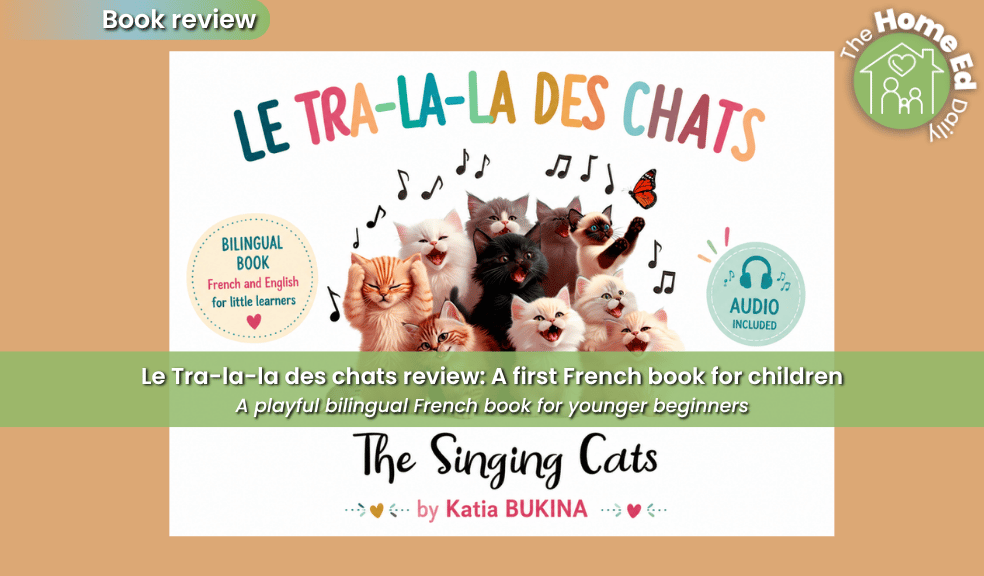
Le Tra-la-la des chats review: A first French book for children
A playful bilingual French book for younger beginners
💚 Gifted review: This book was gifted to The Home Ed Daily for consideration. No payment was received for this review and, as always, all opinions are my own.
Introducing another language at home can feel surprisingly daunting when you don’t speak it yourself. You can find plenty of vocabulary lists and worksheets, but pronunciation is another matter entirely, and it’s easy to worry that you’re confidently teaching your child something completely wrong.
That is one of the things I particularly like about Le Tra-la-la des chats: The Singing Cats, a bilingual French and English picture book by French teacher Katia Bukina. It has been created specifically so that parents don’t need to speak French themselves. Rather than being a conventional language workbook, it is a short, silly and highly repetitive story about an ever-growing collection of cats. Children count from one to ten while meeting simple French words and sentence patterns along the way. And there are a lot of cats. This is probably worth mentioning if your child happens to regard cats as the pinnacle of civilisation.
French through repetition rather than lessons
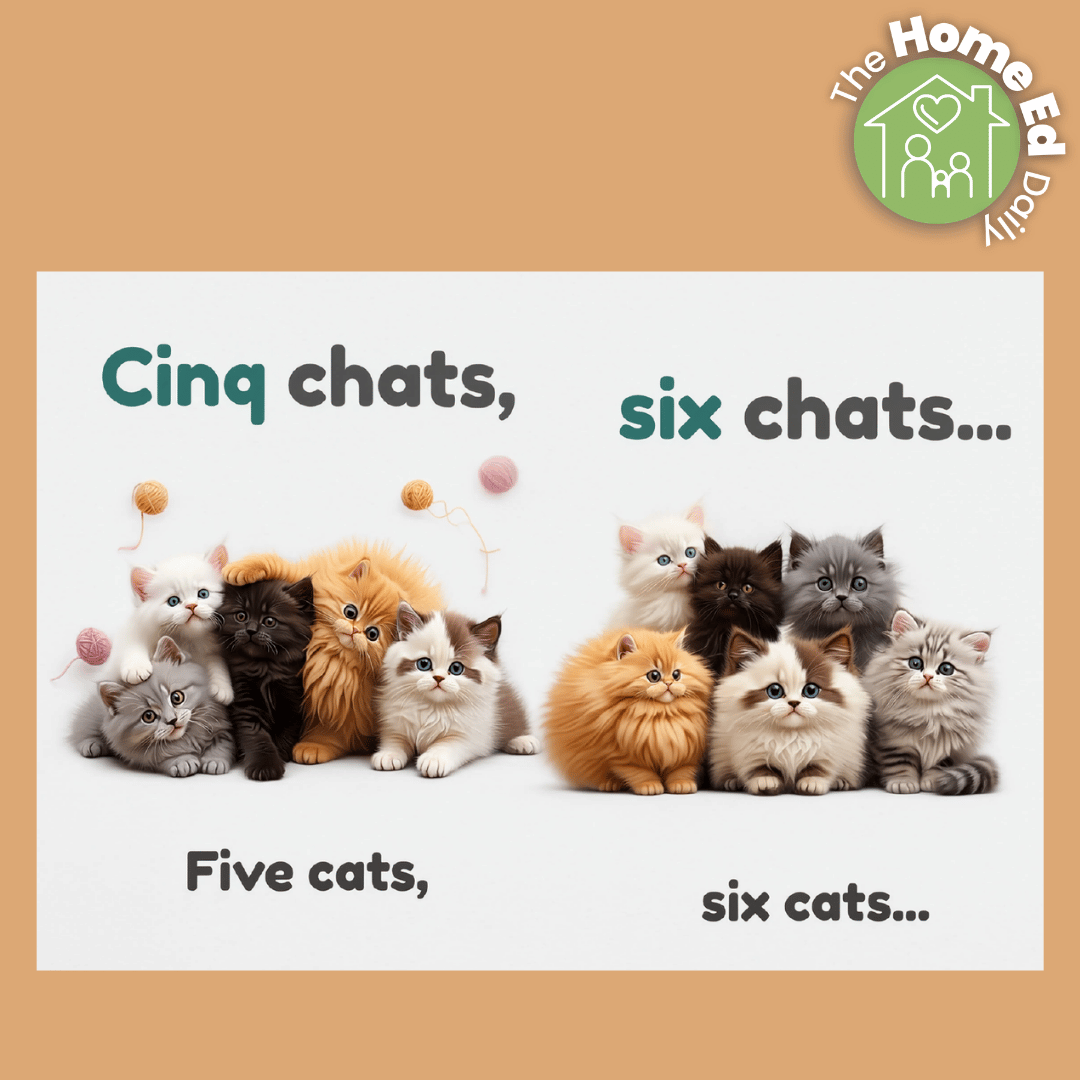
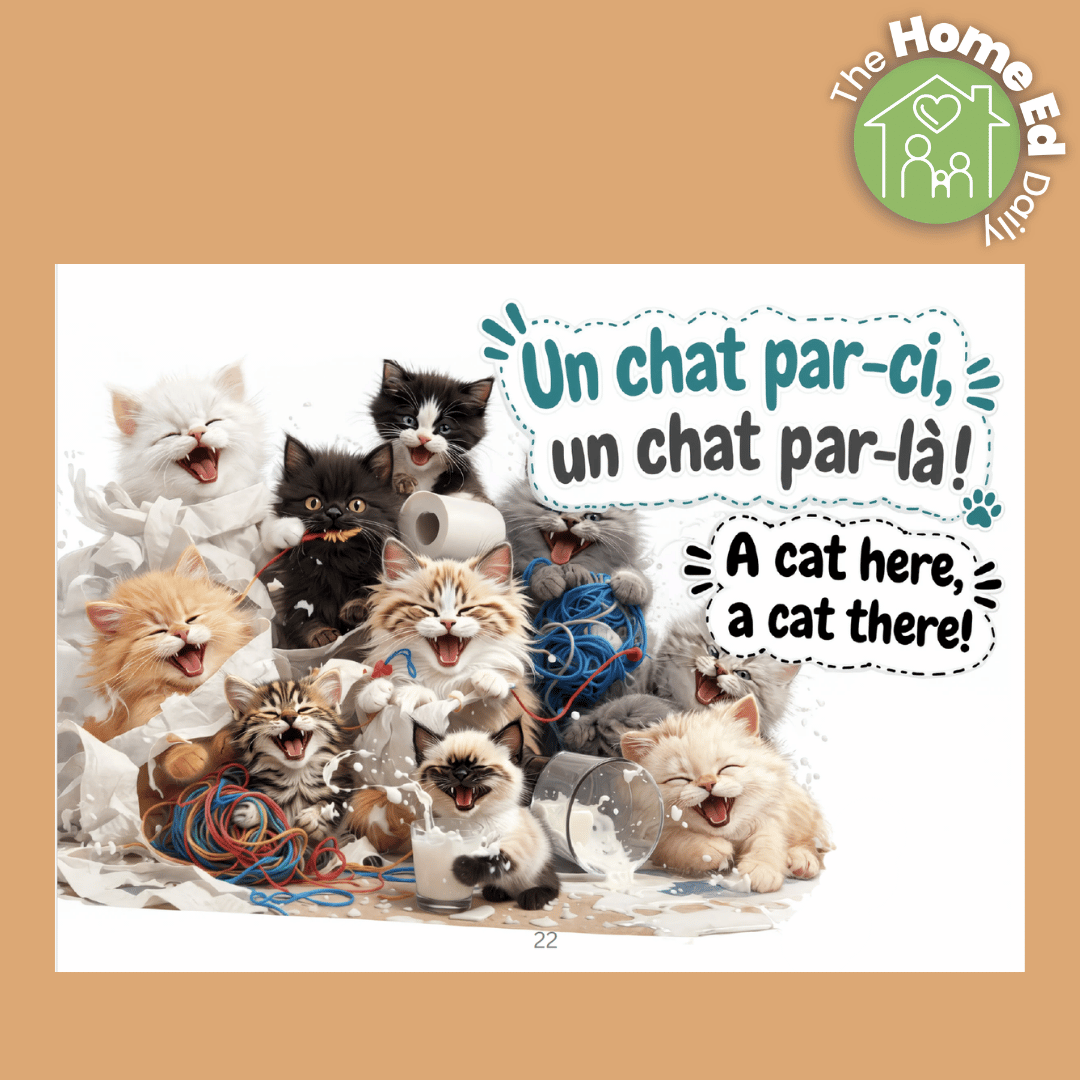
The book begins simply with un chat, deux chats, gradually counting up to ten. Between the counting pages, individual cats introduce useful bits of language. Children encounter phrases such as celui-ci and celui-là for “this one” and “that one”, along with everyday verbs and descriptions. One cat wears shorts, another wears pyjamas, one goes to the spa and another eats his food. There is plenty of deliberate repetition, so children start seeing familiar sentence structures again and again rather than being presented with a long list of isolated vocabulary.
That simplicity is really the point. This isn’t intended to teach a complete French curriculum. It gives beginners a small amount of language to hear, repeat and recognise until it starts becoming familiar. For home ed families, I think that makes it particularly useful as something that can be picked up for ten minutes without turning French into a formal lesson.
The audio makes a real difference
One of the most useful features is the accompanying audio, accessed through a QR code in the book. Katia includes a short parent guide suggesting that families listen first, read the French aloud, compare it with the English, listen again sentence by sentence and return to the story another day.
I think the inclusion of audio is important, particularly for parents with little or no French themselves. It removes some of the anxiety around pronunciation and allows children to hear the rhythm and sounds of spoken French rather than relying entirely on what is printed on the page. It also gives the book more longevity. A child can initially listen and look at the pictures, then begin joining in with familiar words, and eventually try reading some of the French independently.
Who is it best for?
The suggested age range is 3 to 10. Personally, I think its strongest audience is probably towards the younger end of that range, particularly children encountering French for the first time. The large type, fluffy cats, counting structure and repetition feel very much like an early-years or younger-primary picture book. An older beginner could certainly still use it, but some nine or ten-year-olds may find the presentation younger than their tastes. That isn’t really a criticism of the book itself. It is more a case of matching the resource to the child rather than relying too heavily on the age printed on the cover.
A couple of small reservations
The English text sometimes gives the general sense or rhythm of the French rather than translating it literally. For instance, je ne sais pas becomes “who knows?” rather than “I don’t know”. That can make the English flow more naturally as a children’s story, but parents using the two languages side by side should be aware that it isn’t always intended as a word-for-word translation. I would actually quite like to see a small vocabulary page at the back in a future edition. It could give families a straightforward reference for some of the main words and phrases children have encountered.
There are also a few small presentation quirks. The illustrations are extremely bright, glossy and cute, although the visual style varies a little between pages, and there are occasional Americanisms such as “pajamas” rather than “pyjamas”. None of these stopped me liking the basic idea behind the book.
Would I recommend it for home ed?
For younger children beginning French, yes. What I like most is that it doesn’t ask very much of either the child or the parent. You don’t need to prepare a lesson, understand French grammar or persuade somebody to complete a worksheet. You can read the story, listen to the audio, laugh at the increasingly ridiculous cats and gradually pick up some French along the way.
It would work particularly well alongside songs, games and everyday spoken French rather than as a standalone language programme. For families who want to introduce French without making it feel like another subject that needs to be formally “done”, Le Tra-la-la des chats is a cheerful little starting point.