

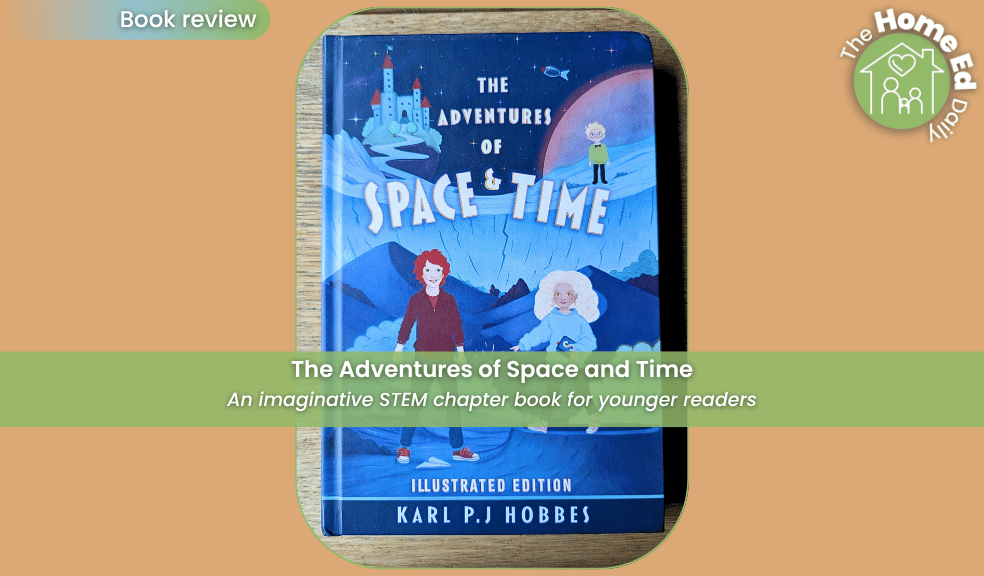
The Adventures of Space and Time review | a story-led STEM book for younger children
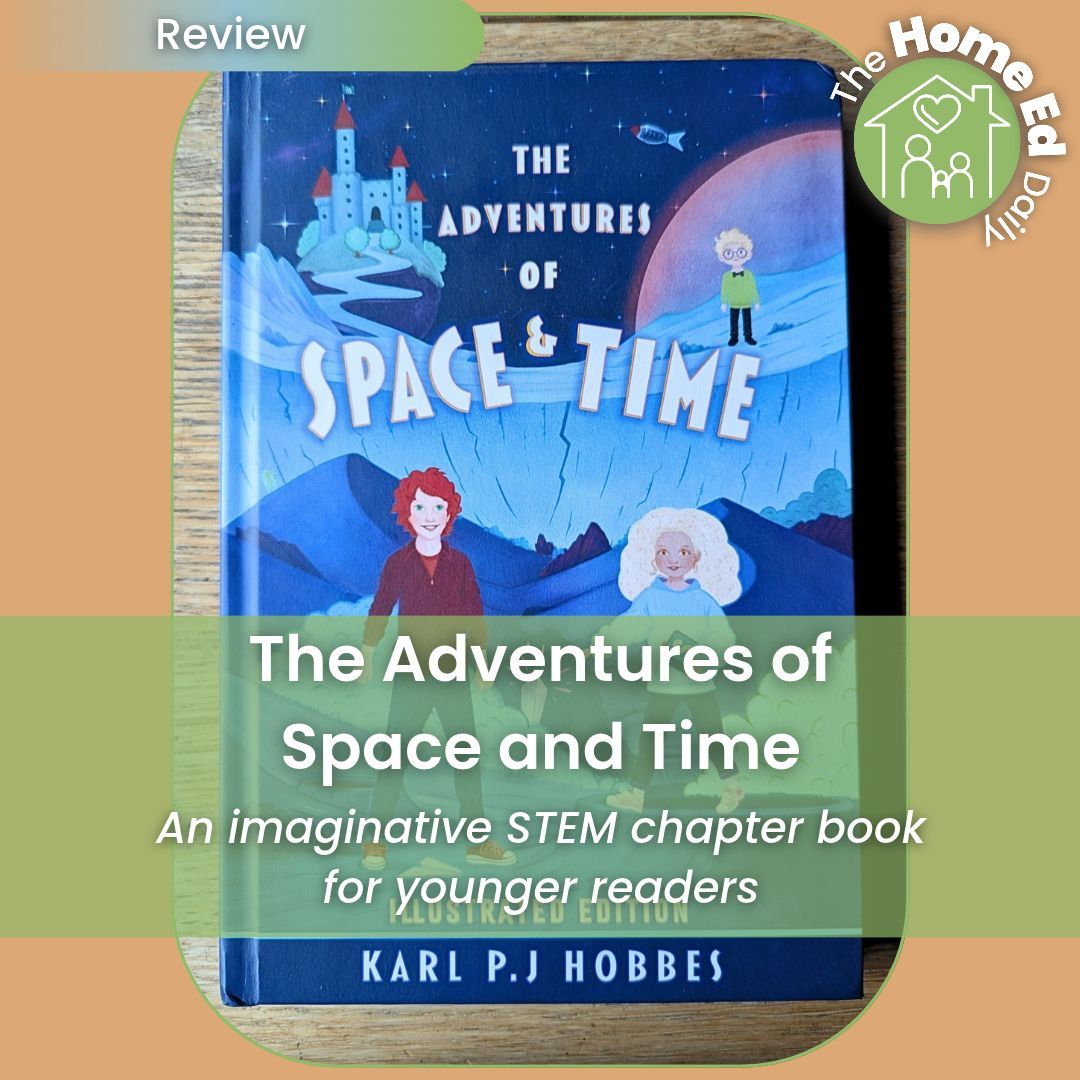
Review of The Adventures of Space and Time, a book by Karl P.J. Hobbes
💚 Gifted review: This book was gifted to The Home Ed Daily for consideration. No payment was received for this review and, as always, all opinions are my own.
Science does not always need to begin with a worksheet, a curriculum plan, or a carefully prepared experiment involving three bowls, vinegar and mild regret. Sometimes it can begin with a story. The Adventures of Space and Time by Karl P.J. Hobbes is a STEM-flavoured chapter book for younger children, aimed roughly at ages 6 to 10. It introduces ideas around space, time, the universe and Einstein’s theories through a fictional adventure, rather than through direct teaching.
The story follows Space and Time as they arrive at the Faraway School of Discovery, make new friends, join a Galaxy Quest team, fall out, and eventually begin to understand the value of working together. Along the way, they meet Albert, a thoughtful new student from Earth, whose ideas help bring the science thread of the story together.
My own son is 15, so clearly well above the intended age range, but he read the book while we were away visiting family. He enjoyed it, and thought it was a fun way to explain scientific concepts to young children. That feels like a fair summary. This is not a dense science book. It is a gentle, story-led introduction to some very big ideas.
 What is The Adventures of Space and Time?
The Adventures of Space and Time is an independently published illustrated chapter book from Foss Publishing. It uses character, friendship and adventure to make abstract scientific ideas feel less intimidating. Space and Time are not just concepts here. They are characters. That is the central idea of the book, and it is a clever one for younger children. Space and time can feel enormous, strange and difficult to pin down. Turning them into characters gives children something familiar to hold on to before the science becomes too big and floaty.
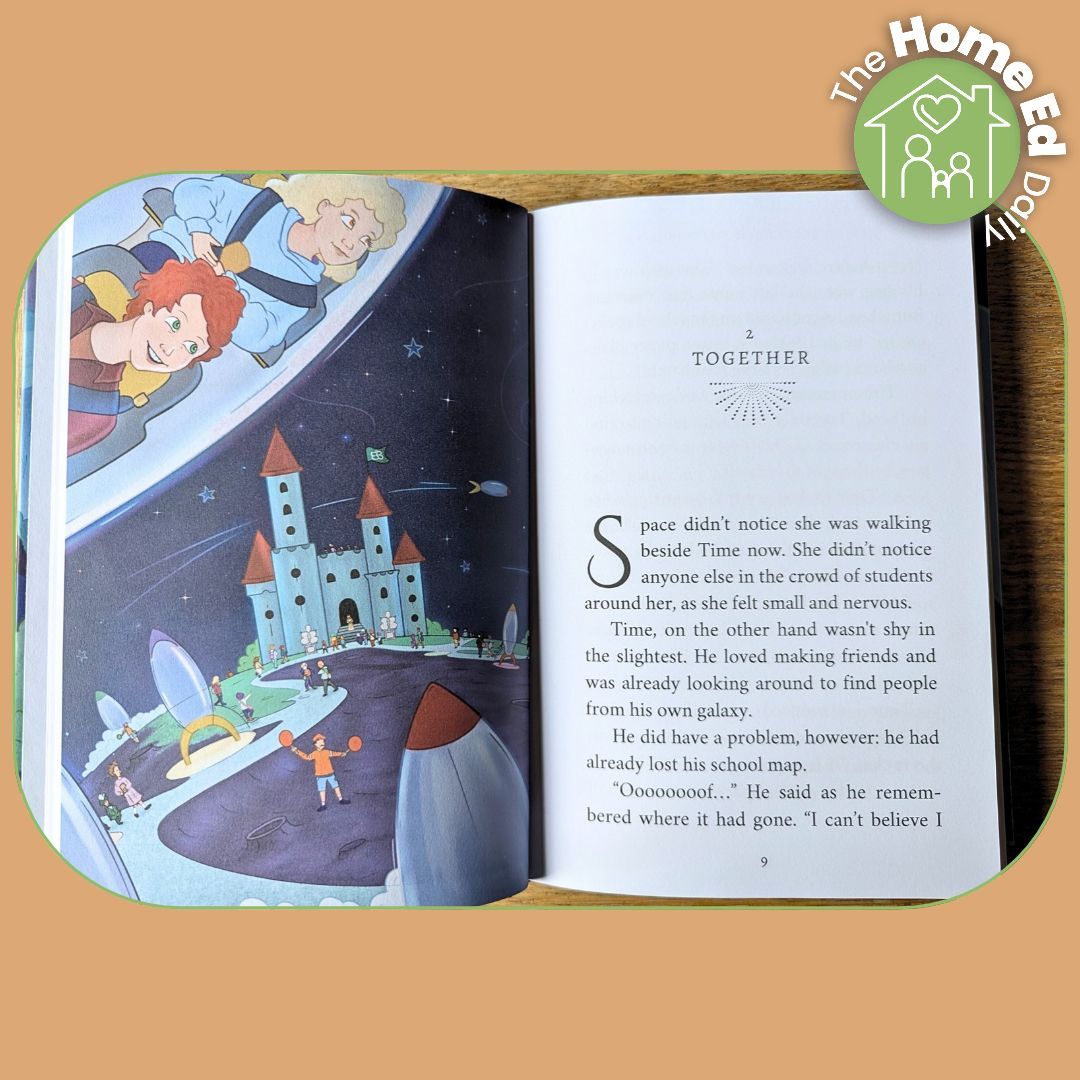
The book has a school-adventure feel, with teams, friendships, rivalry, discovery and a space-themed competition called Galaxy Quest. It also has bright, appealing illustrations throughout, which help break up the text and give the story a more inviting feel. The pages are not crowded, and the font is large and clear, which makes it feel accessible for younger readers or children who are easily put off by dense pages.
That matters. Some children are very happy to read long blocks of text. Others take one look at a packed page and silently leave their own body. A generous layout can make a book feel much less daunting.
Why the story-led science works
The strongest part of the book is the way it uses story as a bridge into science. Rather than presenting space, time and relativity as a formal lesson, the book gives children characters and situations first. They meet Space and Time. They see them work together, struggle, misunderstand each other and reconnect. Then the scientific ideas have somewhere to land. For home ed families, that can be useful. Many children learn well through stories, especially when they are meeting an idea for the first time. A story can soften the edges of a subject. It gives children language, images and emotional hooks before anyone starts explaining the harder bits.
I would not describe this as a full STEM resource. It is more of a science spark. But that is not a criticism. For the right child, a spark is exactly what you want. It can lead into conversations about gravity, planets, time, Einstein, black holes, the universe, or the strange fact that time is not quite as simple as clocks make it look. The “Let’s talk science!” section at the end is a helpful addition. It explains, in child-friendly terms, some of the real science behind the story, including the idea that space and time are connected. I would have liked this section to be a little longer, perhaps with a few simple questions or activities for families to try afterwards, but it is still a useful starting point.
How home educating families could use it
I can see this working well as a relaxed read-aloud for younger children who enjoy science, space or imaginative school-style adventures. Confident readers in the target age range may be able to read it independently, while younger children may prefer sharing it with an adult. For a home ed family, I would probably use it as a starting point rather than a stand-alone science lesson. You could read a chapter or two, then follow the child’s interest. That might mean looking up Albert Einstein, watching a short video about gravity, making a model solar system, visiting a planetarium, or having one of those slightly ridiculous but brilliant conversations about whether time is real while someone is still eating toast. It could also sit nicely alongside:
- space books from the library
- simple gravity experiments
- kitchen science
- model-making or drawing planets
- a documentary about the universe
- a visit to a science museum or planetarium
- creative writing about imaginary planets or things in space
- a discussion about friendship, teamwork and feeling left out
I think it may particularly suit children who like their learning wrapped in story. It may also appeal to families who want to introduce scientific ideas gently, without making science feel like something separate, serious or only for children who already think of themselves as “sciencey”.
 What I liked
I liked the central idea of turning Space and Time into characters. It is simple, but it works. It gives younger children a way into ideas that are usually quite hard to explain. I also liked the visual feel of the book. The illustrations are colourful and appealing, and they make the book feel more inviting. For children who are drawn in by pictures first, that can make a real difference. The large font and clear spacing also make the pages feel manageable, which is worth mentioning because readability is not a small thing for this age group.
The friendship thread is another strength. Space and Time are not perfect friends. They misunderstand each other, drift apart and have to find their way back. That gives the book more emotional shape than a simple “children learn science” story. It also gives families something else to talk about beyond the science. And, importantly, the book does not feel like a worksheet pretending to be a story. The science is there, but it is carried by the adventure.
Things to be aware of
This is best seen as a story-led introduction to science, not a complete STEM programme or activity book. Families looking for experiments, worksheets or structured follow-up activities would need to add those themselves. I also noticed a few small proofreading errors. They did not stop us reading or enjoying the book, but a final polish would make it feel stronger in any future edition.
I would also love to see the science section at the back expanded slightly. Even a few child-friendly extension prompts, discussion questions or simple “try this next” ideas would make it more immediately useful for home educating families. Not every parent has the headspace to invent an extension activity on the spot, especially if there is lunch to make and someone has just glued something to the table.
The age range of 6 to 10 feels about right, though as always I would treat that as a guide rather than a rule. Some younger children may enjoy it as a read-aloud. Some older children may still enjoy the humour and the ideas, especially if they like space or story-led learning.
Who might enjoy The Adventures of Space and Time?
I think this book could work well for children who enjoy space, science, friendship stories, school-style adventures, colourful illustrations and imaginative characters. It may be especially useful for children who are curious but do not necessarily see themselves as “science people”. Because the science is introduced through story, it feels softer and less formal. That can be helpful for children who switch off when a subject looks too much like a lesson. It may be less suited to children who prefer realistic fiction, very fast-paced adventure, or highly detailed science books. This is more gentle and imaginative than technical.
Final thoughts
The Adventures of Space and Time is a warm, bright and imaginative chapter book that introduces younger children to some very big scientific ideas without making them feel heavy. For home ed families, I think its value is in the way it opens a door. It gives children a story, some characters, a few scientific hooks and a reason to ask questions. From there, families can take it in whichever direction suits their child. It is not about mastering relativity at the kitchen table. Thank goodness, because most of us are just trying to keep the milk upright. It is about making space, time and the universe feel a little less distant, and a little more playful. For curious younger children, especially those who enjoy illustrated chapter books and story-led learning, The Adventures of Space and Time could be a lovely way to begin.
Author bio
Karl P.J. Hobbes is a daydreamer and writer based in London. Named after an imaginary tiger and an inspirational thinker, he is a bit of both. The Adventures of Space and Time — his first independently published book — began with a simple question: what would be the perfect gift for his hypothetical grandchildren? The answer turned out to be a gravity-bending chapter-book adventure for 6-10 year olds, about friendship, curiosity and the coolest game in the universe. He can usually be found at karl-hobbes.co.uk, or on a long walk in the rain.