





What is strewing? A simple way to spark curiosity in home education
What is strewing in home education?
One of the loveliest things about home education is that learning does not need to look formal to be meaningful. Some of the richest learning begins quietly, with something small left within reach and a child free to notice it in their own time.
That is where strewing comes in.
Strewing is a gentle, low-pressure way of inviting curiosity. It does not require expensive resources, elaborate planning, or a perfect set-up. In most cases, it simply means placing interesting things in your child’s path and seeing what, if anything, draws them in.
For many home educating families, especially those leaning towards child-led learning or unschooling, strewing is already part of daily life, whether they use the term or not.
What is strewing?
The word itself comes from the idea of scattering or placing things around. In home education, strewing means intentionally leaving out books, objects, materials, tools, games, or experiences for your child to come across naturally.
The key part is this: there is no pressure attached.
You are not setting a task. You are not asking for a finished piece of work. You are not aiming for a fixed outcome. You are simply offering something and allowing your child to respond in their own way.
That response might be immediate enthusiasm. It might be mild interest. It might be complete indifference. All of that is fine.
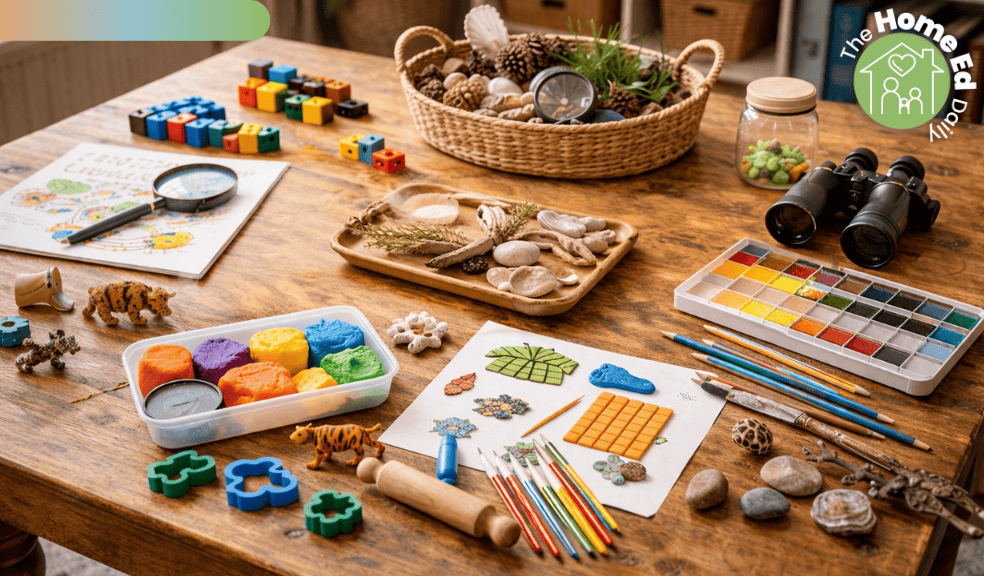
A few feathers on the table, magnetic letters on the fridge, a magnifying glass by the window, a basket of picture books about insects, a map left open on the sofa, a simple science kit on the worktop. Any of these can become an invitation to explore.
Why strewing works so well
Children are naturally curious, but curiosity often thrives best when it is not being managed too tightly.
Strewing works because it creates opportunities without force. It respects the child’s interests and timing. It gives them space to notice, wonder, test ideas, and make connections for themselves.
Sometimes the learning is obvious. A child might pick up the magnetic letters and start building words. Sometimes it is less obvious. They may sort, compare, line up, invent, question, or imagine. All of that still matters.
Often, the adult learns something too. Strewing can reveal what your child is drawn to, how they think, and what kinds of materials genuinely hold their attention.
How to try strewing at home
There is no single correct way to do it, but a simple approach works best.
Choose one or two things that might interest your child. Leave them somewhere visible and easy to access. Then step back.
You might sit nearby and see what happens. You might join in if invited. You might ask a gentle question if it feels natural. Or you might simply let the moment unfold without comment.
This could be as simple as:
- leaving out playdough with child-safe tools
- placing a nature book beside a basket of shells or leaves
- setting out a puzzle, model kit, or card game
- leaving recipe ingredients and a cookbook on the counter
- putting sketching materials near an interesting object
- opening an atlas or placing a globe where it will be noticed
The point is not to direct the activity too quickly. It is to make room for self-led discovery.
Strewing with younger children
For younger children, strewing often looks a lot like thoughtful play invitations. In early years settings, there is a similar idea in the way resources are kept available for children to return to during independent play.
At home, this might mean creating simple spaces or baskets that encourage exploration, such as:
- a role-play area linked to a favourite story
- a creative table with paper, glue, pens, paints and collage bits
- a maths basket with jugs, tape measures, dominoes and counting objects
- a small world set-up with animals, dolls, fabric, sticks, stones or sand
- a book corner with inviting titles and a comfortable place to sit
- a building area with blocks, cardboard tubes, boxes and tape
These kinds of open-ended resources can lead to all sorts of learning through play, experimentation and repetition.
Strewing with older children and teens
With older children, strewing can still be very effective. It just tends to look different.
Instead of dressing-up clothes and sensory play, you might leave out materials connected to their interests, current questions, or future goals. That could include:
- novels, comics, biographies, magazines or poetry
- documentaries, podcasts or carefully chosen online content
- board games and strategy games
- craft materials, sketchbooks or modelling supplies
- science equipment or experiment kits
- recipe books and cooking ingredients
- maps, timelines or reference books
- resources linked to GCSE subjects or exam specifications
For a teen studying English literature, strewing might mean leaving a play script, a well-chosen article, or a poetry anthology on the coffee table. For a child obsessed with engineering, it might mean access to cardboard, tools, tape, and real-world design challenges.
The principle stays the same. Offer without forcing.
The learning may not look how you expect
One of the most important things to understand about strewing is that children do not always use materials in the way adults imagine they will.
You might leave out paper and pens expecting a drawing session. Instead, your child may sort the pens by colour, build with them, use them in imaginative play, or decide to put them away. That does not mean the strew has failed.
In fact, those unexpected responses are often where the richest learning lies.
A child who arranges objects is noticing pattern and order. A child who builds with them is experimenting with shape, balance and structure. A child who puts them away may be showing a strong sense of routine, categorisation or care for their environment.
Not all learning needs to be obvious to be real.
Strewing and life skills
Strewing can also support the wider skills children need as they grow.
These include foundational skills such as literacy, numeracy and digital confidence, but also broader transferable skills like creativity, communication, problem-solving, flexibility and critical thinking.
For example, if your child is fascinated by trains, you might leave out railway books, model trains, maps, drawing materials, documentaries, and safe ways to research how rail systems work. That one interest could lead into geography, history, engineering, writing, maths, design, and discussions about jobs and accessibility.
You might end up exploring questions like:
How does someone become a train driver?
What training do they need?
How do trains work?
How are transport systems designed for different people’s needs?
That is where strewing becomes especially powerful. It can start with a simple object, but it often opens into much deeper thinking.
A gentle tool, not a trick
Strewing works best when it is used lightly. It is not about manipulating your child into learning something. It is about making interesting things available and trusting curiosity to do some of the work.
Some days nothing much will happen. On other days, one book, object or question can lead to hours of thought, conversation, play or research.
That is often how home education works at its best. Quietly. Naturally. Without fuss.
And the lovely thing is that almost any family can try it.
Final thoughts
You do not need a Pinterest-worthy learning space or a house full of resources to use strewing well. A few carefully chosen books from the library, a basket of recycled materials, something from a charity shop, or treasures gathered on a walk can be enough.
At heart, strewing is simply about noticing what might spark something in your child and making room for that spark to catch.
Sometimes that is all learning needs.
You may like to read about morning baskets, which is different to strewing, but they do sit in a similar space. Both can gently invite learning without making everything feel formal or heavy.