






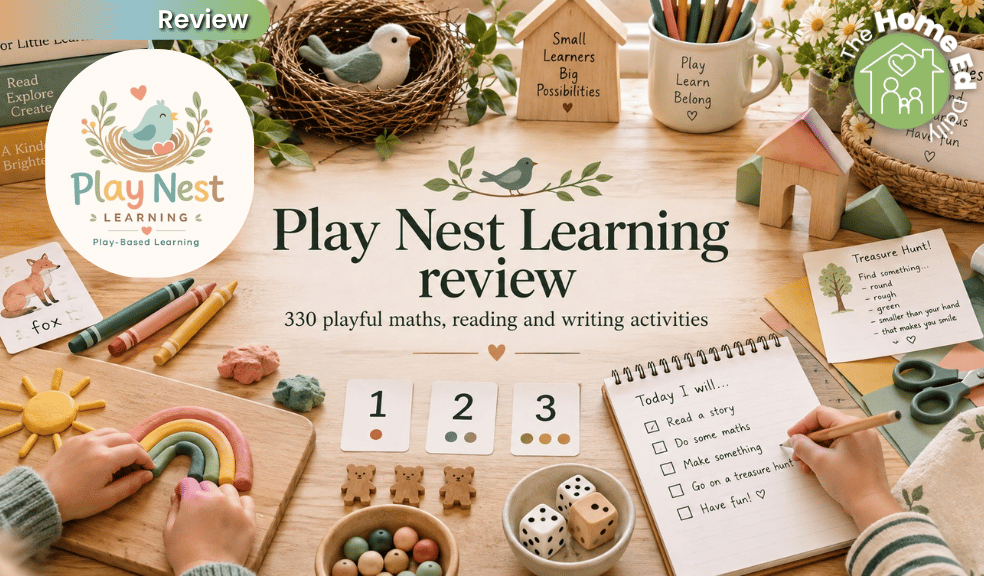
Play Nest Learning review: Play-based maths, reading and writing activities
A review of the Play Nest Learning bundle, playful reading, writing and maths activities for young children.
💚 Gifted review: This bundle was gifted to The Home Ed Daily for consideration. No payment was received for this review and, as always, all opinions are my own.
There comes a point with younger children when you know roughly what they might benefit from practising, but you've completely run out of interesting ways to do it. You've counted the stairs. You've counted the grapes. You've found things beginning with s. You've written letters in sand. You know learning doesn't need to look like worksheets around the kitchen table, but that still leaves the slightly inconvenient question of what to actually do instead.
Play Nest Learning is designed for exactly that gap. Created by Ruth, a qualified primary teacher and home educating parent, the Play Nest resources are collections of short, play-based activities covering early maths, reading and writing. Rather than giving children pages to complete, the PDFs are essentially an enormous bank of ideas for parents to dip into.
I was given access to the Complete Home Learning Bundle to look through for this review. As always, gifted access doesn't guarantee a positive review and the thoughts here are my own.
What's included in the Play Nest Learning bundle?
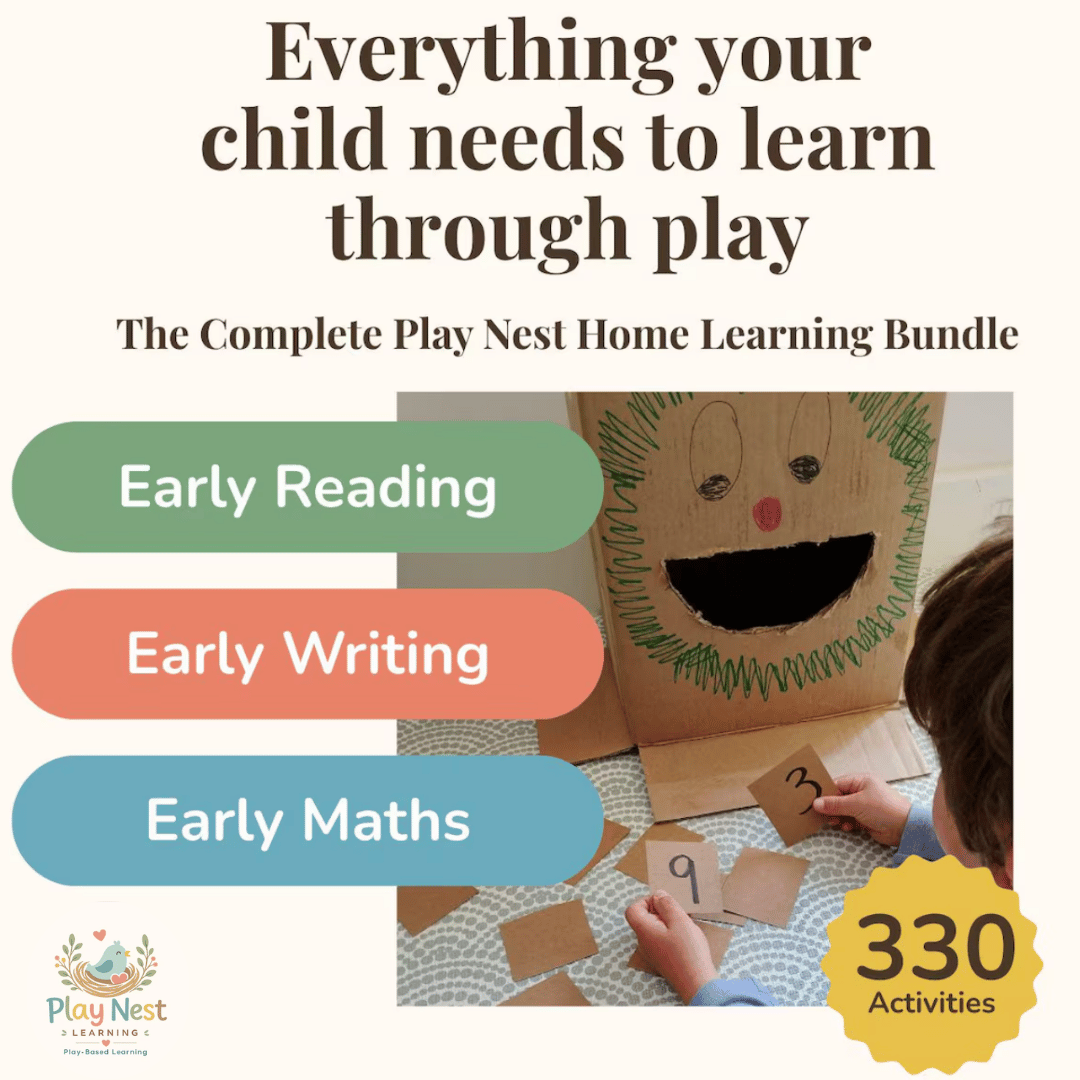
The complete bundle contains 330 activities across 11 different packs, divided into three main areas.
The maths collection contains four packs: three progressively developing number skills, followed by a Beyond the Numbers pack covering areas including shape, measurement, time, fractions and symmetry.
Reading starts with letter sounds, moves into CVC word blending, then includes sight-word activities and purposeful sentence reading.
Writing begins before pencil-and-paper writing really starts, with fine motor activities and early mark-making, before moving into letter formation, word writing and finally sentence writing.
Each pack contains 30 activities and follows a similar format. Individual cards explain the skill being practised, what to do, what you'll need and a short tip for helping or extending the activity. Importantly, these aren't designed to be completed in order. Ruth repeatedly encourages families to choose something appropriate to their child's mood and stage, keep activities short, repeat favourites and simply stop if a child has had enough. Five or ten minutes is generally considered plenty. That makes much more sense to me than treating 330 activities as an enormous educational to-do list.
The maths packs were probably my biggest surprise
I expected lots of cheerful counting games. There are plenty of those, but the maths collection goes considerably further. Level 1 starts with very early number understanding. Children count actual objects, recognise numerals, compare amounts, explore how numbers can be split into smaller groups, experiment with addition and subtraction and notice patterns. The activities are simple. Feed the Monster involves posting pasta or buttons into a container one at a time while counting. Fill the Bucket adds movement by asking children to collect a particular number of objects. Nature Count takes the same idea outside and uses sticks, stones, leaves or petals. There's very little equipment involved, and that continues through the later packs.
Level 2 moves into numbers to 20, counting forwards and backwards, recognising small quantities without counting each item, number bonds and early addition and subtraction strategies. I particularly liked Vanishing Act, where a child gets a quick glimpse of a small group of objects before they're covered and has to work out how many they saw.
By Level 3, children are exploring numbers to 100, tens and ones, odd and even numbers, estimation, counting in 2s, 5s and 10s, fact families and increasingly flexible ways of thinking about addition and subtraction. One activity uses LEGO or similar blocks to physically build two-digit numbers into groups of tens and ones. Another stacks 5p and 10p coins while counting in multiples. These are straightforward ideas, but they make quite abstract mathematical concepts visible and touchable.
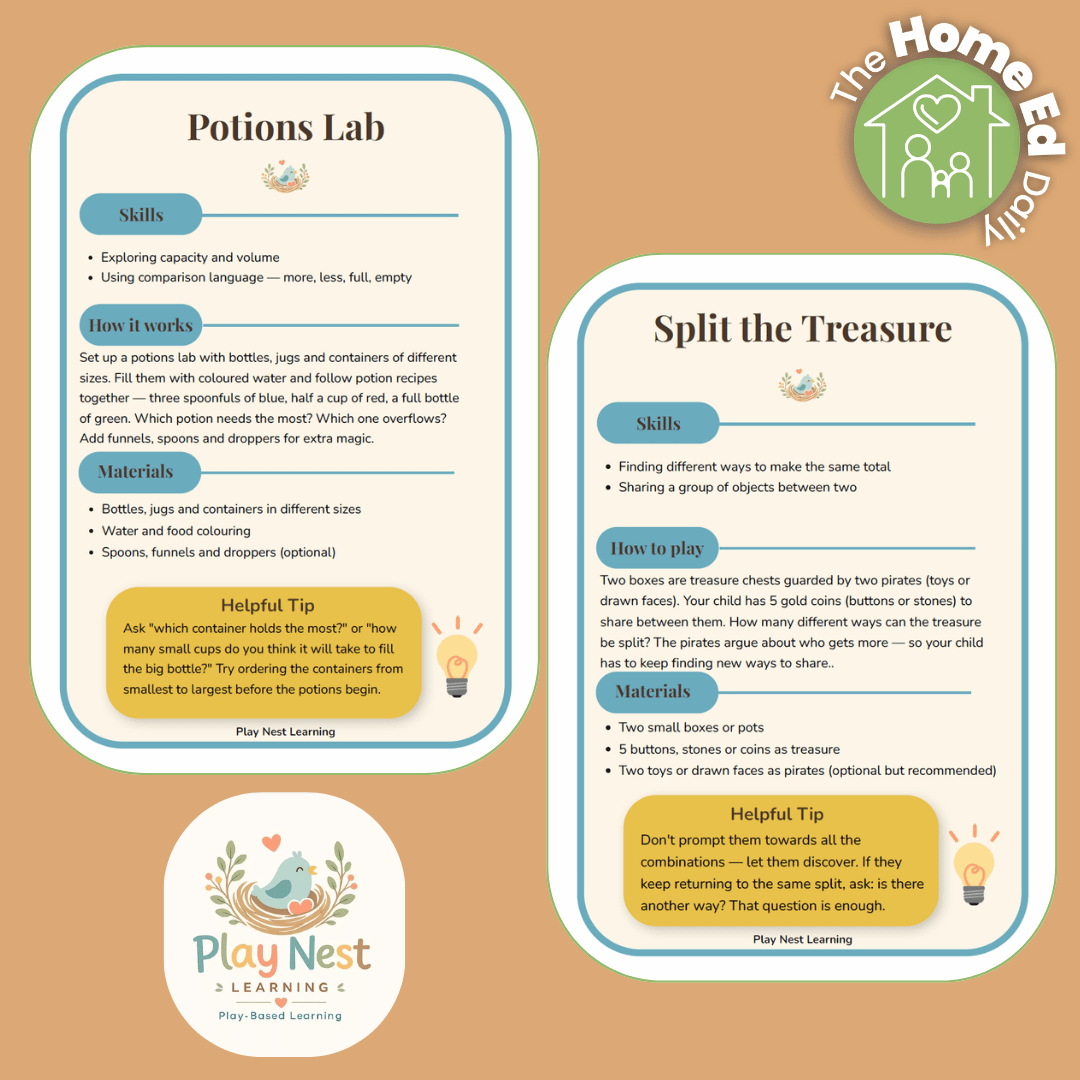
Then Beyond the Numbers moves away from number work altogether. Its 30 activities cover 2D and 3D shapes, positional language, sorting, measuring, time, fractions and symmetry. There are shape hunts, building challenges, a potions lab for exploring capacity, weighing activities and butterfly prints for symmetry.
Taken together, the maths packs feel much more substantial than a collection of preschool counting games.
Learning to read through play
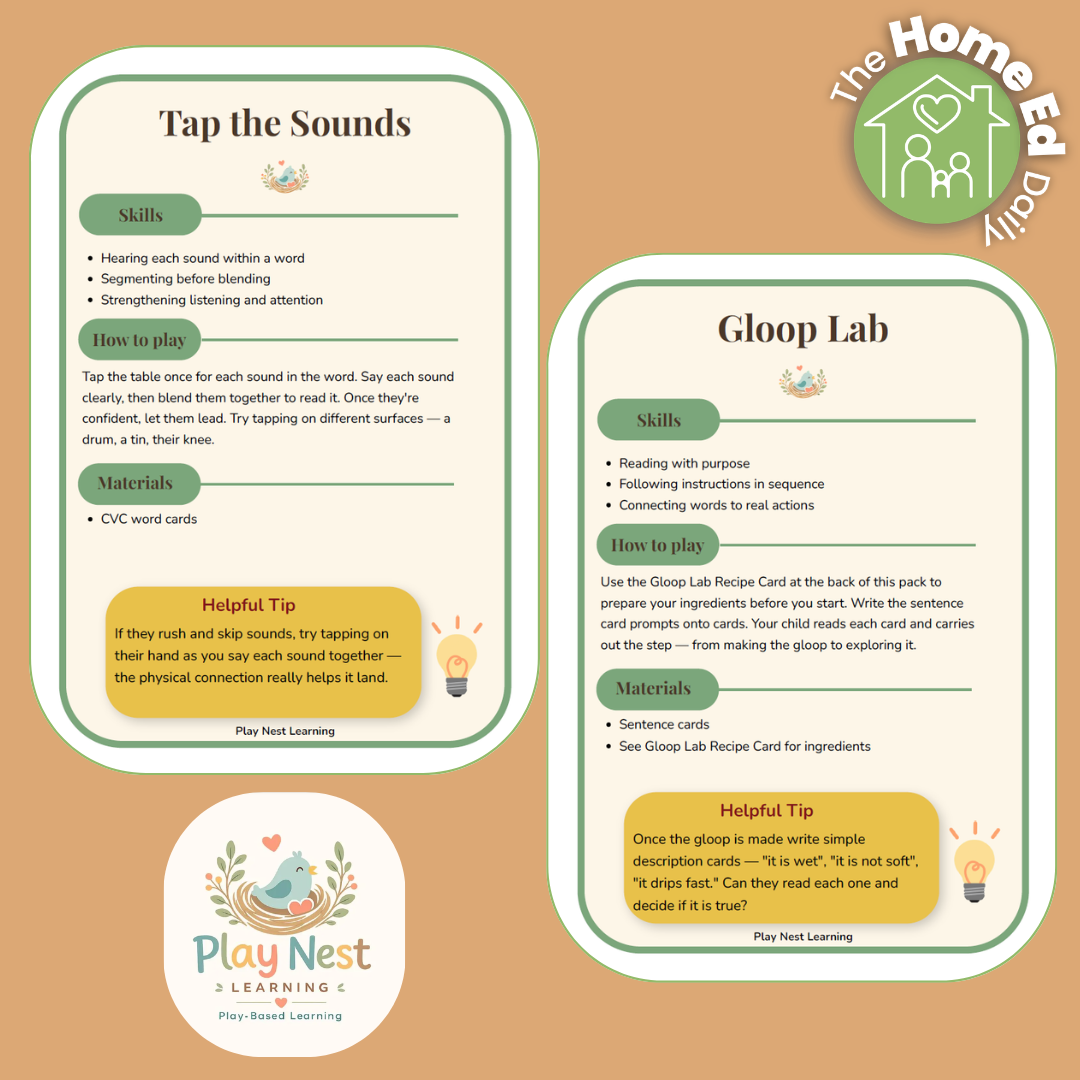
The reading collection begins with letter sounds, then moves into CVC word blending, familiar or high-frequency words and finally purposeful sentence reading. The accompanying You Can Teach Your Child to Read guide is useful here because it gives parents more structure than the individual activity packs suggest at first glance. Ruth recommends beginning with the sounds s, a, t, p, i and n, which immediately gives children enough sounds to start building words such as sat, pin, tin and tap. Further sounds are then introduced gradually, followed by common digraphs including sh, ch, th, ng and ck. That makes the reading resources feel much more joined-up than simply having 30 unrelated phonics games.
The activities themselves are varied. Children can hunt for sounds around the house, jump onto the correct letter, blend words using funny robot voices, build words with magnetic letters or use sound buttons to hear the separate sounds before pushing them together. The sentence-reading pack is particularly good because reading is needed to make something happen. A child might follow instructions around an obstacle course, read clues to find treasure or use a sentence to work out what they need to draw or build. That shift from read this because we're practising reading to read this because you want to know what happens next makes a lot of sense to me.
A small note about sight words
Play Nest also includes activities for building quick recognition of frequently encountered words. Ruth's approach is to introduce a small number of words such as the, I, was, he, she and they alongside phonics and practise them through repeated exposure. There are different schools of thought around how these words are best taught, including approaches that continue to explore the phonics within less straightforward words rather than learning them wholly by sight. For home educators, I don't think this needs to become an either/or issue. The games themselves are easily adaptable. If you already follow a particular phonics programme or have your own approach to tricky and high-frequency words, you can simply use the Play Nest activities with the words your child is currently learning.
I would still see Play Nest primarily as a play-based reading resource rather than a complete phonics programme. The parent guide gives families a useful starting sequence and explains blending clearly, while the activity packs provide plenty of ways to turn that practice into something much more enjoyable.
Writing starts long before sentences
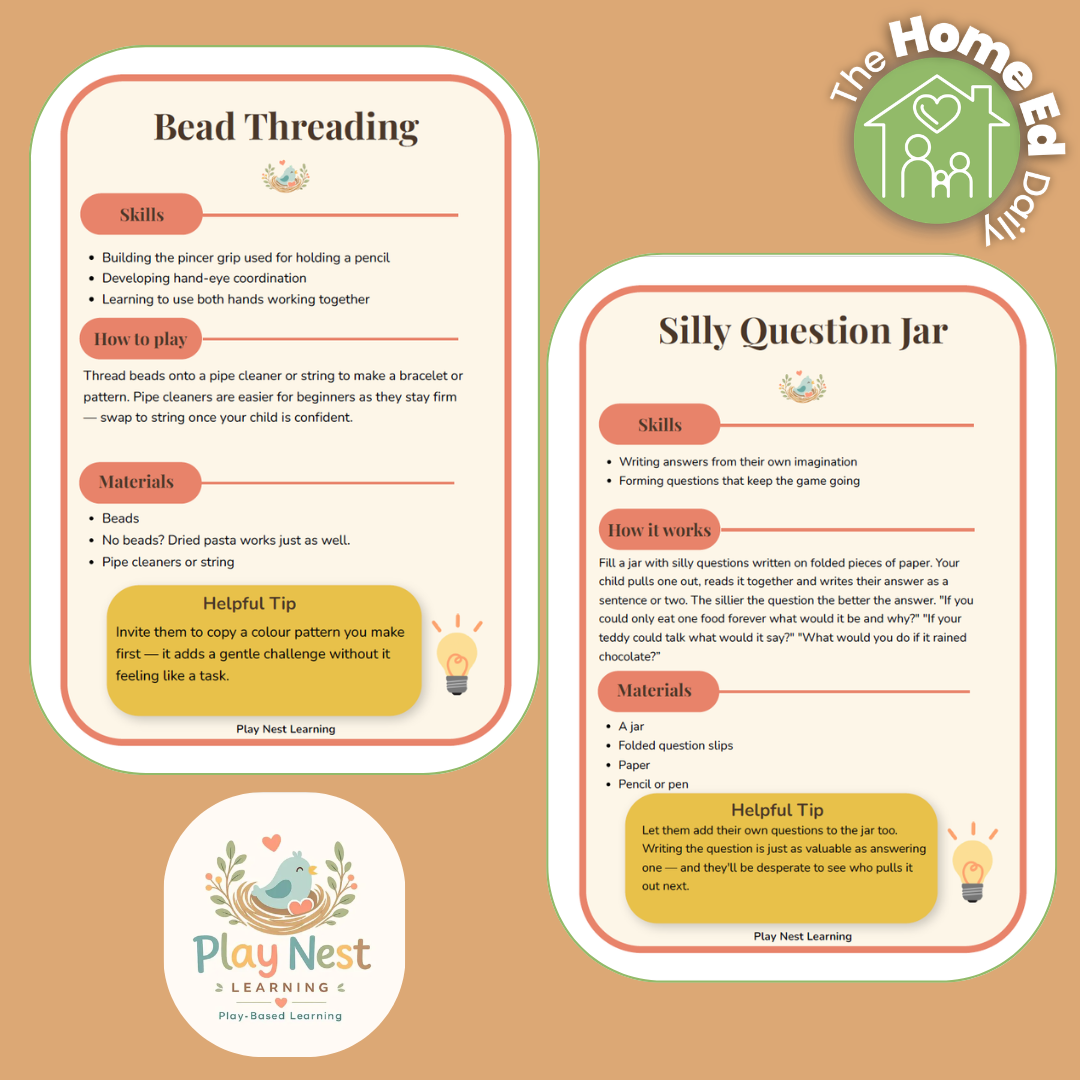
The writing resources are possibly my favourite part of the whole bundle. The accompanying You Can Teach Your Child to Write guide starts well before handwriting. Ruth looks first at hand strength, fine motor skills and mark-making, with activities involving playdough, threading, squeezing, tweezers, painting, drawing and other everyday play. I especially liked the suggestion to put writing materials alongside things a child is already doing: paper near the building blocks, crayons beside the train set, a clipboard within reach of pretend play. Rather than announcing that it's time to practise writing, you're simply making writing available if the play happens to need a ticket, a sign, a list or a label. From there, the resources move into letter formation and word writing. Ruth gives parents practical ways to help children hear the individual sounds in words, including stretching words aloud and tapping out each sound before trying to write it. She also encourages parents not to interrupt a child's flow to correct every spelling attempt.
Eventually this leads into Let's Write Sentences!, and this is where I think Play Nest really comes into its own. Children aren't simply being asked to produce sentences for the sake of demonstrating that they can. They might write rules for their den, a warning for a dragon's cave, tickets for an imaginary train, a café menu, a wanted poster, an invitation, a secret message or even a dramatic complaint about the terrible injustice of bedtime. The educational skill is still there. The difference is that the child has something they actually want the writing to do. For reluctant writers especially, that distinction can be enormous.
How much preparation is involved?
Most Play Nest activities use things you're likely to already own: paper, pens, toys, blocks, pasta, buttons, chalk, containers, dice and bits scavenged from the kitchen or craft drawer. That's a genuine strength.
I'd describe the bundle as low-prep rather than entirely no-prep, though. Quite a few activities involve quickly making number cards, writing words or sentences onto pieces of paper, drawing a grid, setting up an obstacle course or finding a collection of suitable objects. The sentence-reading activities in particular rely on an adult writing sentences appropriate to their child. I actually think that's useful because it makes the resources very adaptable, but it's worth knowing if you're hoping to press Print and immediately hand the whole thing over to your child while you drink coffee in peace. Tragically, no PDF has yet achieved this.
Do you really need 330 activities?
No. And that's rather the point. There are repeated game ideas across the bundle. Hopscotch, treasure hunts, movement games, matching activities, things to splat and things to hide turn up in different forms. I don't see that as a problem. A familiar game with different learning dropped into it can be much easier for a child than constantly introducing something new. But I'd think of this as a large activity library, not 330 completely unrelated games and certainly not 330 things you're supposed to get through. If your child becomes obsessed with one particular activity and wants to do it every day for a fortnight, Ruth's own advice is essentially: let them. I like that.
How much does Play Nest Learning cost?
At the time of writing, the Complete Home Learning Bundle costs £27.59 and includes all 11 packs across maths, reading and writing. The separate subject bundles cost £13.19 each, while individual packs are £4.79 each. For me, the complete bundle offers considerably better value if you expect to use resources across more than one subject. That said, I wouldn't automatically buy the whole collection simply because it's bigger. If you already have a reading approach you're happy with but desperately need fresh maths ideas, the £13.19 maths collection makes perfect sense. Equally, the sentence-writing pack could be useful on its own for a child who needs more meaningful reasons to write. I like that families have that choice.
Who would I recommend Play Nest Learning for?
I think Play Nest will be particularly useful for families with younger children who enjoy movement, pretend play and hands-on activities, or who quickly switch off when learning starts looking too much like a worksheet. It's also a good fit for parents who don't necessarily want a curriculum telling them what to do every day but would appreciate having a large bank of ideas ready when inspiration has temporarily left the building.
Children develop at wildly different rates, particularly in the early years, so I'd pay far more attention to the skills in each pack than to a particular age on a product listing. Some three-year-olds will happily recognise letters while some six-year-olds aren't remotely interested in writing sentences yet. Home education gives us the freedom to work with the child rather than the number attached to them.
My verdict
Having looked through all 11 activity packs and the accompanying parent guides, I think Play Nest Learning offers considerably more substance than its simple activity-card format might initially suggest.
The maths collection is probably the strongest overall. There is a clear progression from early counting into number relationships, place value, calculation, shape, measurement, fractions and other early mathematical ideas, while keeping most of the learning physical and practical.
The writing resources are another real strength. They understand that learning to write begins with hands, movement, marks and ideas long before a child is producing neat sentences, and they increasingly give children genuine reasons to put words on paper.
The reading collection also makes more sense when used alongside Ruth's parent guide. There is an introductory sound sequence, a clear move into blending and then lots of opportunities to practise reading through games and purposeful activities. Families may differ in exactly how they approach high-frequency or tricky words, but the Play Nest activities are flexible enough to fit around different approaches.
Most importantly, I don't think the bundle needs to be treated as a programme you have to complete. It's better thought of as a very well-stocked activity cupboard. You know what your child is beginning to explore, you open the appropriate pack, choose something that fits their interests and energy that day, and adapt it however you need to. If one particular game works brilliantly, repeat it. If another falls completely flat, close the PDF and try something else tomorrow.
At £27.59 for the complete bundle of 330 activities, I think the full collection offers good value for families likely to use resources across reading, writing and maths. It manages to provide parents with ideas and progression without demanding that home education starts looking like school at the kitchen table.