





What Is Deschooling? A UK Home Education Guide
What is deschooling? For us, it meant giving our son room to breathe before working out what home ed would become.
Leaving school is a big adjustment for children and parents. Deschooling gives families time to find a different rhythm, rediscover how their child learns and work out what home education might actually look like.
You’ve sent the deregistration letter. Your child is home. And suddenly the school timetable that has shaped five days out of every week has disappeared. It can feel wonderfully freeing. It can also feel slightly terrifying.
There is a strong temptation at this point to replace school immediately. New workbooks arrive. Educational websites are bookmarked. Perhaps a timetable appears on the fridge. Maths at 9.00, English at 10.00, science after a snack. If we’re going to home educate, we’d better get on with the educating. Except that for many families, one of the most useful things they can do at the beginning is slow down.
This period of adjustment is often called deschooling.
What does deschooling actually mean?
Deschooling isn’t a particular style of home education, and it doesn’t mean deciding never to teach your child anything again. It is simply a period of transition between school and home educating.
A child who has been at school has become used to somebody else organising a large part of their day. There are set times to arrive, eat, work, play and leave. Subjects begin and end according to a timetable. Adults decide what will be learnt and when. Even children who were perfectly happy at school may need time to get used to suddenly having much more freedom over their time. For children who had a difficult experience of school, that adjustment can be much bigger. Some leave after bullying, anxiety, unmet additional needs, exhaustion or months, sometimes years, of feeling that something simply isn’t working. They may associate anything that looks vaguely educational with pressure, fear or failure. Others leave a school they quite liked and settle into home education almost immediately.
There isn’t one standard deschooling experience because there isn’t one standard child.
Why children may need time after leaving school
Our own home ed journey began when my youngest son was six. His little rural primary school was lovely in many ways. There wasn’t one dramatic event that made us leave. The problem was that school itself simply wasn’t working for him. He was anxious, overwhelmed and increasingly unhappy. Mornings had become awful. He would cry and beg me not to leave him, and I would often end up crying in the car afterwards.
When I finally deregistered, I didn’t need convincing that he needed some breathing room. And the change was surprisingly quick. Within weeks he was lighter, calmer and happier. It felt as though somebody had flicked a switch. But something else happened too. I started noticing how he learnt when nobody was telling him what he was supposed to learn.
I remember being genuinely surprised by some of the books he chose for himself. They were richer and more complicated than the reading-band books he had been bringing home from school. I realised I had underestimated what he could do. Once he had the freedom to choose, he read because something interested him rather than because it was the correct colour band.
That was probably the beginning of my own deschooling too. I started to understand that education wasn’t something I had to recreate at the kitchen table. A question could become an afternoon of learning. An interest in wildlife, space, mythology or history could suddenly disappear down an enormous rabbit hole. Learning was still happening. I was simply becoming better at seeing it.
What deschooling can look like in real life
Deschooling might mean slower mornings, lots of reading or being read to, gaming, drawing, baking, watching documentaries, seeing friends, walking the dog, visiting the library, spending hours on a particular interest or simply having more time to talk. It might also involve sleeping more, refusing anything resembling a worksheet, declaring everything boring and apparently doing very little for a while.
None of these things gives you a formula for deschooling. The point is to give yourself enough space to observe your child without immediately trying to reproduce the structure they have just left.
What if my child seems to do nothing?
This is probably the bit that tests parental nerves most. You imagined woodland walks, fascinating documentaries, elaborate science experiments and perhaps the occasional wholesome afternoon sketching leaves. Your child has apparently decided to watch YouTube for six hours. Or game. Or sleep until lunchtime. Or wander around announcing that they’re bored while rejecting every single suggestion you make. That doesn’t automatically mean home education has gone horribly wrong before it has even started.
Think about how much of a schoolchild’s time is externally controlled. Suddenly having open-ended time can be surprisingly difficult. Some children initially gravitate towards the things that previously represented their downtime because those are the activities they are used to choosing for themselves.
For a child who has been stressed or exhausted, there may also be quite a lot of actual rest needed. That doesn’t mean removing every family boundary or silently sliding meals underneath a bedroom door for six months. You are still their parent. It simply means you can observe what is happening before deciding it is a problem that needs fixing.
And boredom isn’t necessarily an emergency either. When children have spent years being told what happens next, it can take time to work out what they actually want to do when nobody provides the next activity. Sometimes the empty space is useful.
Learning may look different from what you expect
Parents often have at least as much deschooling to do as children. Most of us have spent our entire lives surrounded by a very particular model of education. A child sits down. An adult teaches something. The child completes some work. There is something written afterwards to prove learning happened. Without those visible markers, it can be surprisingly difficult to trust what you’re seeing.
Home education doesn’t have to work like that.
Maths can happen through cooking, money, games, measuring, building or budgeting. Reading might involve novels, comics, instructions, websites, subtitles or researching an interest. Conversations can wander through history, politics, science, ethics and geography without anybody announcing that the lesson has begun.
A walk can involve ecology, weather, geology and navigation. Making something involves planning and problem-solving. Museums, podcasts, gardening, looking after animals, repairing something, films and enormous internet rabbit holes can all form part of an education.
This doesn’t mean we need to desperately re-label every ordinary thing a child does as educational. Sometimes they are watching television because they fancy watching television. It simply means learning is bigger than lessons and worksheets.
What should you do during deschooling?
You don’t need to create a special deschooling curriculum. That would rather defeat the point.
Keep living. Go to the library. Cook together. Watch films. See friends. Play games. Go somewhere interesting. Spend time outdoors. Let your child return to old interests or discover new ones.
Talk. And notice things. If they want to do maths, do maths. If they suddenly want to learn Japanese, see where it goes. If they spend an afternoon drawing digitally, building something in Minecraft or reading everything they can find about sharks, you don’t need to interrupt because Tuesday afternoon was supposed to be geography. You can offer things without turning every offer into an obligation.
The early weeks are also a good time to experiment. You may discover that your child loves online resources and hates workbooks. That they concentrate better after lunch. That they prefer listening to reading. That they actually like a timetable and feel unsettled without one.
Deschooling isn’t an ideology. You don’t win a prize for having the most autonomous child. It is partly about giving yourself time to find out what works.
How long does deschooling take?
There is no correct number of weeks. You may encounter the often-repeated suggestion of allowing roughly one month for every year a child spent at school. It can be a useful way of reminding anxious parents that adjustment may take longer than a fortnight, but it isn’t a scientific formula, a legal requirement or a deadline. Some children settle quickly. Some take months.
A six-year-old leaving after a relatively positive experience is in a very different position from a fourteen-year-old who has spent years anxious, bullied, overwhelmed or having their needs repeatedly unmet. Rather than watching the calendar, watch your child.
Perhaps old interests begin returning. They start asking more questions. They initiate things rather than waiting for instructions. Their sleep settles. They become more willing to try something unfamiliar.
Sometimes the change is less obviously educational than that. They are simply happier. For us, that mattered enormously.
Deschooling doesn’t mean no education
There is an important legal distinction here. Deschooling is a term used within the home education community. It isn’t a legal category.
In England, parents of children of compulsory school age remain responsible for ensuring that their child receives an efficient, suitable, full-time education. That does not mean recreating a school day.
Department for Education guidance for parents says home educators are not required to have a timetable, set particular teaching hours, follow school terms, teach the National Curriculum, give formal lessons, make detailed lesson plans or formally assess their child. The same guidance also acknowledges that, in the early stages of home education, plans may not yet be detailed and families may need a reasonable period in which their provision develops. However, it is clear that there should not be a significant break between school ending and suitable education being provided at home.
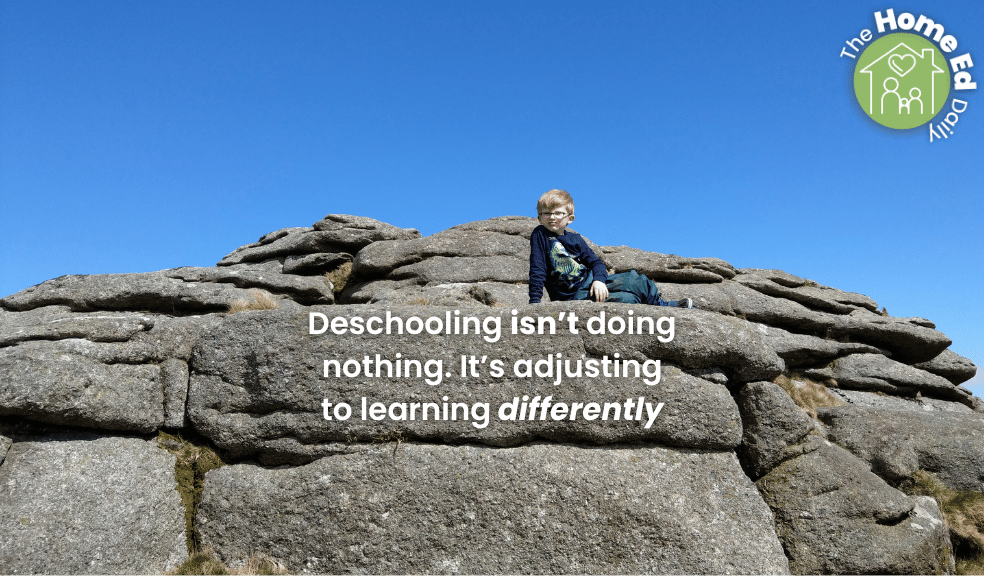
So deschooling is better understood as education changing shape, rather than education stopping.
If your Local Authority contacts you during this period, I would describe what your child is actually doing and learning rather than relying on the word deschooling to explain everything. You might describe reading, conversations, practical activities, creative work, educational visits, documentaries, projects, interests, online resources, social activities and the way your approach is developing around your child’s needs. The term itself isn’t forbidden. It simply means something within the home education community that a Local Authority officer may understand rather differently.
The legal information above refers to England. Home education law and guidance differ elsewhere in the UK.
Parents need to deschool too
I think this is one of the most important parts. You may have removed your child from school, but school doesn’t necessarily leave your head quite so easily. We carry around deeply ingrained ideas about what children should be doing at particular ages.
Maths should happen every day. Writing proves learning. September means moving up a year. A nine-year-old should know this. A twelve-year-old should be doing that. And if a child isn’t visibly working, perhaps they’re falling behind.
I certainly had assumptions of my own to dismantle. Home ed has repeatedly reminded me that children often learn extremely well when they have time, trust and freedom, but trusting that is different from saying you trust it.
There will still be days when you wonder whether you’re doing enough.
It doesn’t help when another home educating family appears to have built a functioning robot, learnt Latin, are thinking about exams at 12, and have identified every British moth before breakfast.
Try not to replace comparison with school by comparison with other home educators. There isn’t one correct way to do this. Some families are highly structured. Others are largely child-led. Many, including us, sit somewhere in between and shift according to age, circumstances and what is actually working. That flexibility is one of home education’s greatest strengths.
What about deschooling teenagers?
Deschooling an older child can feel harder because the clock suddenly seems much louder. At six or seven, taking some time to find your feet can feel manageable. At fourteen or fifteen, GCSEs, college and the future are lurking in the corner making pointed little coughing noises. It is understandable to worry about lost time.
But immediately recreating the environment that wasn’t working may not move a teenager forward either. An older child may need time to recover, but they can also be involved in deciding what happens next. What interests them? Are there qualifications they actually need for something they want to do? Would they prefer to concentrate on a smaller number of subjects? Are there courses, practical routes or different ways of learning that suit them better?
Home educated young people do not necessarily have to take the same subjects, in the same number or at exactly the same ages as pupils in school. Deschooling a teenager therefore doesn’t have to mean ignoring the future. Sometimes it gives you enough breathing room to think about the future more clearly.
The first weeks are a beginning, not a test
There can be enormous pressure when you first start home education to prove you made the right decision. To relatives. To the Local Authority. To your child. And, perhaps most of all, to yourself.
You don’t have to establish your perfect version of home ed in the first fortnight. Watch your child. Talk to them. Notice what makes them curious, what drains them and what they keep coming back to. Meet other home educating families. Try resources without feeling obliged to continue them. Resist buying an entire curriculum before you know whether anyone actually wants it. Give yourselves room to find a different rhythm.
The approach you eventually settle into won’t necessarily be permanent either. What works at seven may be hopeless at eleven. A child who initially needs plenty of structure may become increasingly independent. Another who wants complete freedom may later ask for formal lessons or courses. You’re allowed to change things.
Deschooling isn’t about stepping away from education. It is about stepping away from the assumption that education can only look one way. And, quietly, noticing what happens next.
Further reading:
Getting started and Not going back to school