




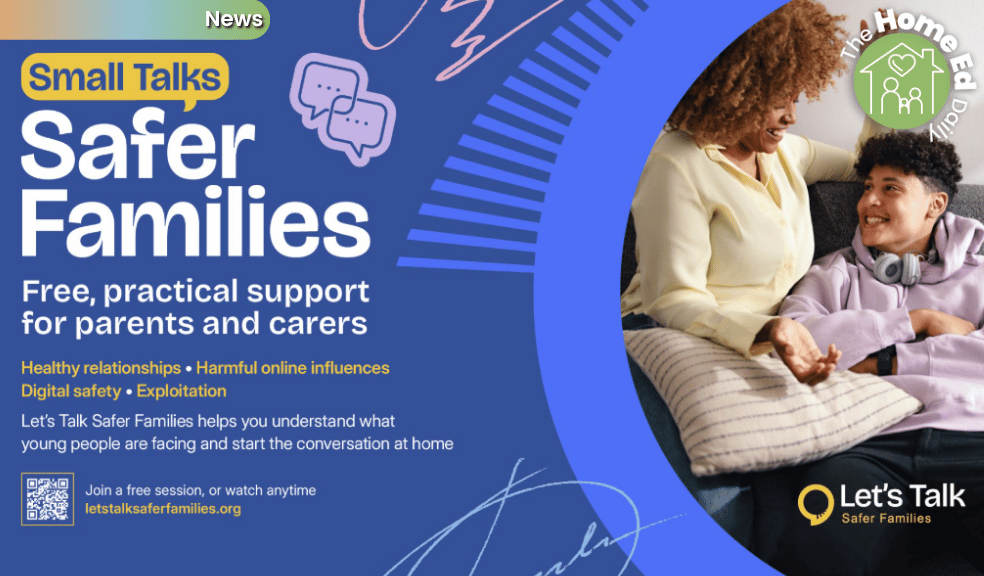
Free online safety webinars for parents and carers
Free online digital safety and family support sessions for home educating parents
Talking to children and teenagers about online safety, relationships, AI, exploitation and the things they encounter online can be difficult. It can be even harder when the risks seem to change every five minutes. Let’s Talk Safer Families is a free online programme designed to give parents and carers practical, up-to-date information about some of the issues affecting children and young people today.
The programme is part of the South Devon and Dartmoor Community Safety Partnership and received £100,000 in funding from the Office of the Police and Crime Commissioner in April 2026 to expand its live sessions, appoint a project lead and reach more families. Although the project began in the South West, the sessions are online and open much more widely. There is no requirement to live in Devon or Cornwall.
What is Let’s Talk Safer Families?
Let’s Talk provides free webinars, recorded sessions, downloadable toolkits and practical guidance for parents and carers.
Rather than focusing only on internet filters or screen-time rules, the programme covers the wider issues young people can encounter both online and offline. These include exploitation, unhealthy relationships, pornography, social media, harmful online content and communication within families. The aim is not to frighten parents. The organisation describes its approach as helping families understand current risks and giving adults practical ways to talk about them, recognise concerns and find further support when needed.
For home educating families, that makes it another useful source of safeguarding and digital-life information that can be dipped into when it becomes relevant. Home educated children are not one single group, and educating outside school does in no way mean a child lacks safeguarding or support. But home educating parents, like all parents, still find themselves navigating smartphones, gaming, friendships, AI, relationships, social media and a digital world that can be difficult to keep up with. Having somewhere to get clear information without having to become an expert in every emerging online trend is useful.
Free sessions for different ages and needs
One thing I particularly like about the programme is that it isn’t trying to squeeze every family into one generic “online safety” webinar.
The autumn programme includes separate core sessions for primary-age children, pre-teens, teenagers and children and young people with SEND. There are also more focused sessions on exploitation, relationships, misogyny, harmful online narratives and AI. The current programme includes:
- 30 September, 7.30pm: Let’s Talk Primary, Building Strong Foundations. For parents and carers of children aged 5–9, covering friendships, emotions, communication and the online world.
- 5 October, 7pm: The ‘Manosphere’, Influencers, Algorithms and Masculinity. Looking at online misogyny, influencers and the messages reaching boys and young men.
- 7 October, 7.30pm: Let’s Talk SEND, ages 6–11. A strengths-based session covering communication, friendships, boundaries, online safety and resilience.
- 12 October, 7.30pm: Let’s Talk SEND, ages 12–17. Exploring independence, relationships, online experiences, healthy boundaries and communication.
- 13 October, 7pm: When Online Content Shapes Harm. A session on violent pornography, relationships and how parents can respond.
- 20 October, 7pm: Online Narratives; Offline Consequences. Looking at algorithms, harmful online content and the digital spaces teenagers move through.
- 4 November, 7pm: AI and Online Harm: What Families Need to Know. Covering AI-generated imagery, deepfakes and emerging forms of online abuse.
- 9 November, 7pm: Educating Against Hate. Looking at hateful rhetoric, extremist ideas, algorithms and peer culture.
- 12 November, 7pm: Understanding Child Criminal Exploitation. With Junior Smart, covering grooming, coercion, warning signs and ways adults can respond.
- 19 November, 7pm: Masculinity, Belonging and Exploitation. Exploring how status, identity and belonging can be used to draw boys and young men into exploitation.
- 26 November, 7pm: Teenage Relationship Abuse. Focusing on early warning signs, coercive and controlling behaviour, and conversations about healthy relationships.
The pre-teen session on 23 September has already taken place, while the earlier teenage session is now available as a recording.
No camera or microphone needed
The live sessions are free and held online. Parents and carers do not need to use a webcam or microphone, which may make them considerably easier to join after a long day when nobody wants to appear on Zoom looking remotely presentable. The sessions also include links to further resources and support.
That low-pressure format may particularly suit families who want information without having to participate in a group discussion or explain their own circumstances.
Support for parents of children with SEND
The separate SEND sessions are worth highlighting. The younger session is aimed at parents and carers of children aged 6–11 and focuses on safety, communication, friendships, boundaries and confidence. The session for ages 12–17 looks more at growing independence, relationships and online experiences while maintaining trust and communication at home.
The wider Let’s Talk website also includes neurodiversity among its ongoing support topics. For families whose children find standard online-safety advice too abstract, judgemental or simply not designed with their needs in mind, having dedicated material may be useful.
Free toolkits and recordings too
You don’t have to attend a live webinar to use the project. Let’s Talk Safer Families also has free downloadable toolkits for parents of pre-teens and teenagers, alongside recorded talks and shorter resources on subjects including consent, body image, online grooming and exploitation, toxic masculinity and difficult conversations.
The teenager toolkit, for example, covers teenage development, relationships, body image, social media, county lines, family communication and emotional wellbeing.
There is also a directory of further support services for families who need more specialised help.
Why I’m sharing it with home educating families
Home education can give families plenty of space for conversations that might otherwise be squeezed between school, homework and bedtime. But it doesn’t magically hand us a detailed working knowledge of deepfake abuse, coercive relationships, algorithms or whatever corner of the internet has become influential this week.
Sometimes we simply need good information from people who know the subject.
Let’s Talk Safer Families isn’t a home education programme, and I don’t think it needs to be. It is a free resource for parents and carers that home educating families can use in whatever way suits them.
Some may want to attend a webinar because a particular issue has cropped up. Others may use a toolkit as a starting point for a conversation with a teenager. Some may simply want to understand what certain online risks actually mean before deciding whether they are relevant to their family.
You can pick and choose rather than work through it as a programme.
How to join a free session
All of the current sessions and booking links are available through the Let’s Talk Safer Families events page.
Cost: Free
Where: Online
Who can attend: Parents and carers
Camera/microphone: Not required
Current programme: Events page
You can also explore the free toolkits, recordings and support information on the main Let’s Talk Safer Families website.
The programme changes as new sessions are added, so it is worth checking the events page for the latest dates rather than relying on an older timetable.