





Home education as a quiet act of courage
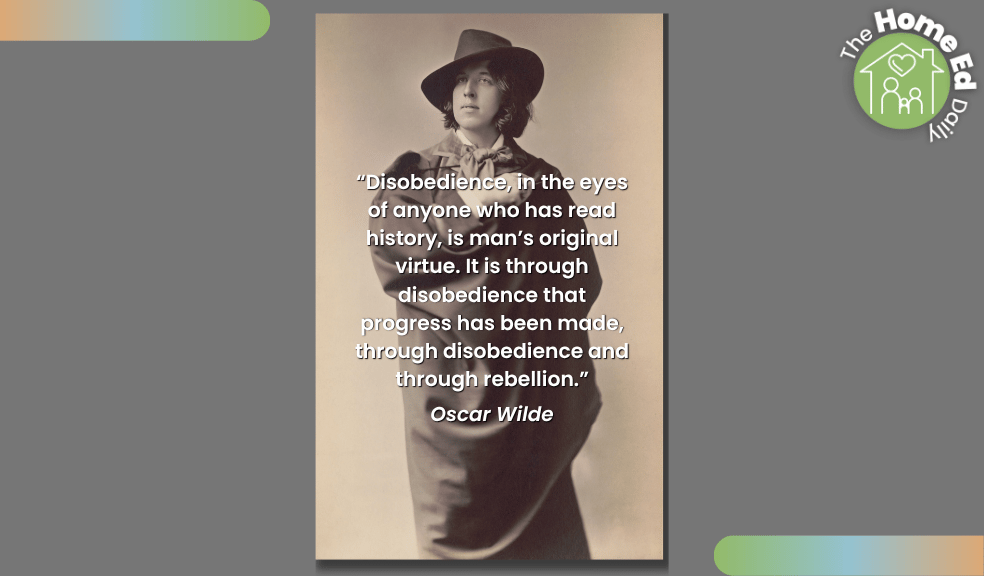
Oscar Wilde wrote: “Disobedience, in the eyes of anyone who has read history, is man’s original virtue. It is through disobedience that progress has been made, through disobedience and through rebellion.”
It is a powerful line. And for many home educating families, it lands somewhere deep. Because many of us come to home ed through a quiet act of disobedience. Not the loud, reckless kind. Not rebellion for the sake of it. But the steady, uncomfortable kind that begins when you realise you can no longer keep saying yes to something that is harming your child, shrinking them, exhausting them, or simply failing to recognise who they are.
At some point, many parents reach a line. Enough. Not this way. There has to be something better.
Saying no can be an act of care
Choosing home education is often spoken about as if it is a refusal.
A refusal to follow the expected route.
A refusal to trust the system.
A refusal to accept “that’s just how it is”.
But for many families, it is not really a refusal at all. It is a response. A response to a child who is anxious, overwhelmed, bored, unseen, misunderstood, bullied, burnt out, masking, or quietly disappearing into themselves. It is a response to the dawning realisation that a child’s wellbeing matters more than fitting in neatly. That childhood is not meant to be endured. That learning does not have to come at the cost of confidence, curiosity, sleep, joy, or connection.
There is nothing careless about that. It takes courage to step away from what everyone else seems to be doing. It takes courage to trust your own judgement when the wider culture keeps telling you that school is the only safe, sensible, respectable path. And it takes deep love to look at your child and say, “I see you. I believe you. We will find another way.”
Progress often begins with discomfort
Wilde’s words remind us that progress rarely begins with polite agreement. Change often starts when ordinary people stop accepting what they have been told is unavoidable.
Not all disobedience is noble, of course. But history is full of moments where progress depended on people questioning the rules, challenging the accepted wisdom, and refusing to cooperate with systems that caused harm. Home education sits within that same uncomfortable space. It asks difficult questions.
Who gets to decide what a good education looks like?
Why do we measure children by narrow standards?
Why is sitting still often valued more than curiosity?
Why do we treat difference as a problem to be managed?
Why are parents so often expected to ignore what they can clearly see?
These are not small questions. They unsettle people because they challenge something very deeply embedded. School is often treated as neutral. Natural. Inevitable. But it is not. It is one model of education. A dominant one, yes, but not the only one.
Home education reminds people of that.
Home education challenges old assumptions
By choosing to educate outside school, home ed families challenge old assumptions about children, learning, family life, and authority.
We challenge the idea that learning must be delivered in age-batched groups.
We challenge the idea that progress always looks linear.
We challenge the idea that social development depends on being surrounded by thirty children the same age.
We challenge the idea that education must be separated from ordinary life.
We challenge the idea that children need constant measuring to prove they are learning.
That can make people uncomfortable. Some discomfort comes from genuine concern. Some comes from misunderstanding. Some comes from the fact that when one family steps away and thrives, it can quietly expose cracks in the system others are still trying very hard to believe in.
Home education does not need to be anti-school to be radical. It is radical because it says children are not all the same. It says family knowledge matters. It says learning can be slow, deep, messy, relational, seasonal, practical, self-directed, joyful, and still entirely valid.
This is not failure to comply
Home education is sometimes framed as opting out. As if families have simply withdrawn from responsibility. But most home educating parents know the truth. This is not opting out of education. It is opting into a different kind of education.
One that may happen at the kitchen table, in the woods, at museums, in community groups, through books, documentaries, projects, conversations, volunteering, gaming, crafts, travel, nature, work experience, theatre, coding, cooking, animals, local history, maths in daily life, and long rabbit holes of curiosity that no timetable could have planned.
It is not a failure to comply. It is a deliberate act of rebuilding. For some families, that rebuilding comes after crisis. For others, it grows from a philosophical belief that children deserve more freedom. For many, it is both.
Either way, it is not passive. It is active, thoughtful, demanding, and deeply personal.
Rebellion can be quiet
When people hear the word rebellion, they often imagine noise. Protest. Drama. A raised fist. But many home educating families know another kind of rebellion.
It looks like a child sleeping properly for the first time in months.
It looks like a parent ignoring the pressure to recreate school at home.
It looks like a slow morning after years of rushing and tears.
It looks like a child reading when they are ready, not when a chart says they should.
It looks like protecting a child’s nervous system.
It looks like choosing connection over compliance.
It looks like trusting that learning is still happening, even when it does not resemble a classroom.
This kind of rebellion is not always visible from the outside. It is quiet, but it is not small. Every family who chooses another way helps widen the conversation about what education can be. Every child who thrives outside the standard model becomes living evidence that there is not one right path.
You are not the odd one out
It can still feel lonely. Even when you know home ed is right for your family, there can be moments when you feel like the difficult one. The awkward one. The parent who would not just go along with things. You might feel that more strongly when dealing with relatives, professionals, local authority processes, old friends, or strangers who ask too many questions in the supermarket.
But being out of step does not mean you are wrong. Sometimes it means you are paying attention. Many of the world’s most meaningful changes began with someone refusing to accept the obvious answer. Someone quietly saying, “No. Not this way.” Someone imagining something more humane before everyone else could see it.
Home education is not always easy. It is not a magic fix. It will not protect families from every difficulty. But it can be a profound act of love, conscience, and courage. It can be a way of saying that children deserve more than survival. More than compliance. More than being fitted into systems that do not fit them back. They deserve freedom, kindness, depth, time, trust, and joy. And sometimes, the first step towards that is a quiet, steady no.
Three questions to sit with
What have you had to quietly say no to in order to protect your child’s wellbeing?
Where has home education allowed your child to be more fully themselves?
What old assumption about education have you found yourself questioning since stepping away from school?